


Rare Phillip Lloyd Powell Free-Standing Sofa in Carved Walnut and Mohair by Pierre Frey
 Open here
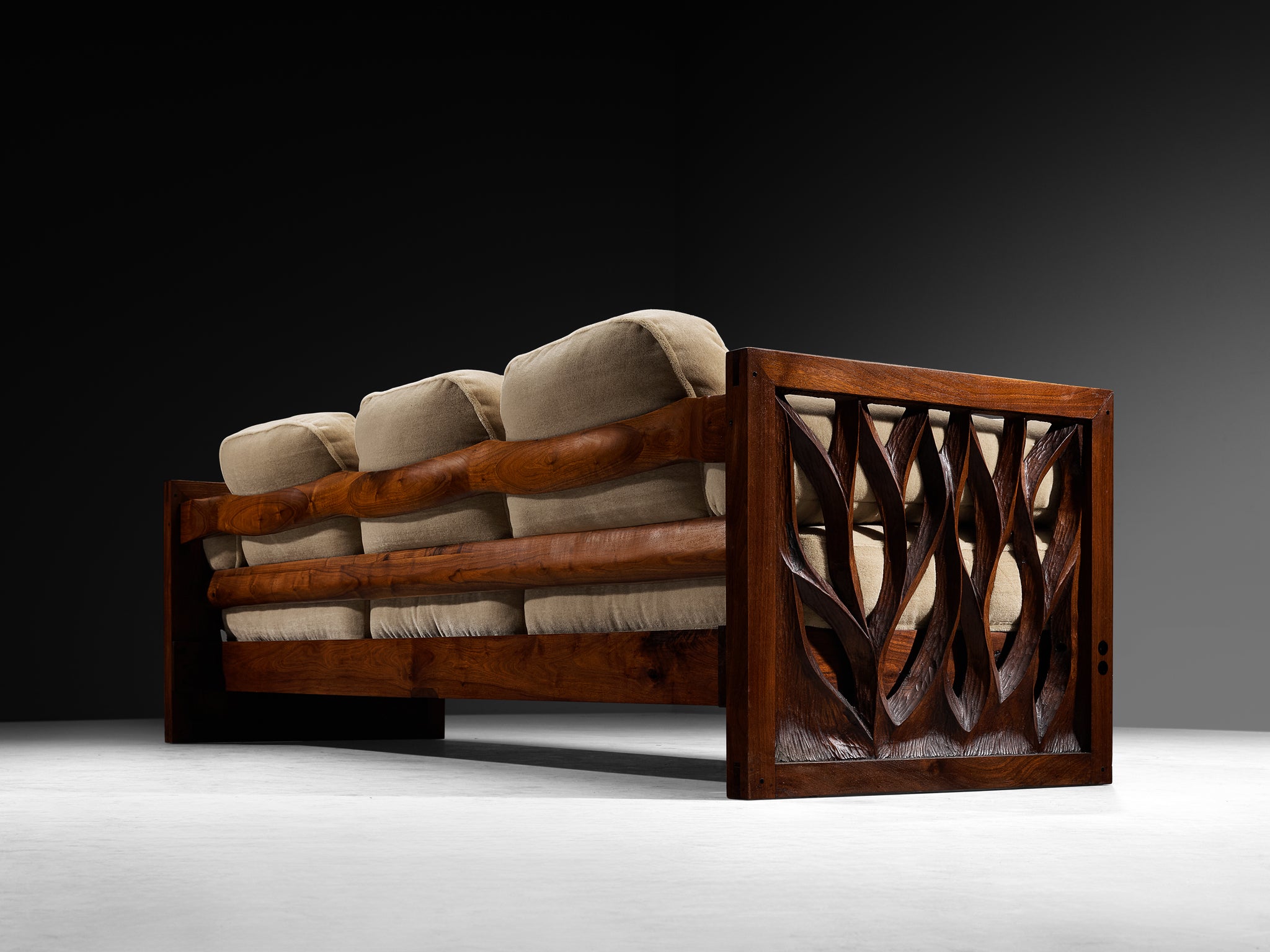
Phillip Lloyd Powell, free-standing sofa, walnut, reupholstered in “Teddy” mohair by Pierre Frey, United States, 1969
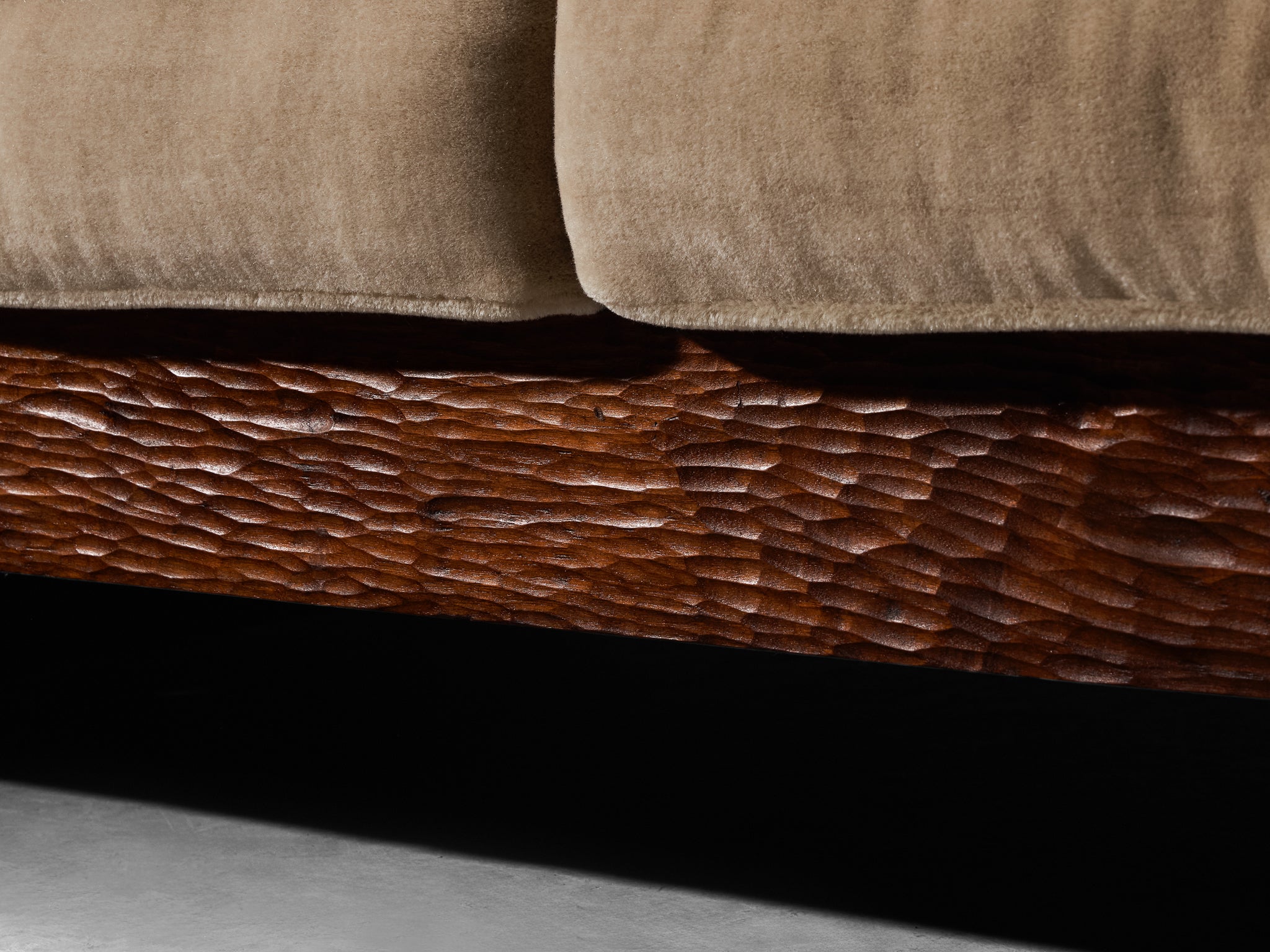
Phillip Lloyd Powell is a master in approaching wood as a sculpture. With his skillful hands and his respect towards the inherent qualities of the wood, he succeeds in working with the wood’s structure instead of against it, resulting in organic, naturally flowing forms. This very rare sofa is exemplary of this approach, captured by the intricately carved framework using chip carving techniques. Powell transforms the wooden panels into a rhythmic lattice of vertical, twisting forms that resemble tree trunks rising from the forest floor. Each element swells and narrows organically, echoing the natural growth patterns of wood – branches bending, trunks splitting, roots spreading. The wooden surface reveals the artist’s hand and the gestures used to shape the material.
The backrest does not go unnoticed: its intricately carved top rail, whose concave shaping allows the round-contoured cushions to fit seamlessly within the frame. This demonstrates Powell’s keen attention to detail and his ability to unite beauty and function.
Phillip Lloyd Powell (1919–2008) was a key figure in the American Studio Craft Movement. Born in Germantown, Pennsylvania, in 1919, he developed an early passion for furniture design, crafting pieces for himself as well as custom works for family and friends during his adolescence. He studied engineering at Drexel University before being drafted into the Army Air Corps during the Second World War.
After returning from military service, Powell settled in New Hope, Pennsylvania, a thriving center for craftspeople that included artists such as Paul Evans. It was there that he met Evans, and throughout the 1950s and 1960s the two shared a studio. Their close working relationship led to frequent collaborations and the creation of some of the most significant works of the Midcentury Studio Furniture Movement.
Powell was deeply committed to craftsmanship and to the expressive qualities of natural materials. He worked primarily with richly grained woods, often allowing the natural contours and character of the material to shape his designs. Slate was another favored material, frequently incorporated as tops for tables and credenzas, its deep gray tone providing a striking contrast to the warmth of wood.
Dedicated to producing only the finest pieces, Powell maintained an exceptionally small output. In contrast to his contemporary George Nakashima, Powell produced fewer than 1,000 works over the course of five decades. Indeed, it was Nakashima who initially encouraged him to pursue furniture design independently.
Today, Powell’s carved wooden cabinets, consoles, chairs, and dining tables are among the most sought-after works of the period, celebrated for their sculptural presence, material integrity, and masterful craftsmanship.
Phillip Lloyd Powell is a master in approaching wood as a sculpture. With his skillful hands and his respect towards the inherent qualities of the wood, he succeeds in working with the wood’s structure instead of against it, resulting in organic, naturally flowing forms. This very rare sofa is exemplary of this approach, captured by the intricately carved framework using chip carving techniques. Powell transforms the wooden panels into a rhythmic lattice of vertical, twisting forms that resemble tree trunks rising from the forest floor. Each element swells and narrows organically, echoing the natural growth patterns of wood – branches bending, trunks splitting, roots spreading. The wooden surface reveals the artist’s hand and the gestures used to shape the material.
The backrest does not go unnoticed: its intricately carved top rail, whose concave shaping allows the round-contoured cushions to fit seamlessly within the frame. This demonstrates Powell’s keen attention to detail and his ability to unite beauty and function.
Phillip Lloyd Powell (1919–2008) was a key figure in the American Studio Craft Movement. Born in Germantown, Pennsylvania, in 1919, he developed an early passion for furniture design, crafting pieces for himself as well as custom works for family and friends during his adolescence. He studied engineering at Drexel University before being drafted into the Army Air Corps during the Second World War.
After returning from military service, Powell settled in New Hope, Pennsylvania, a thriving center for craftspeople that included artists such as Paul Evans. It was there that he met Evans, and throughout the 1950s and 1960s the two shared a studio. Their close working relationship led to frequent collaborations and the creation of some of the most significant works of the Midcentury Studio Furniture Movement.
Powell was deeply committed to craftsmanship and to the expressive qualities of natural materials. He worked primarily with richly grained woods, often allowing the natural contours and character of the material to shape his designs. Slate was another favored material, frequently incorporated as tops for tables and credenzas, its deep gray tone providing a striking contrast to the warmth of wood.
Dedicated to producing only the finest pieces, Powell maintained an exceptionally small output. In contrast to his contemporary George Nakashima, Powell produced fewer than 1,000 works over the course of five decades. Indeed, it was Nakashima who initially encouraged him to pursue furniture design independently.
Today, Powell’s carved wooden cabinets, consoles, chairs, and dining tables are among the most sought-after works of the period, celebrated for their sculptural presence, material integrity, and masterful craftsmanship.

Choose options
Rare Phillip Lloyd Powell Free-Standing Sofa in Carved Walnut and Mohair by Pierre Frey
Sale price$189,000.00
Regular price
Product Details
VAT within the EU: When buying or delivering an item within the EU, VAT usually applies and will be added.