


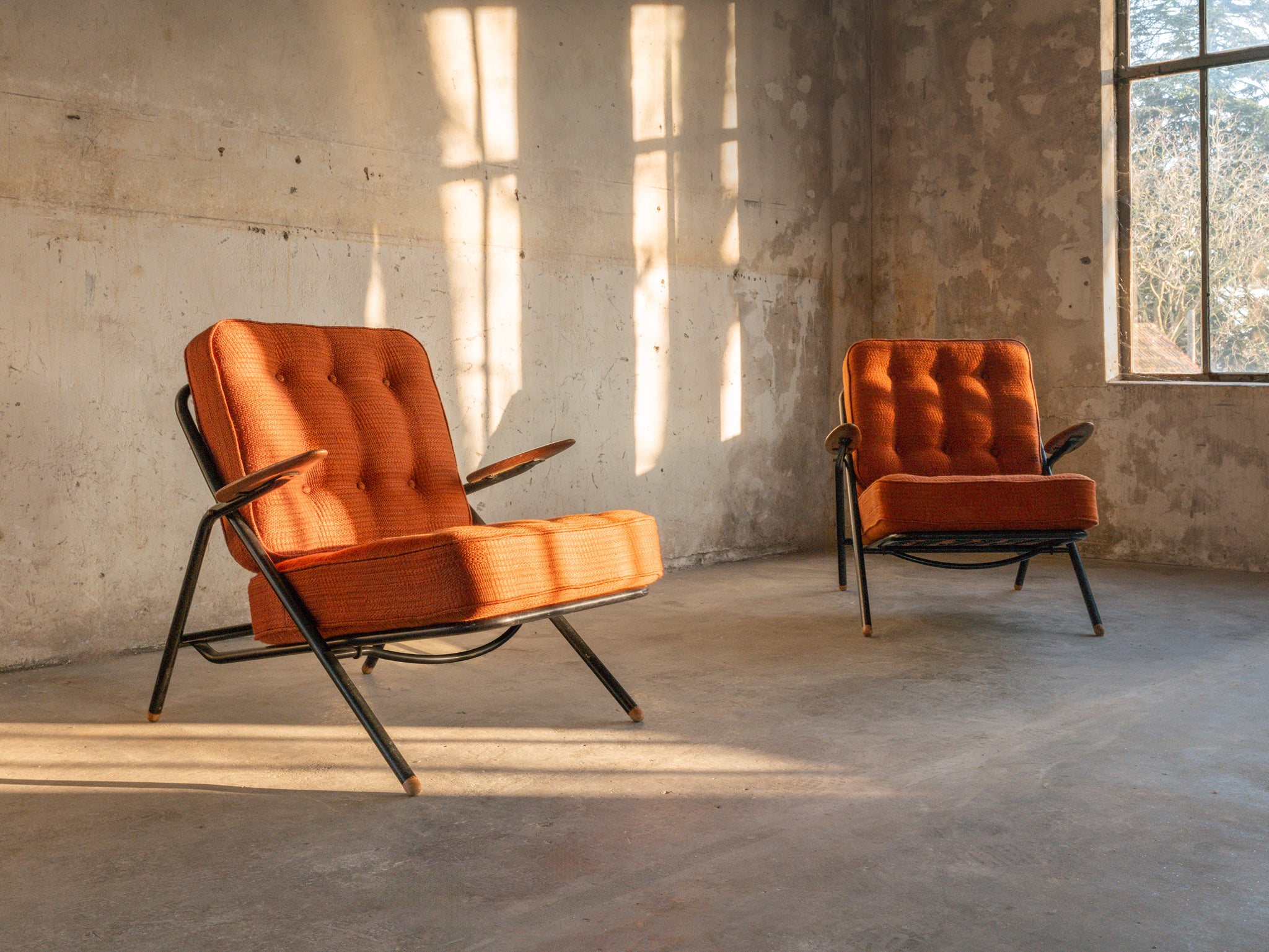
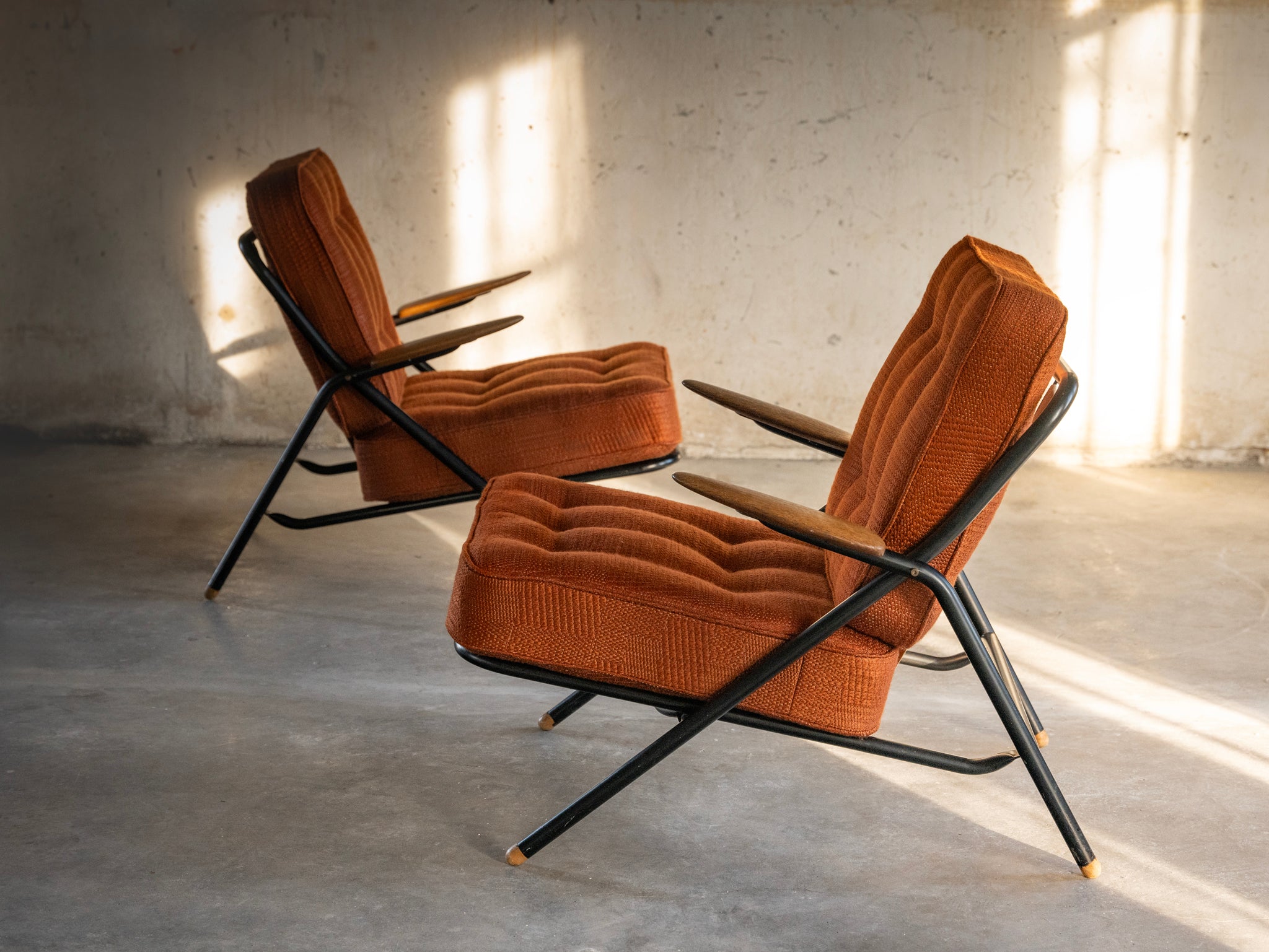
Rare Hans J. Wegner for Getama Pair of 'Sawbuck' GE215 Lounge Chairs
 Open here
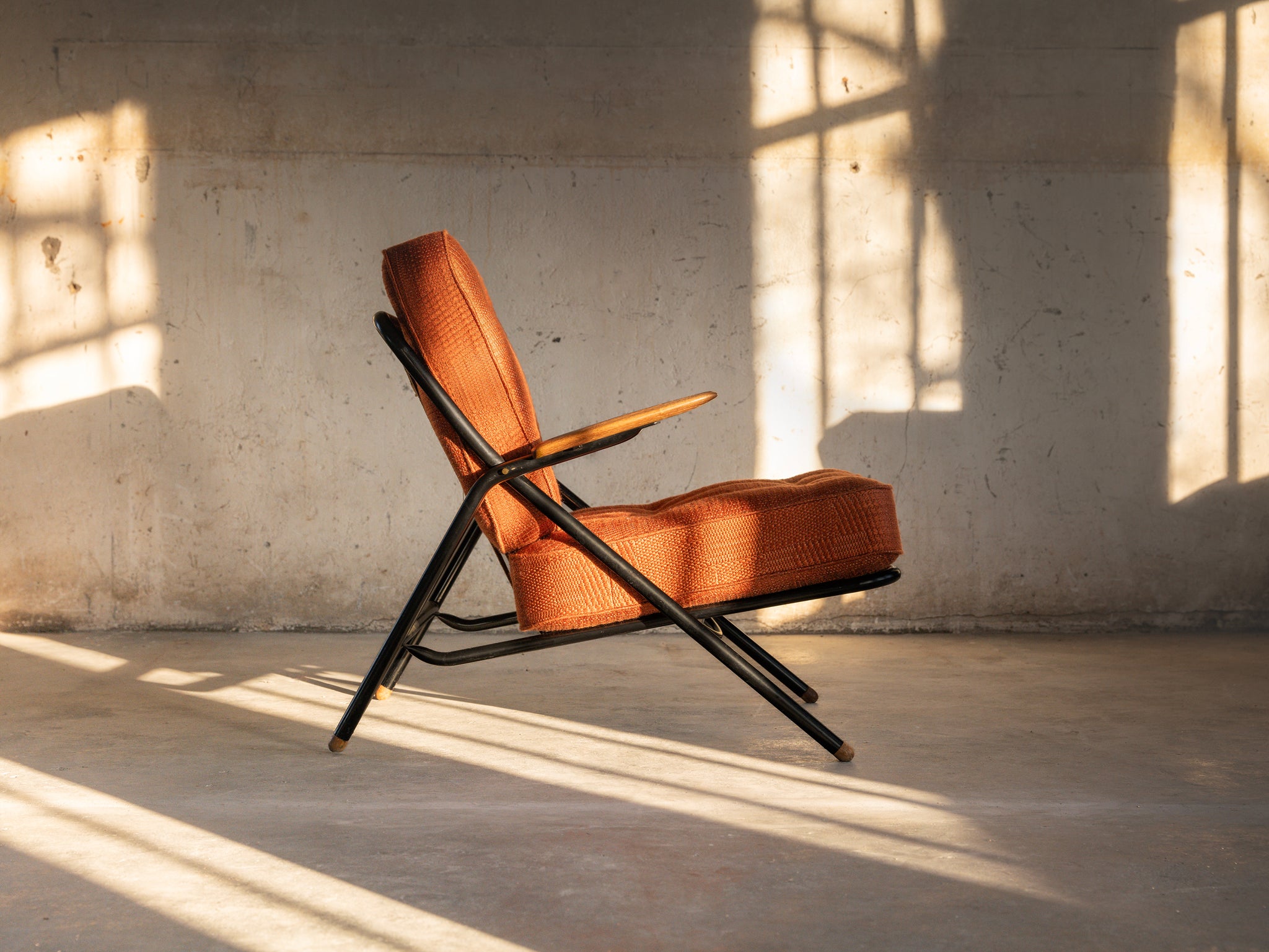
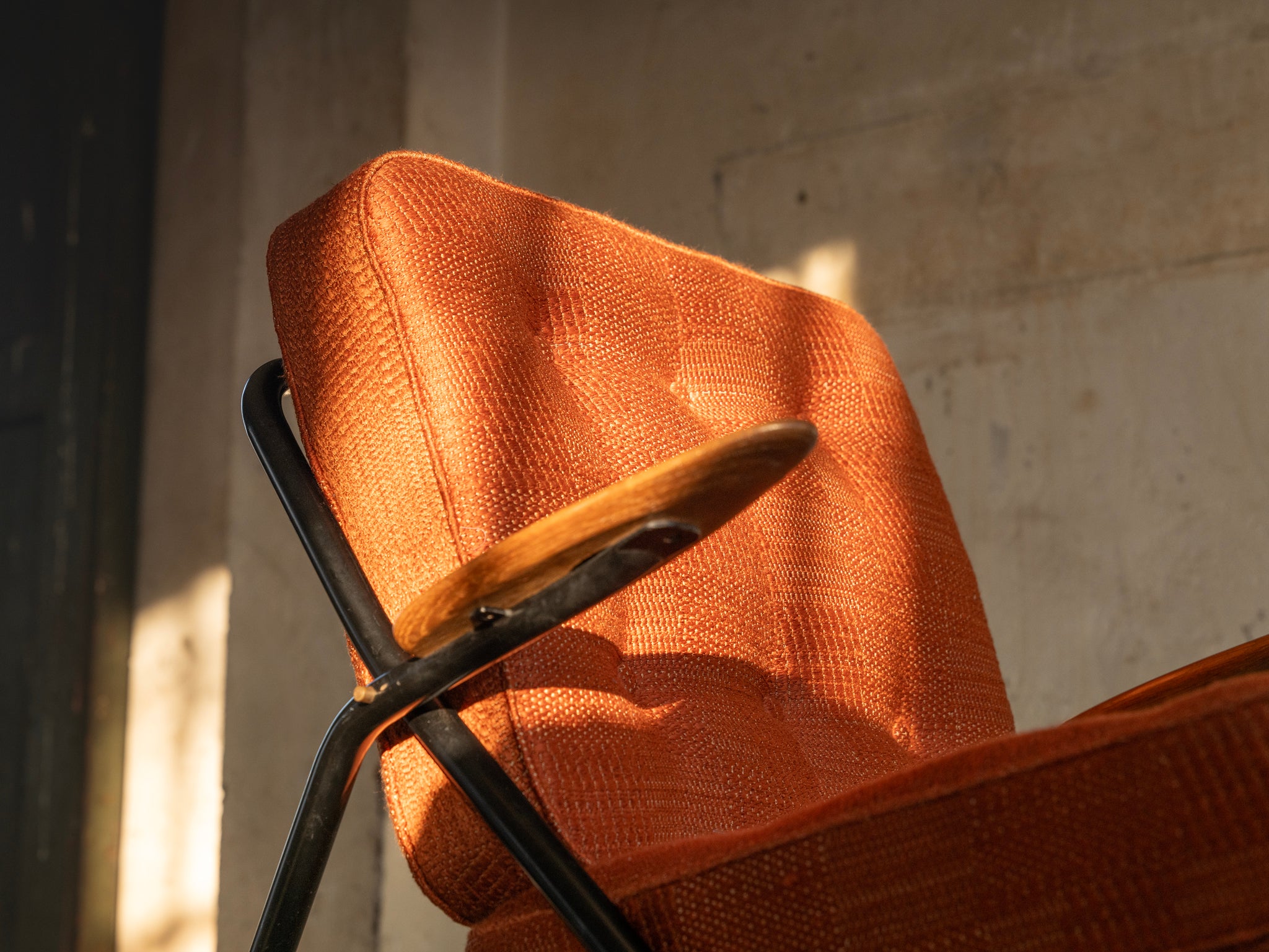
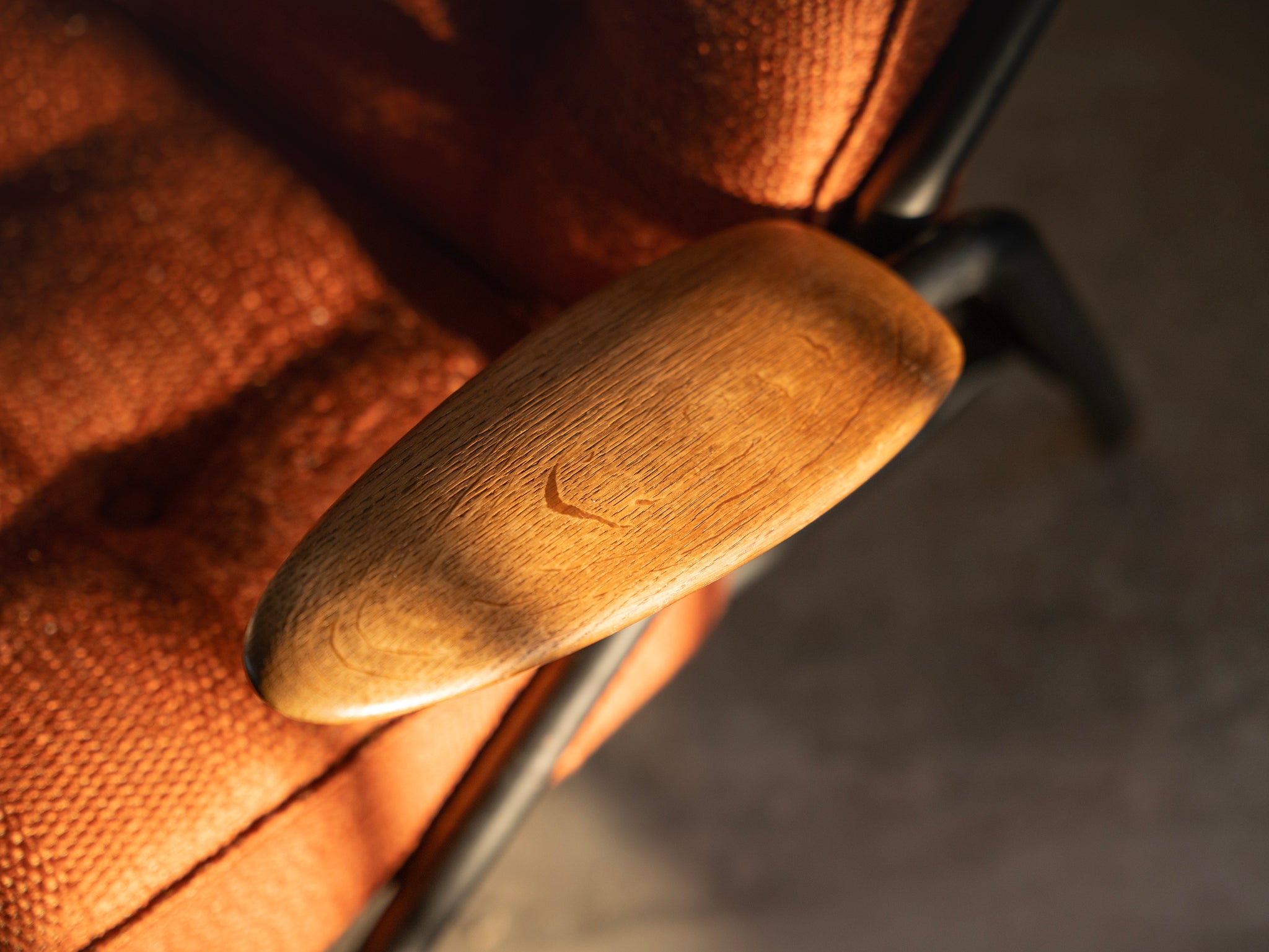
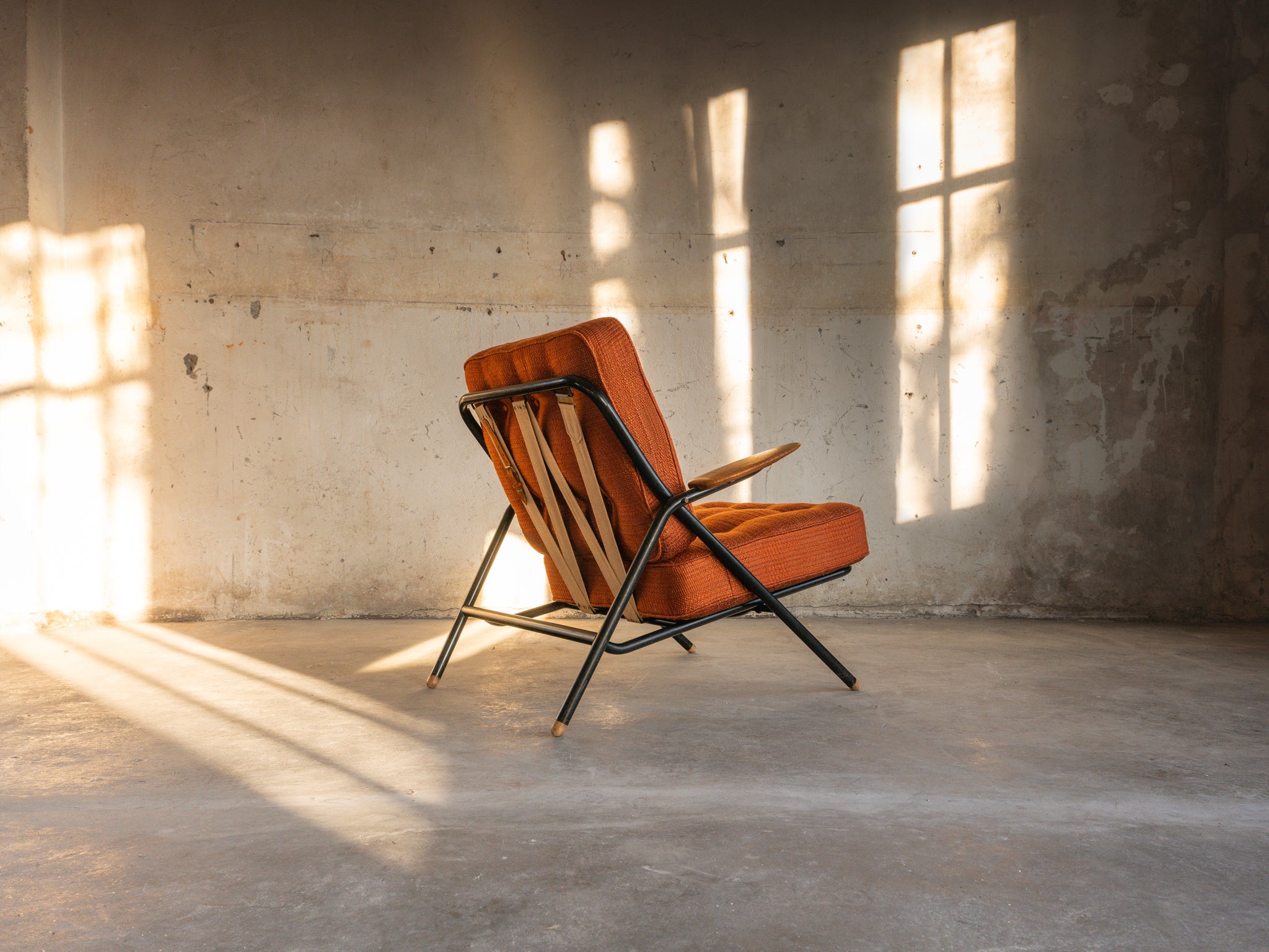
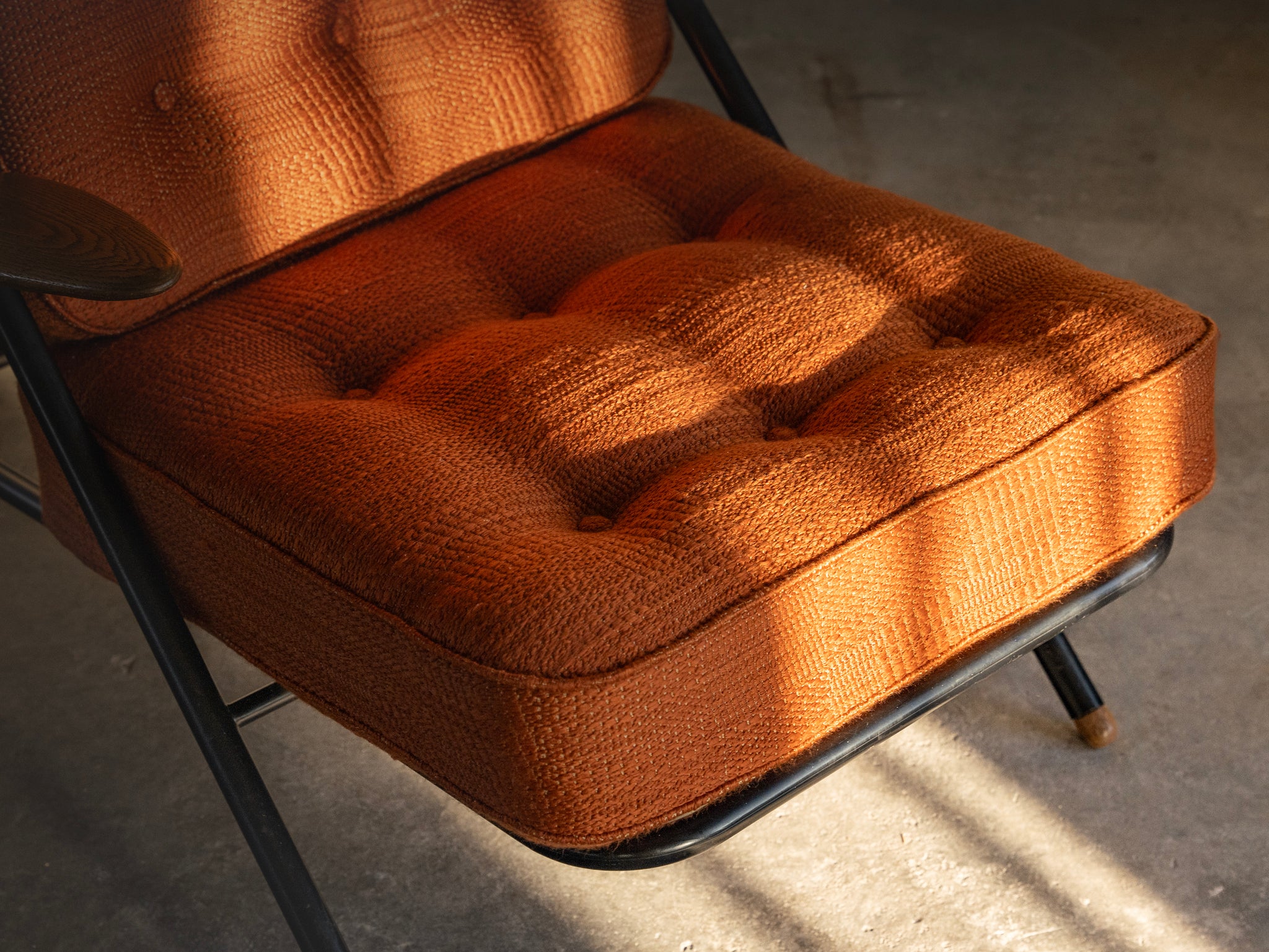
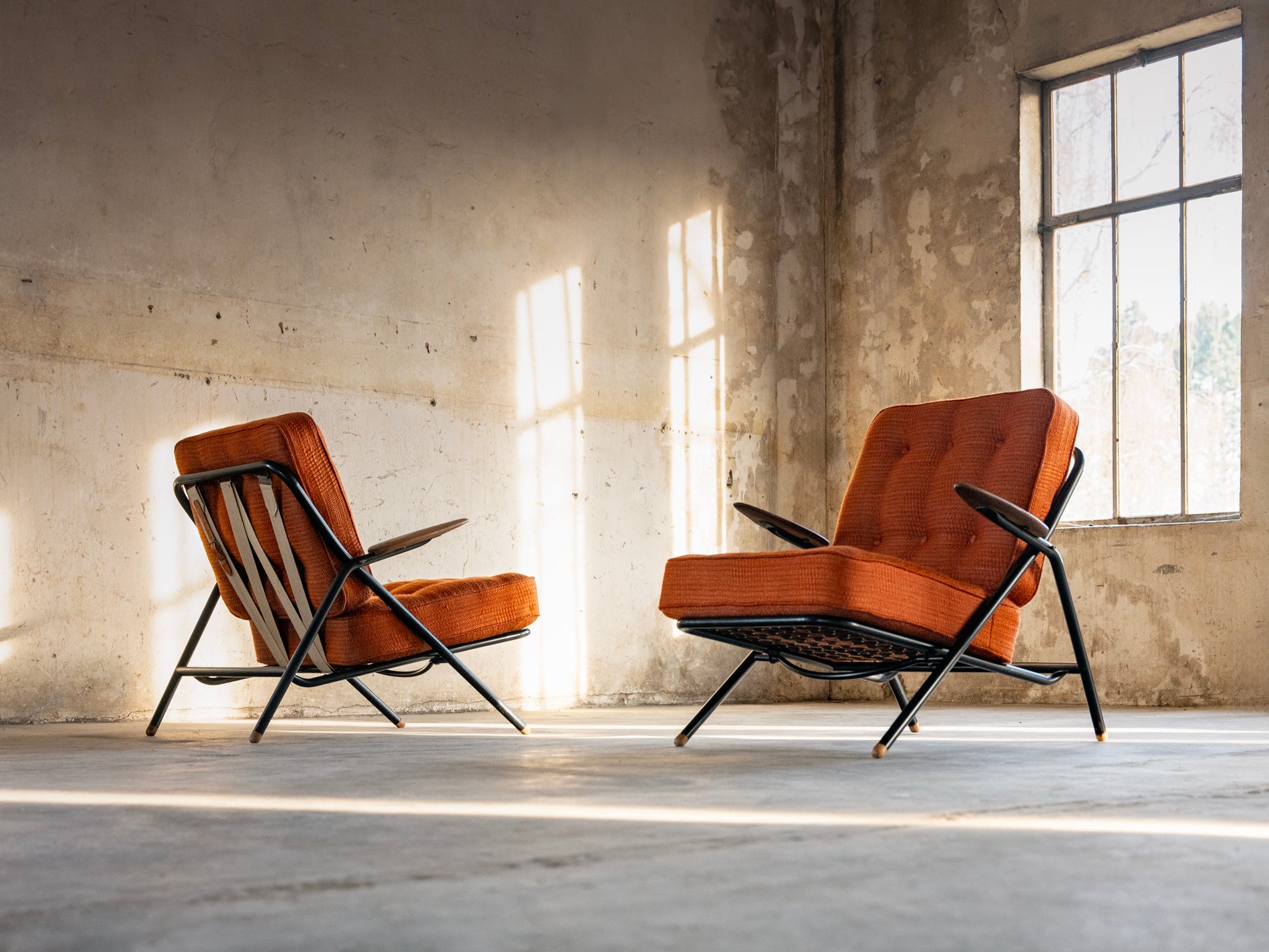
Designed by Hans J. Wegner and produced by GETAMA, the GE215 Sawbuck chair holds a special place in Wegner’s work. Although he is best known for chairs made from solid wood with intricate joinery, this design shows him experimenting with a diversity of materials and different techniques. The GE215 reworks Wegner’s earlier wooden Sawbuck chairs. It keeps the familiar crossed frame and clear structure made from slim black-lacquered steel, yet positioned in a low-slung angle. The thick cushions newly reupholstered in a textural orangey fabric contrast strongly with the sleekness of the frame, defining its main character. The angled armrests recall the sculptural “flipper” shapes seen in his CH28 chair, here simplified into flat wooden elements that connect the upholstery to the metal frame. Small wooden feet at the base soften the meeting of steel and floor, adding warmth and linking the chair to Wegner’s cabinetmaking roots. On the back of the chair, straps formed in a “W”-shape are fastened to the steel structure with leather buckles.
The GE215 was shown in 1955 at the H55 exhibition in Helsingborg, Sweden, a key event in Scandinavian modern design. H55 promoted ideas of good craftsmanship, honest materials, and comfortable furniture for everyday use. The GE215 reflects these values by combining careful construction with an informal, welcoming feel.
Hans Wegner (1914-2007) is one of the most prolific furniture designers of the world. Wegner was born in 1914 in Denmark and began his apprenticeship with Danish master cabinetmaker H.F. Stahlberg when he was fourteen years old. Afterwards, he moved to Copenhagen and attended the School of Arts and Crafts between 1936 and 1938. In 1938, he was approached by the architects and designers Arne Jacobsen and Erik Møller. It was also during this period that he started to collaborate with cabinetmaker Johannes Hansen. In 1943, he established his own studio, and he became one of the most renowned and creative Danish furniture designers. Wegner's furniture was designed with the greatest understanding of materials, construction techniques, and use. Wegner is known to have thorough understanding of the materials he worked with, yet his greatest aim was to create expressive and exciting design. Although Wegner was a functionalist, he was not a rational dogmatist such as Kaare Klint, of whom he was a student. Instead, his designs sparkle with inventiveness and sculptural sense. But this never meant that his organic and sensuous forms left the strict rules of functionalism. At heart, Wegner was an idealist. He was relentless in his quest for the best chair: 'there is never one damn thing that cannot be made better'. However, Wegner was aware that he could not create the 'perfect' chair, which gave him the freedom to produce as much as possible. He left behind more than 3500 drawings and about 500 of his designs went into production. His designs feature in the UN Building and Seagram Building in New York, UNESCO's headquarters. NATO's headquarters in Paris, and several buildings by the architects Skidmore, Owings & Merrill.

Choose options
Product Details

From an apprenticeship in Tønder to 'The Chair'
Born in the southern Danish town of Tønder, the son of a shoemaker, Wegner began training as a cabinetmaker at fourteen and had completed four years under master H.F. Stahlberg by the time he turned eighteen. He moved to Copenhagen to study at the School of Arts and Crafts from 1936 to 1938, then joined architects Arne Jacobsen and Erik Møller in Aarhus to design furniture for the new Aarhus City Hall — his first serious commission.
It was in this period that master joiner Johannes Hansen began following Wegner's progress; their collaboration, formalised through the 1940s, produced showpieces built for Copenhagen's Cabinetmakers' Guild exhibitions, among them the Round Chair of 1949, developed from Wegner's studies of Ming dynasty portrait chairs. In 1950, a separate partnership with Carl Hansen & Søn brought the related Wishbone Chair (CH24) into continuous production, a chair still made to Wegner's original drawings today.
VAT within the EU: When buying or delivering an item within the EU, VAT usually applies and will be added.