


Rare Hans Bergström for Ateljé Lyktan Two-Armed Floor Lamp with Cocoon Shade
Tearsheet
×
Receive a copy in your email or download directly:
I accept emails from Morentz.
 Open here
Hans Bergström for Ateljé Lyktan, floor lamp, model 'C716', plastic, aluminum, lacquered brass, brass, granite, Sweden, design 1951, production 1950s
This floor lamp from 1951 is a presumably unique or very rare piece designed by Hans Bergström for Ateljé Lyktan. The spray-on polymer technique is often associated with the Viscontea lamp designed by Achille and Pier Giacomo Castiglioni for Flos in 1960. While the Castiglioni brothers popularised the method in the 1960s, Bergström had already begun exploring plastic as a novel material for modern lighting in the early 1950s, anticipating this later development.
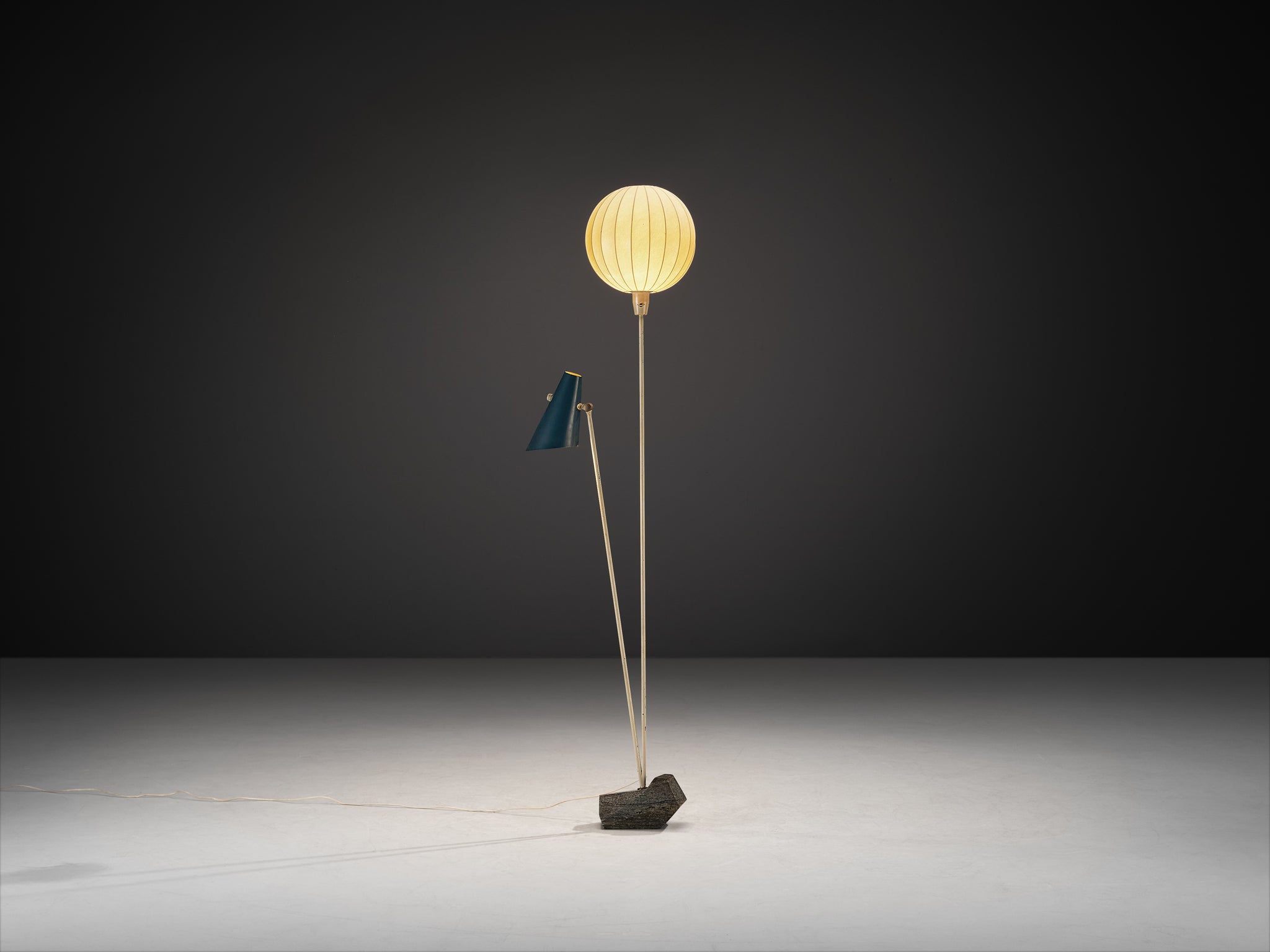
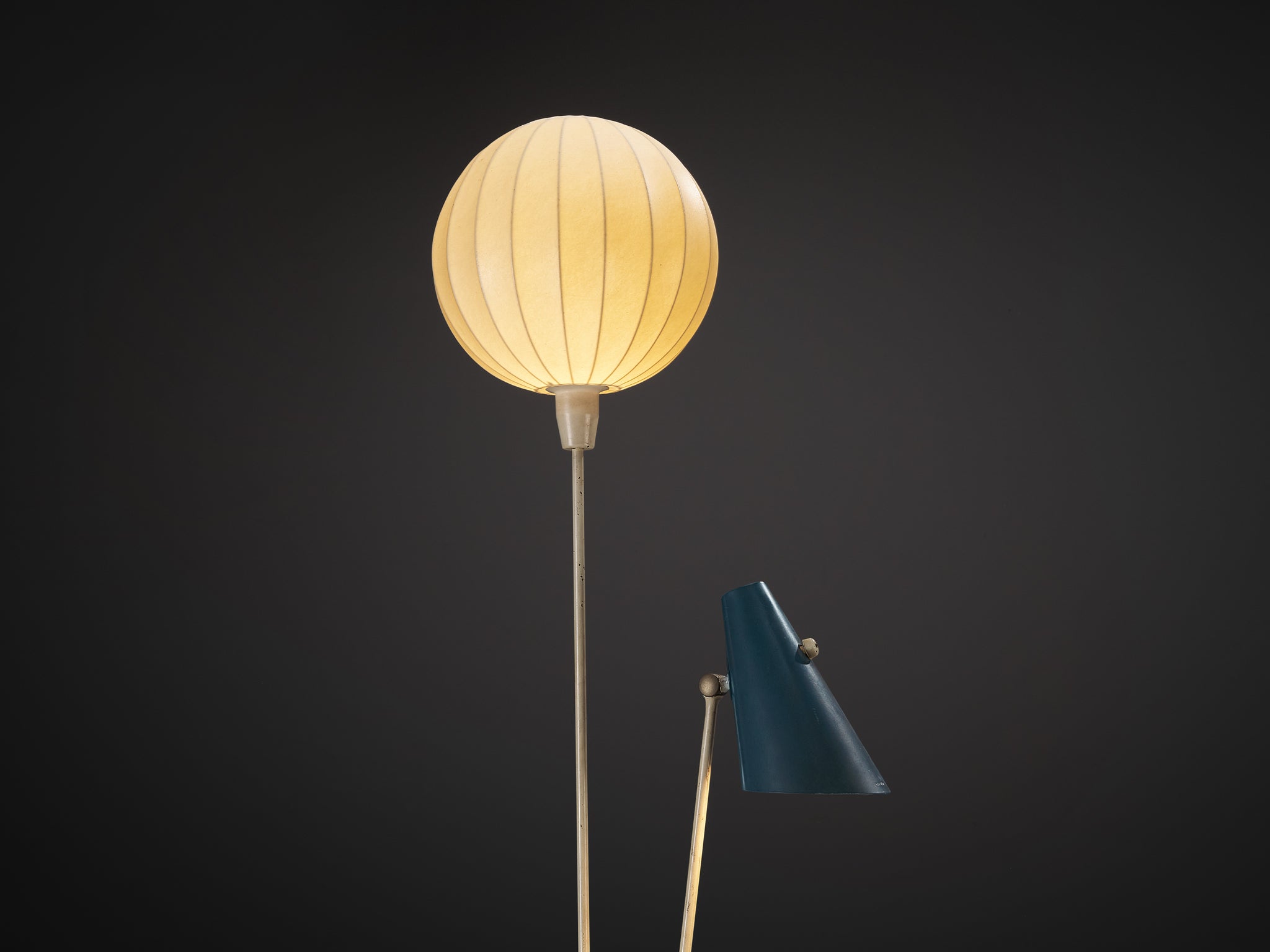
Within Bergström’s body of work, this design is notably experimental and unconventional, distinguished by its varied shapes and bold combination of materials. A substantial block of travertine grounds the lamp; literally, through its weight, and figuratively, through its natural, earthy presence. From this base, two stems rise in opposite directions: one ending in a cone-shaped aluminum shade, the other capped with a softly rounded cocoon shade articulated by vertical ribbing. The translucent material gently diffuses the light, casting a warm, inviting glow.
Hans Bergström (1910-1996), a luminary figure hailing from the realm of Swedish architecture and design, was born on November 4, 1910, in Karlshamn, Sweden. After his completion of secondary school in 1927, Hans embarked on an internship at Ystad Metall, a local craft industry situated near his grandfather's farm. In 1929, he sought further education and enrolled at the esteemed School of Art and Design in Stockholm. Remarkably, even before his graduation from this institution, at the age of twenty, Hans showcased his prowess as a designer for Ystad Metall at the prestigious Stockholm Exhibition in 1930.
In the 1920s, Hans encountered his future wife Verna during the summer holidays in his native town of Karlshamn. In 1934, the couple jointly established the company ateljé Lyktan, a venture that combined their collaborative efforts in luminaire design and various artistic pursuits. Bergström undertook various commissions spanning a wide range of architectural environments, including churches, private residences, and public buildings. It was from this point forward that Bergström spearheaded a revolution in Swedish luminaire manufacturing, fundamentally transforming the perception and application of electric lighting in the coming decades.
During the advent of the 1950s, the emergence of plastic as a novel material in modern lighting captured Hans' attention. As the United States gradually introduced plastic as a material of significance, Bergström encountered a method involving the application of sprayed plastic onto a rotating wire frame, facilitated by a spray gun. Interestingly, this technique bore certain resemblances to the later approach employed by Achille & Pier Giacomo Castiglioni in the creation of their Viscontea Lamp (1960), reminiscent of a cocoon, designed for Flos. Recognizing the vast potential offered by this new technology, he successfully managed to get a patent for the production.
For a span of three decades, Bergström held the position of creative director at ateljé Lyktan and served as the sole designer of the company until the early 1960s. A significant portion of his designs were unique pieces, numbered but lacking specific names. Through his pioneering work, Bergström emerged as a leading figure in the realm of modern Swedish lighting fixtures. On June 14, 1996, Hans Bergström passed away at the age of 86, leaving behind a remarkable legacy.
This floor lamp from 1951 is a presumably unique or very rare piece designed by Hans Bergström for Ateljé Lyktan. The spray-on polymer technique is often associated with the Viscontea lamp designed by Achille and Pier Giacomo Castiglioni for Flos in 1960. While the Castiglioni brothers popularised the method in the 1960s, Bergström had already begun exploring plastic as a novel material for modern lighting in the early 1950s, anticipating this later development.
Within Bergström’s body of work, this design is notably experimental and unconventional, distinguished by its varied shapes and bold combination of materials. A substantial block of travertine grounds the lamp; literally, through its weight, and figuratively, through its natural, earthy presence. From this base, two stems rise in opposite directions: one ending in a cone-shaped aluminum shade, the other capped with a softly rounded cocoon shade articulated by vertical ribbing. The translucent material gently diffuses the light, casting a warm, inviting glow.
Hans Bergström (1910-1996), a luminary figure hailing from the realm of Swedish architecture and design, was born on November 4, 1910, in Karlshamn, Sweden. After his completion of secondary school in 1927, Hans embarked on an internship at Ystad Metall, a local craft industry situated near his grandfather's farm. In 1929, he sought further education and enrolled at the esteemed School of Art and Design in Stockholm. Remarkably, even before his graduation from this institution, at the age of twenty, Hans showcased his prowess as a designer for Ystad Metall at the prestigious Stockholm Exhibition in 1930.
In the 1920s, Hans encountered his future wife Verna during the summer holidays in his native town of Karlshamn. In 1934, the couple jointly established the company ateljé Lyktan, a venture that combined their collaborative efforts in luminaire design and various artistic pursuits. Bergström undertook various commissions spanning a wide range of architectural environments, including churches, private residences, and public buildings. It was from this point forward that Bergström spearheaded a revolution in Swedish luminaire manufacturing, fundamentally transforming the perception and application of electric lighting in the coming decades.
During the advent of the 1950s, the emergence of plastic as a novel material in modern lighting captured Hans' attention. As the United States gradually introduced plastic as a material of significance, Bergström encountered a method involving the application of sprayed plastic onto a rotating wire frame, facilitated by a spray gun. Interestingly, this technique bore certain resemblances to the later approach employed by Achille & Pier Giacomo Castiglioni in the creation of their Viscontea Lamp (1960), reminiscent of a cocoon, designed for Flos. Recognizing the vast potential offered by this new technology, he successfully managed to get a patent for the production.
For a span of three decades, Bergström held the position of creative director at ateljé Lyktan and served as the sole designer of the company until the early 1960s. A significant portion of his designs were unique pieces, numbered but lacking specific names. Through his pioneering work, Bergström emerged as a leading figure in the realm of modern Swedish lighting fixtures. On June 14, 1996, Hans Bergström passed away at the age of 86, leaving behind a remarkable legacy.

Choose options
Rare Hans Bergström for Ateljé Lyktan Two-Armed Floor Lamp with Cocoon Shade
Sale price$38,000.00
Regular price
Tearsheet
×
Receive a copy in your email or download directly:
I accept emails from Morentz.
VAT within the EU: When buying or delivering an item within the EU, VAT usually applies and will be added.
Product Details