
Paul Evans for Directional 'Patchwork' Sideboard in Copper, Pewter, Bronze
 Open here
The Piece at a Glance
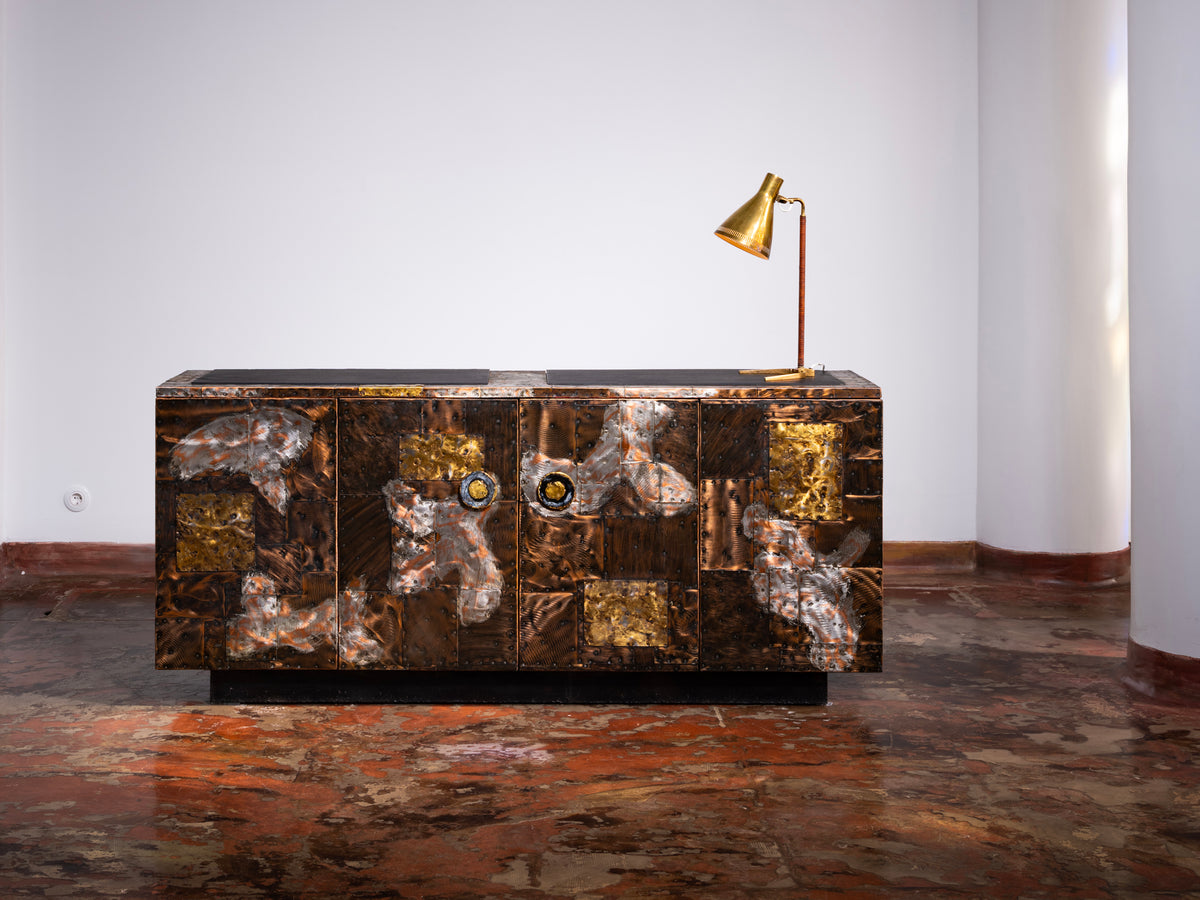
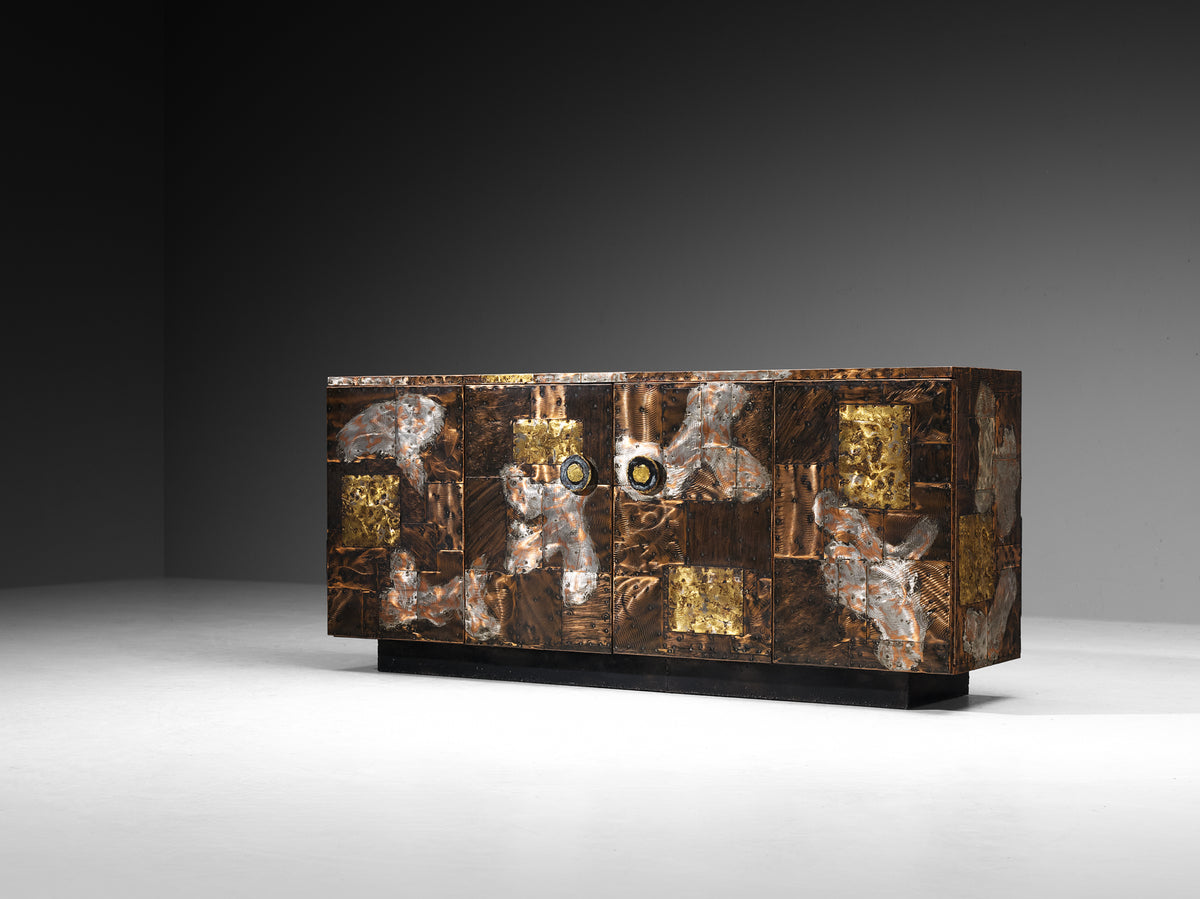
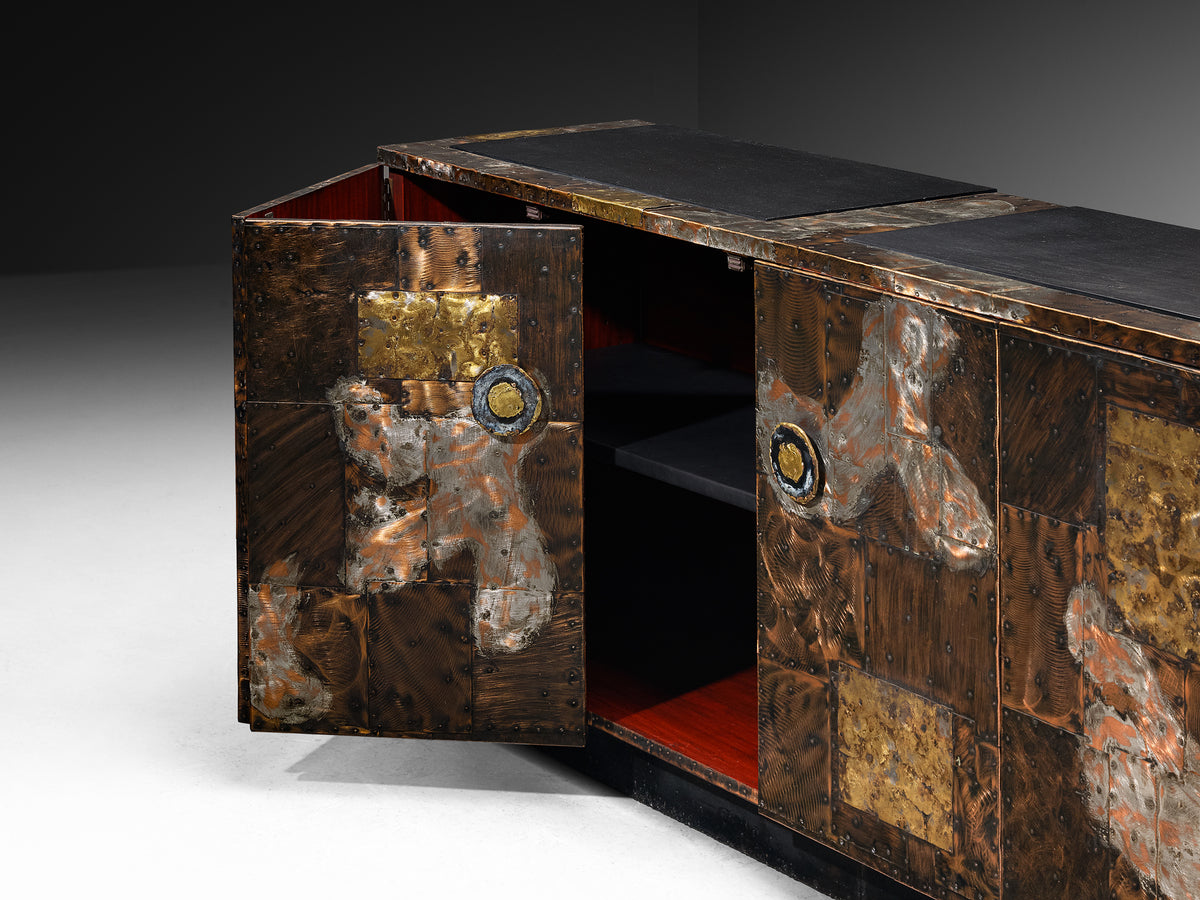
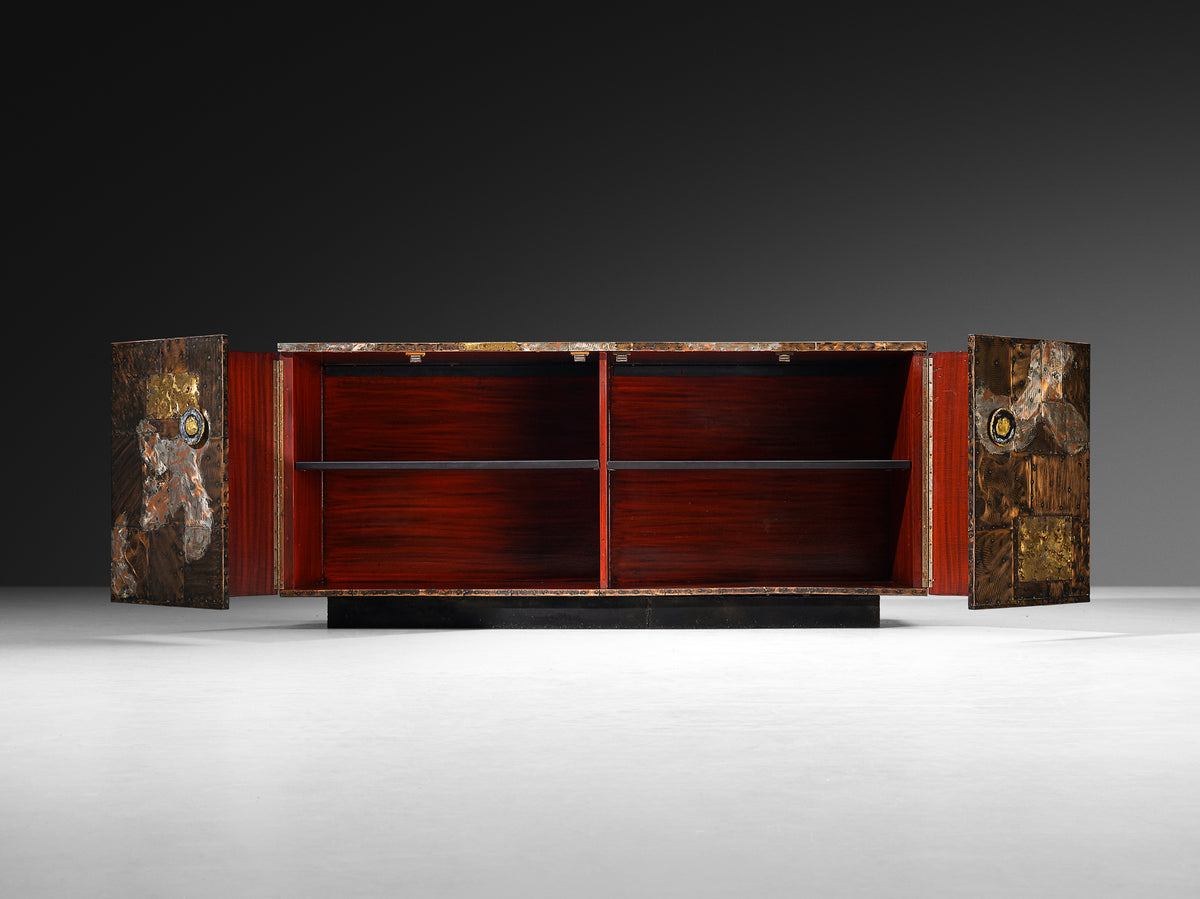
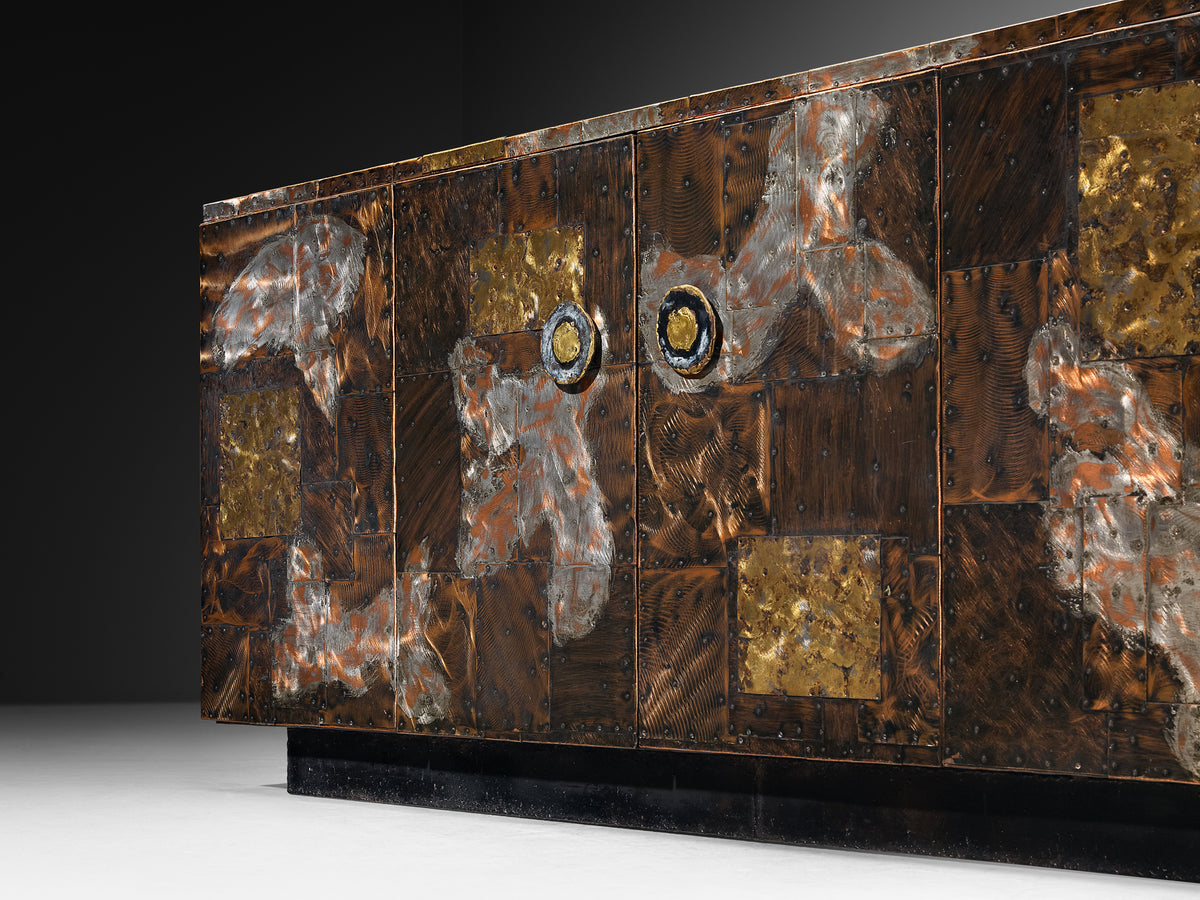
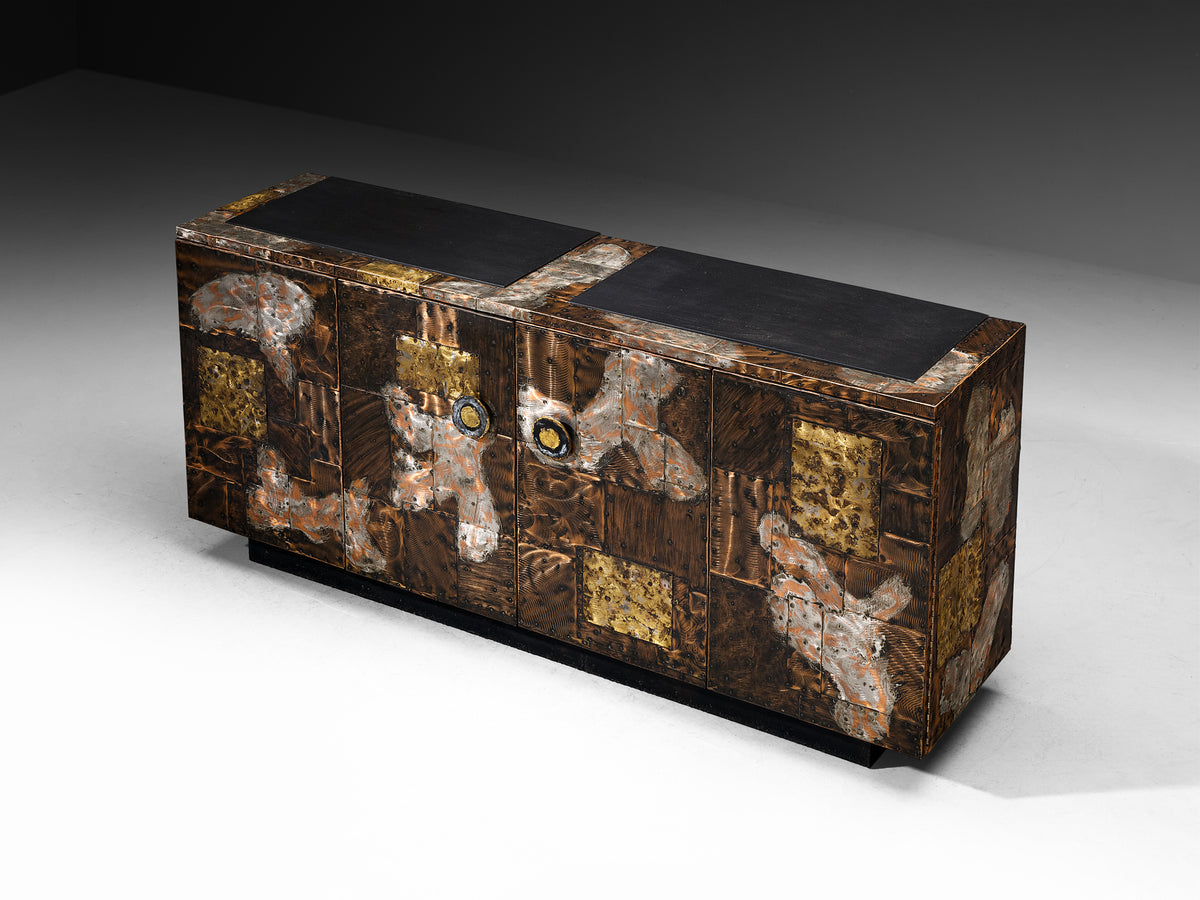
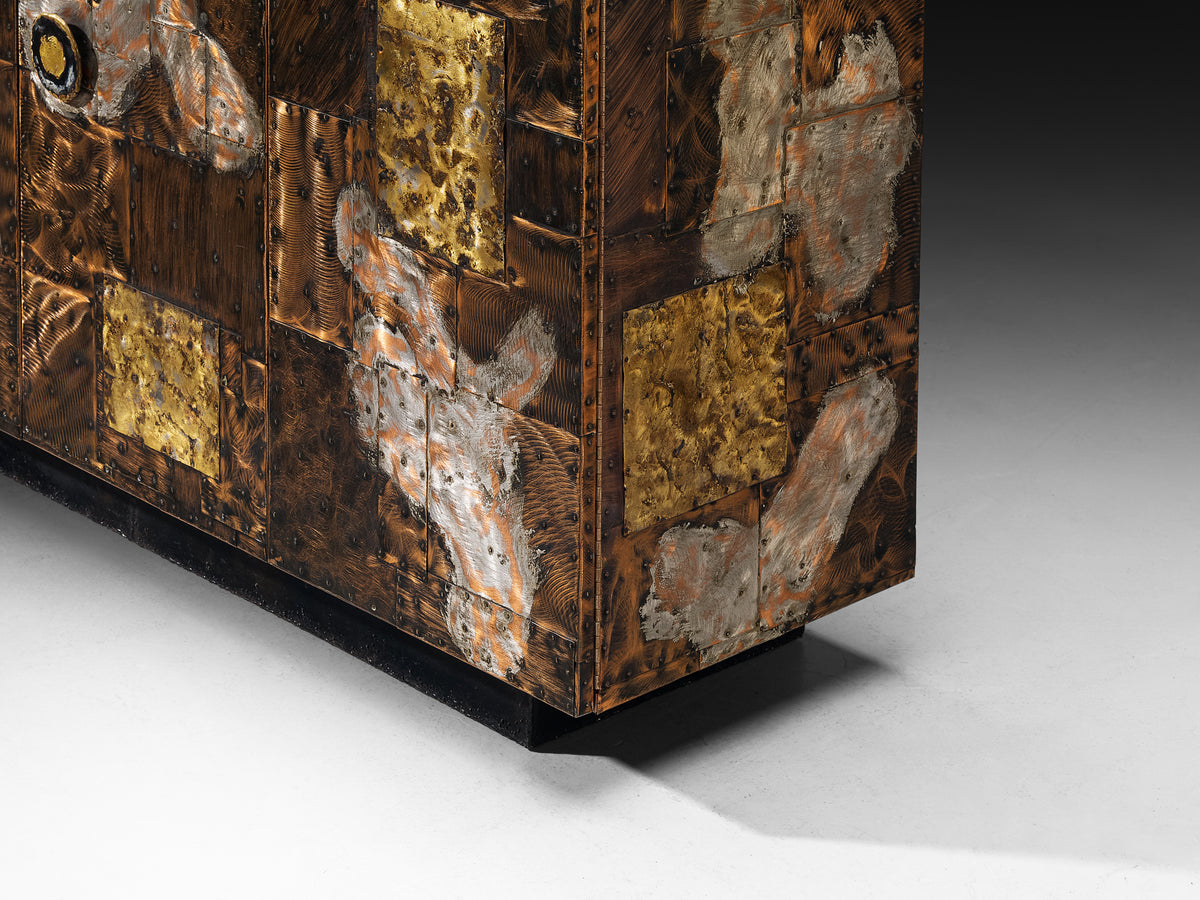
This exceptionally rare ‘Patchwork’ sideboard from around 1970 is a handcrafted studio piece from the formative years of Paul Evans’s collaboration with Directional, which began in 1964. Central to Evans’s philosophy was the belief that handmade furniture should visibly bear the mark of its maker, possessing a richness and individuality that industrial production could not reproduce. Here, that principle is expressed across every surface. Sheets of patinated copper, pewter, and bronze are individually worked and joined into an irregular patchwork of geometric and organic forms, creating a façade in which welding, texture, color, and deliberately induced patination become the design itself. Its bright red interior is deliberately left with visible brushstrokes, revealing the hand of the maker. Produced during an important early phase of Evans’s work for Directional, the sideboard exemplifies the experimental metalworking for which his studio became renowned, positioning him at the forefront of the American Studio Furniture movement and blurring the boundaries between furniture, craft, and sculpture. Its rarity and unmistakably handmade character make each example inherently individual.
The Hand of the Maker
The sideboard exemplifies Evans’s idiosyncratic way with welding and constructing. Evans departed from the traditional values of the designer-craftsman, which prioritize respect for materials and functional simplicity. Instead, he showed a keen interest in manipulating materials and creating artificial aging effects. However, he maintained a strong belief in the importance of the craftsman's expertise and ingenuity as the foundation for innovation and replication. The emphasis on surface treatment became the defining characteristic of his furniture designs. As Evans articulates the essence of his oeuvre, handmade product should bear the mark of the hand. Mere good lines are insufficient, as those can be industrially produced. Furniture ought to embody detail and richness.
A Patchwork of Metals
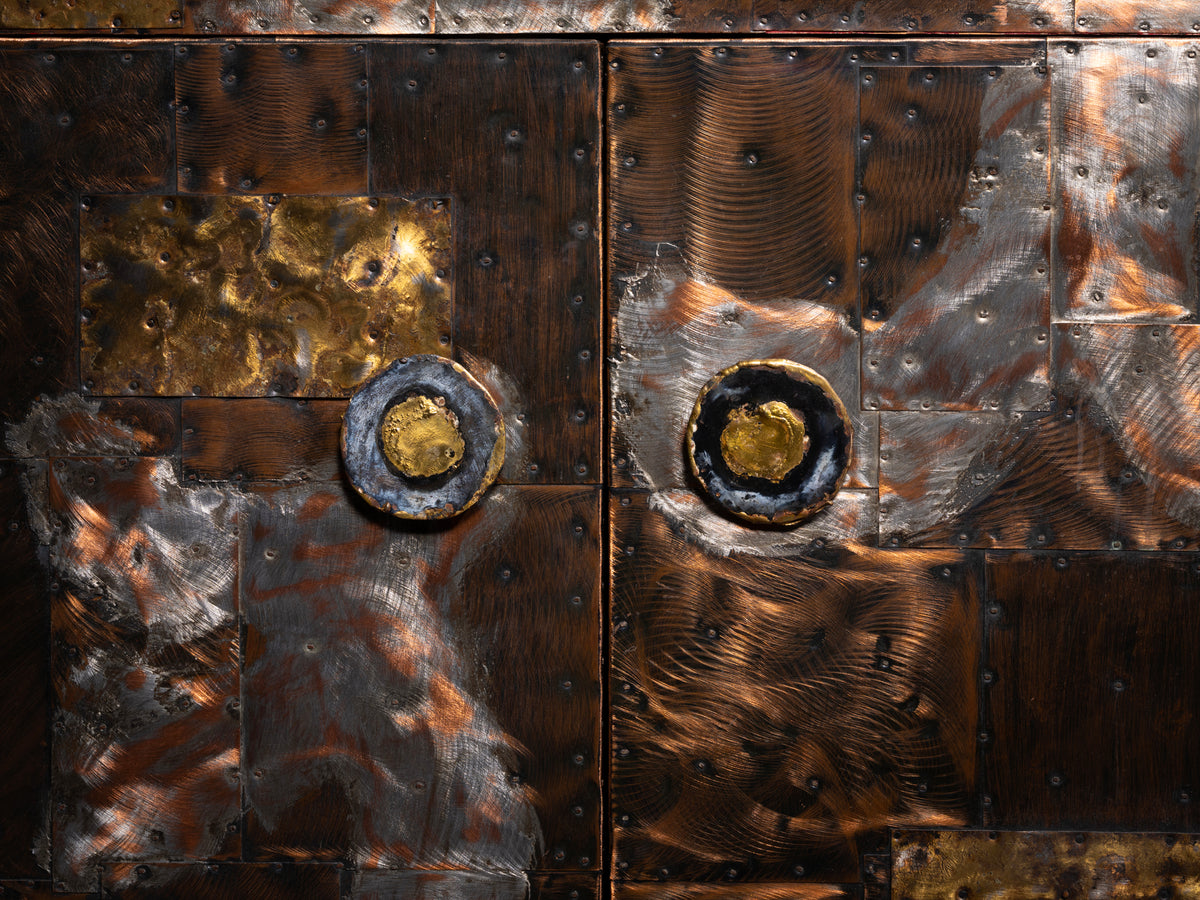
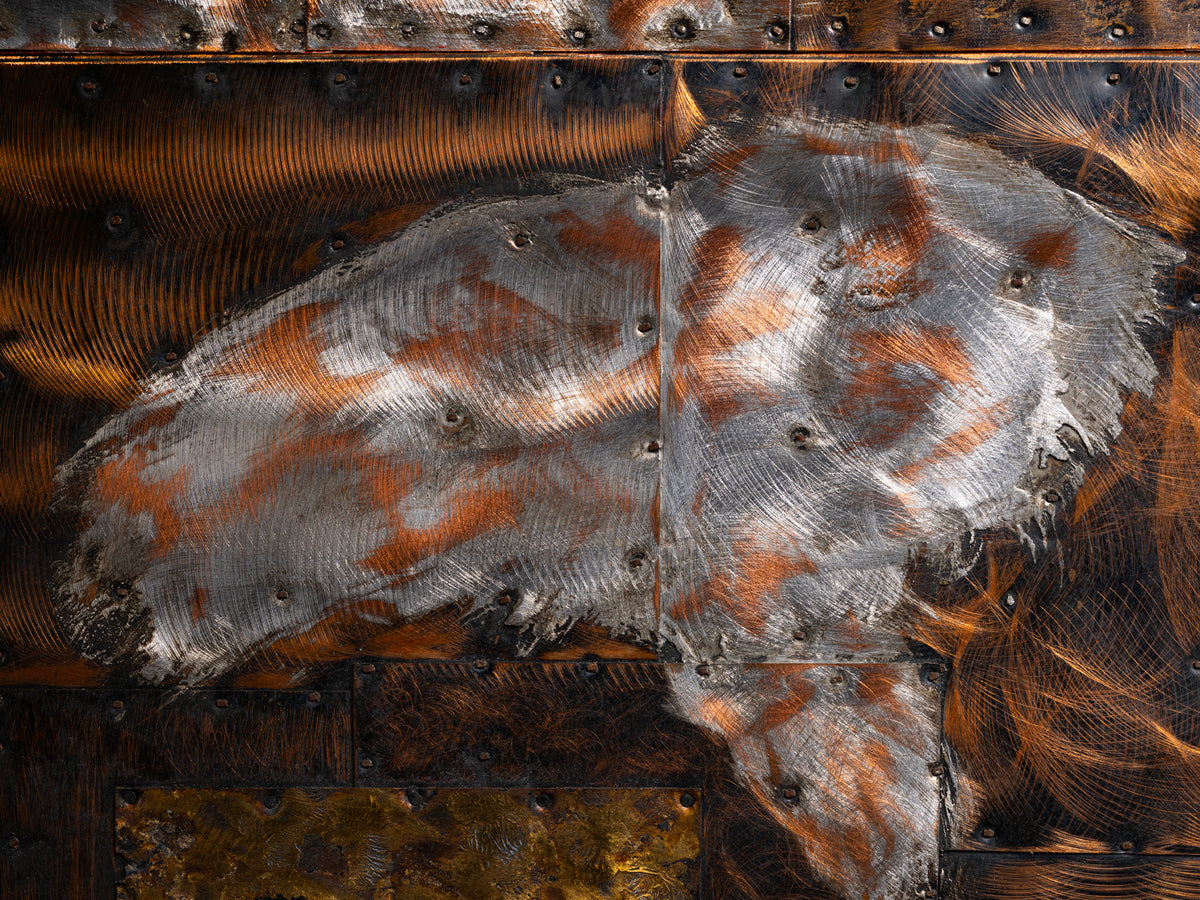
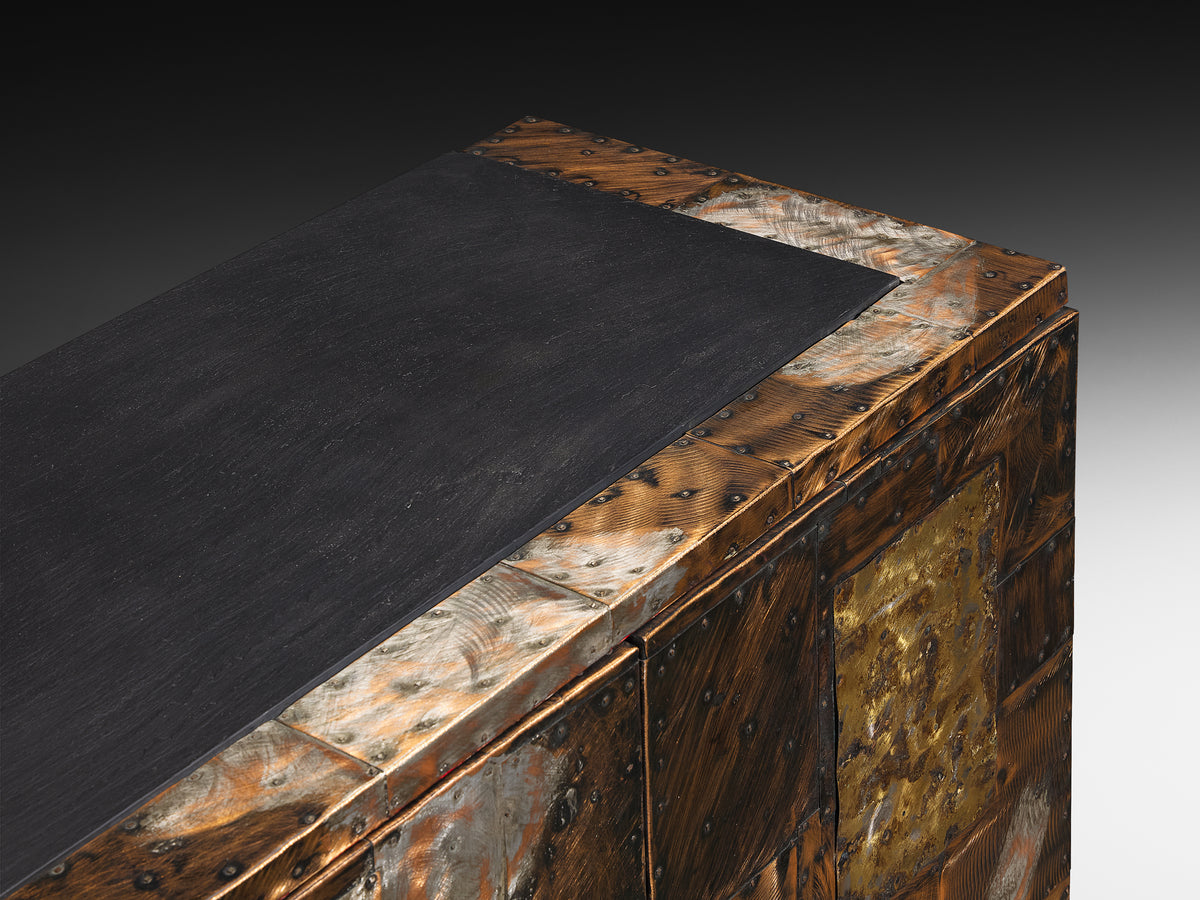
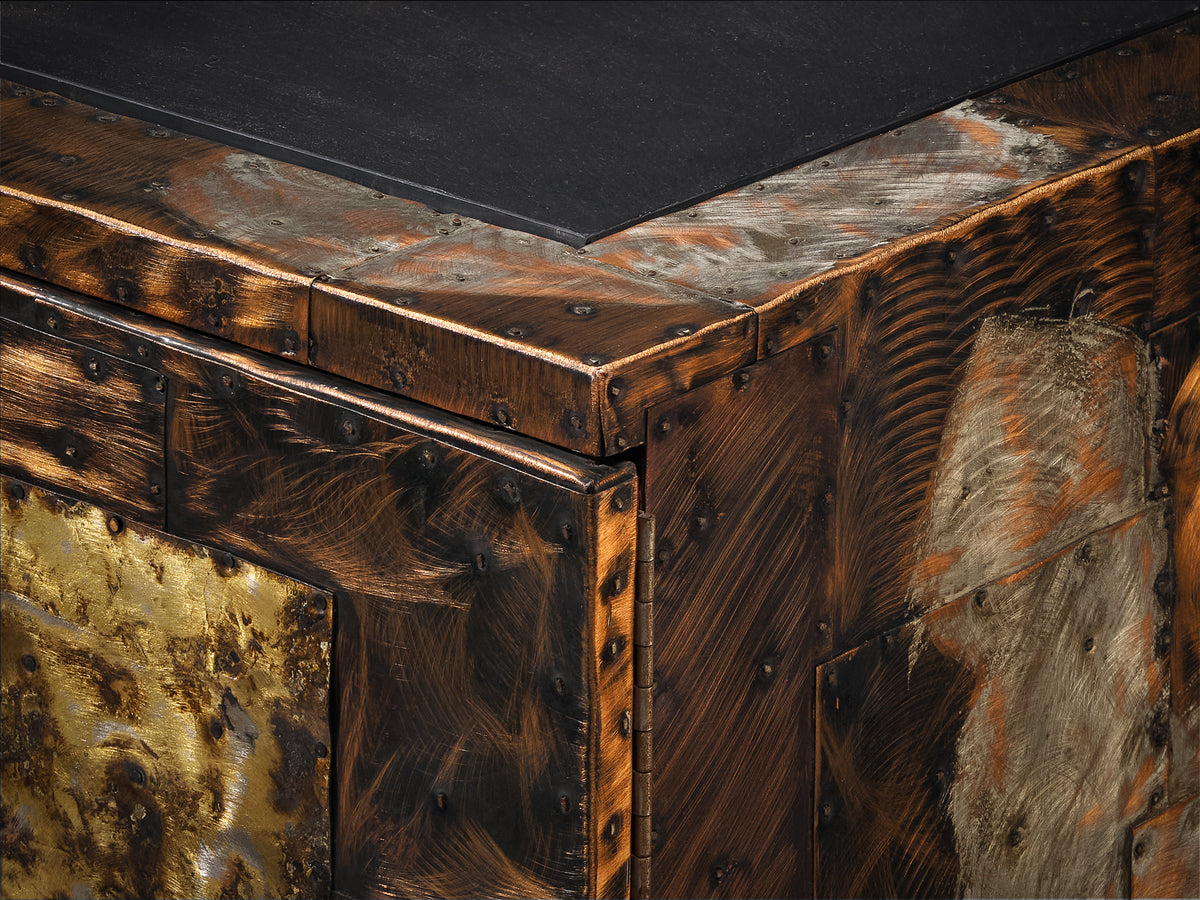
The sideboard’s surface is composed of individually worked sheets of copper and bronze, arranged in an irregular patchwork of geometric forms. Rather than treating the metal as a smooth, uniform material, Evans manipulated each section through hammering, punching, abrasion, and patination. Repeated circular punch marks remain clearly visible across the surface, alongside directional tool marks and irregularly applied patches of metal, preserving the physical traces of the making process. The contrast between angular sheets and more fluid, organically shaped outlines in pewter give the façade an almost painterly quality, while the varying brown, copper, silver, and golden tones create remarkable depth. The result is characteristic of Evans’s experimental approach to metalwork.
Biography
Paul Evans (1931–1987) was one of the leading figures of the American Studio Furniture movement, distinguished by his radical approach to metal and his ability to blur the boundaries between furniture, craft, and sculpture. Born in Trenton, New Jersey, Evans briefly attended the Philadelphia Textile Institute before receiving an Aileen O. Webb Scholarship to study at the School for American Craftsmen at the Rochester Institute of Technology from 1950 to 1952. That same year, an Ellen S. Booth Scholarship enabled him to continue his training in metalwork at Cranbrook Academy of Art.
After working as a metalsmith at Old Sturbridge Village in Massachusetts, Evans moved to the Lambertville–New Hope area in 1955, then an important community for American studio craft. He shared a showroom in New Hope with furniture maker Phillip Lloyd Powell, beginning a creative partnership that lasted until 1966. Powell’s expressive woodwork and Evans’s increasingly experimental metalwork complemented one another, and during these years Evans began applying his training in metalsmithing to furniture on an increasingly ambitious scale. Their work appeared in the Museum of Contemporary Crafts’ influential Furniture by Craftsmen exhibition in 1957, and in 1961 the pair held a two-man exhibition at America House in New York.
In 1964, Evans began designing for Directional Furniture, a collaboration that dramatically expanded the reach of his work while allowing him to retain the handcrafted character central to his practice. His studio developed a succession of highly distinctive techniques and series, including Copper, Bronze and Pewter, Sculpted Steel, Argente, Sculpted Bronze, Verdigris Copper, and later Cityscape. His continuous experimentation with welding, patination, applied metal, and sculptural surface treatments established texture and material transformation as defining features of his work.
From 1971, the polished brass and chrome surfaces of the Cityscape series introduced a markedly sleeker vocabulary alongside the heavily textured furniture of the previous decade. Yet Evans’s commitment to craftsmanship remained fundamental. Although his expanding studio eventually employed between thirty-five and eighty people, production remained closely tied to the workshop, with Evans directing the transformation of his drawings and prototypes into finished furniture.
Evans continued experimenting with furniture and new technologies into the 1980s. On March 6, 1987, he left his business to begin his retirement in Massachusetts; the following morning, he died of a heart attack at the age of fifty-five.

Choose options
Product Details
Biography
Born in Newton, Pennsylvania, Evans studied at the Philadelphia Textile Institute, the Rochester Institute of Technology, the School for American Craftsman and the Cranbrook Academy of Art. In 1955 he was drawn to New Hope, Pennsylvania, where he collaborated with Phillip Lloyd Powell and shared a showroom with him until 1966. A new phase of his career began in 1964, when he started working for the Directional Furniture company, which gave him a route to selling his work throughout the US and a reason to keep introducing new lines.
Together with artists such as Wharton Esherick and George Nakashima, Evans helped make the Philadelphia region a prominent centre for studio craft in the late 1960s. In those years he began to make furniture in metal, and sculpture, manipulating the material to achieve expressive surface effects. Through the 1970s he replaced those crusty, textured surfaces, patinated with paint and acid, with dazzling reflective metal that was sometimes mixed with woods. His line proved too expensive, and by the end of the decade he ended his relationship with the company. On 6 March 1987 he shut down his business and died the next day of a heart attack.
VAT within the EU: When buying or delivering an item within the EU, VAT usually applies and will be added.