
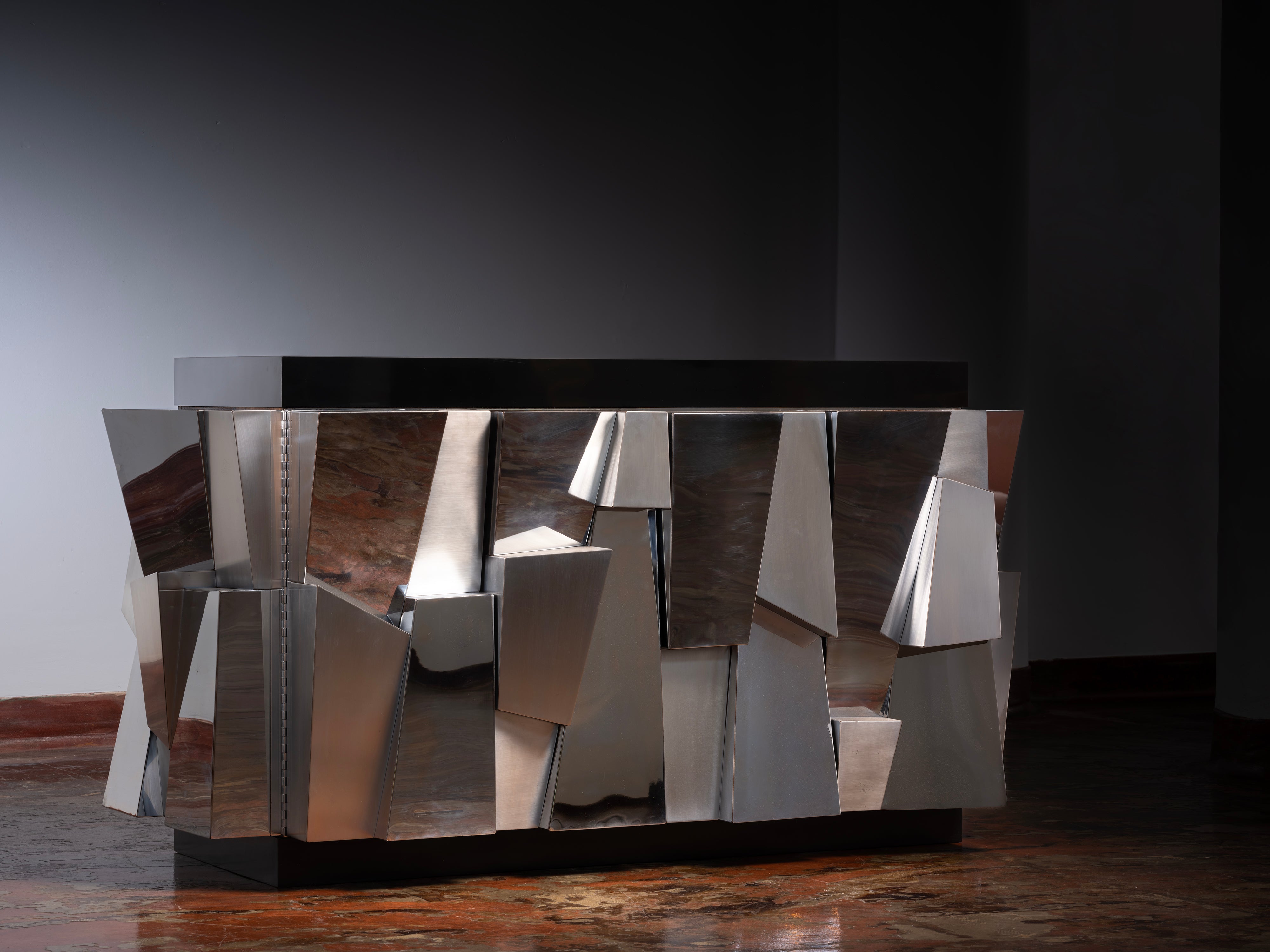
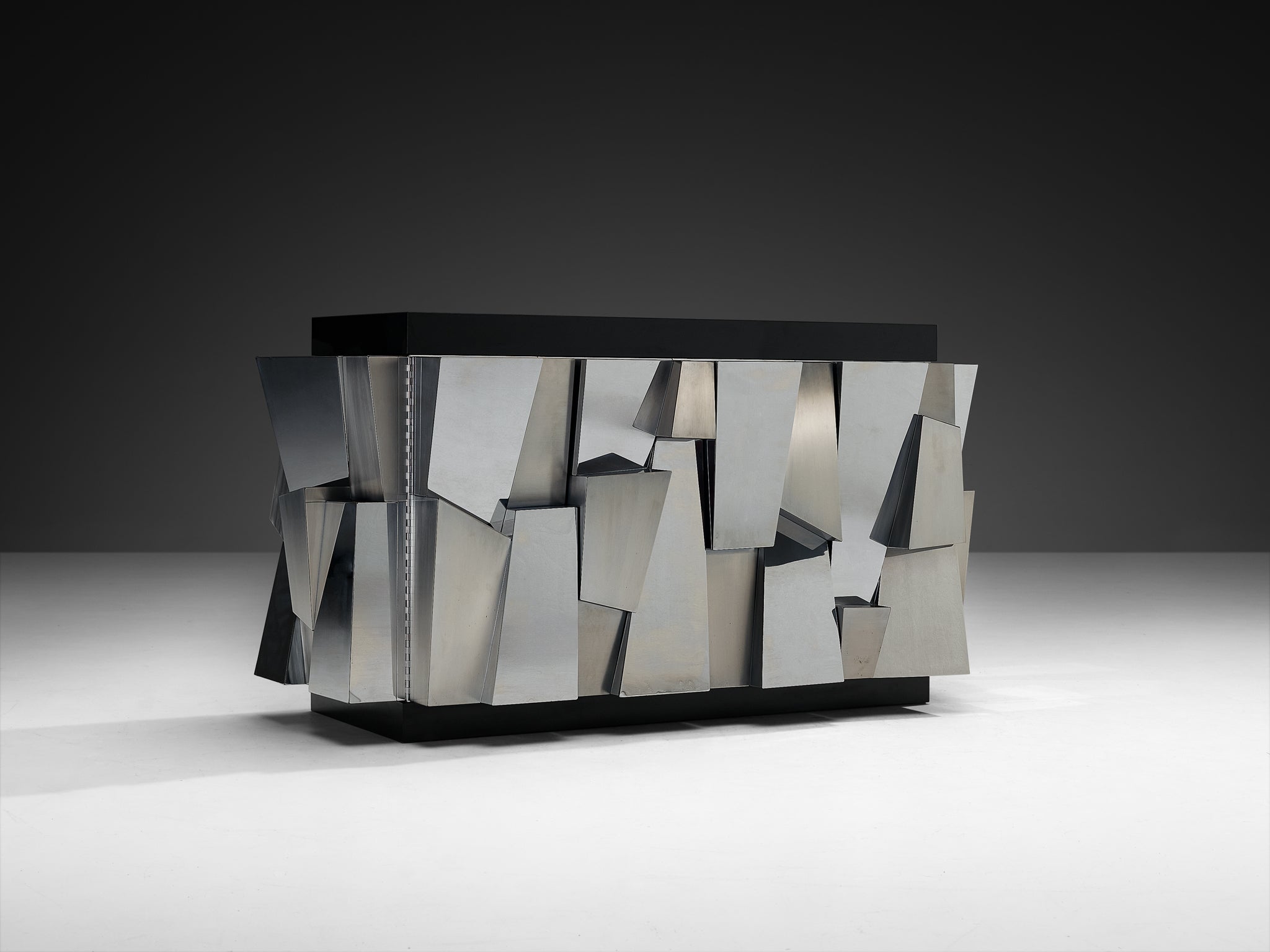
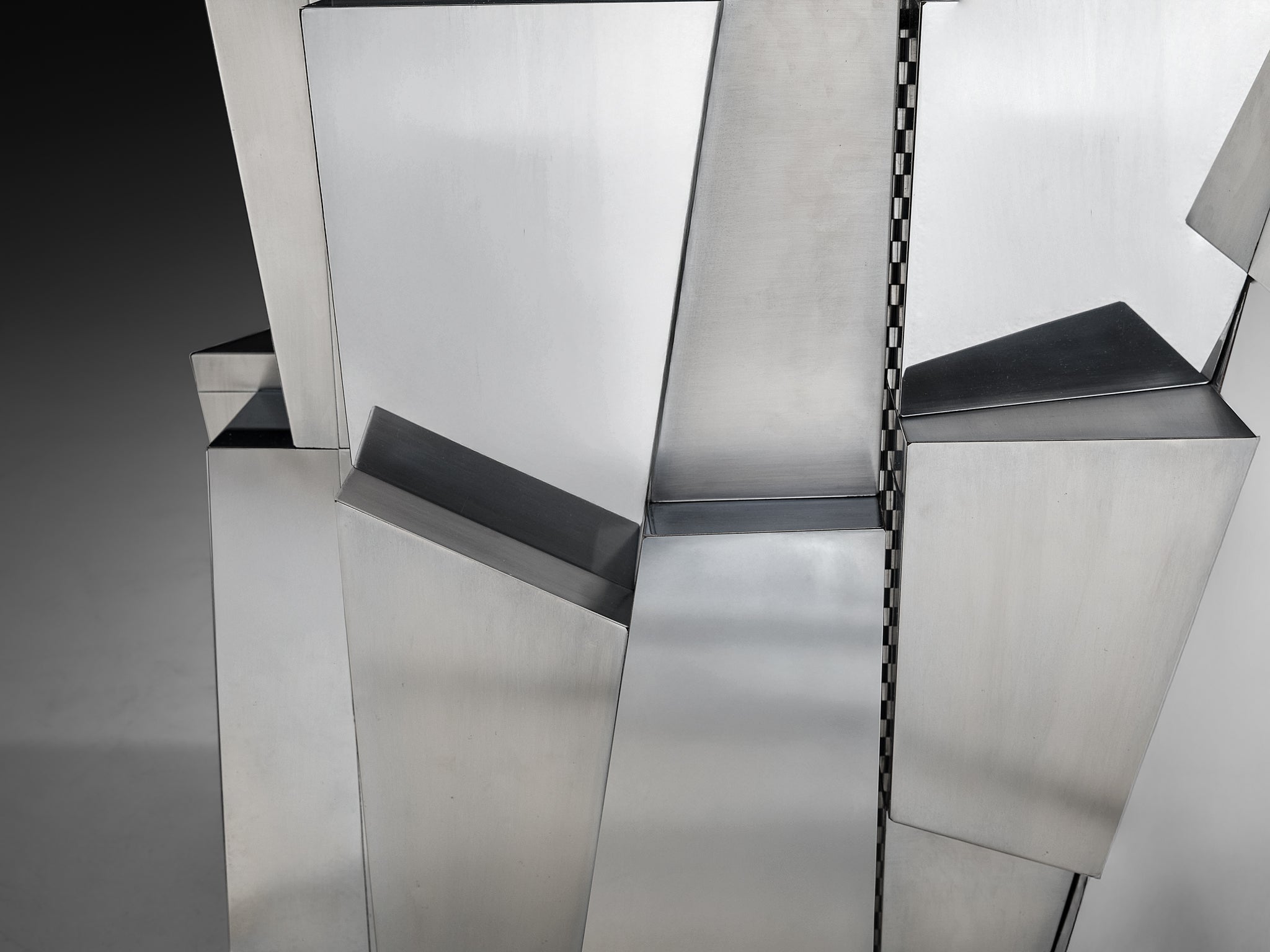
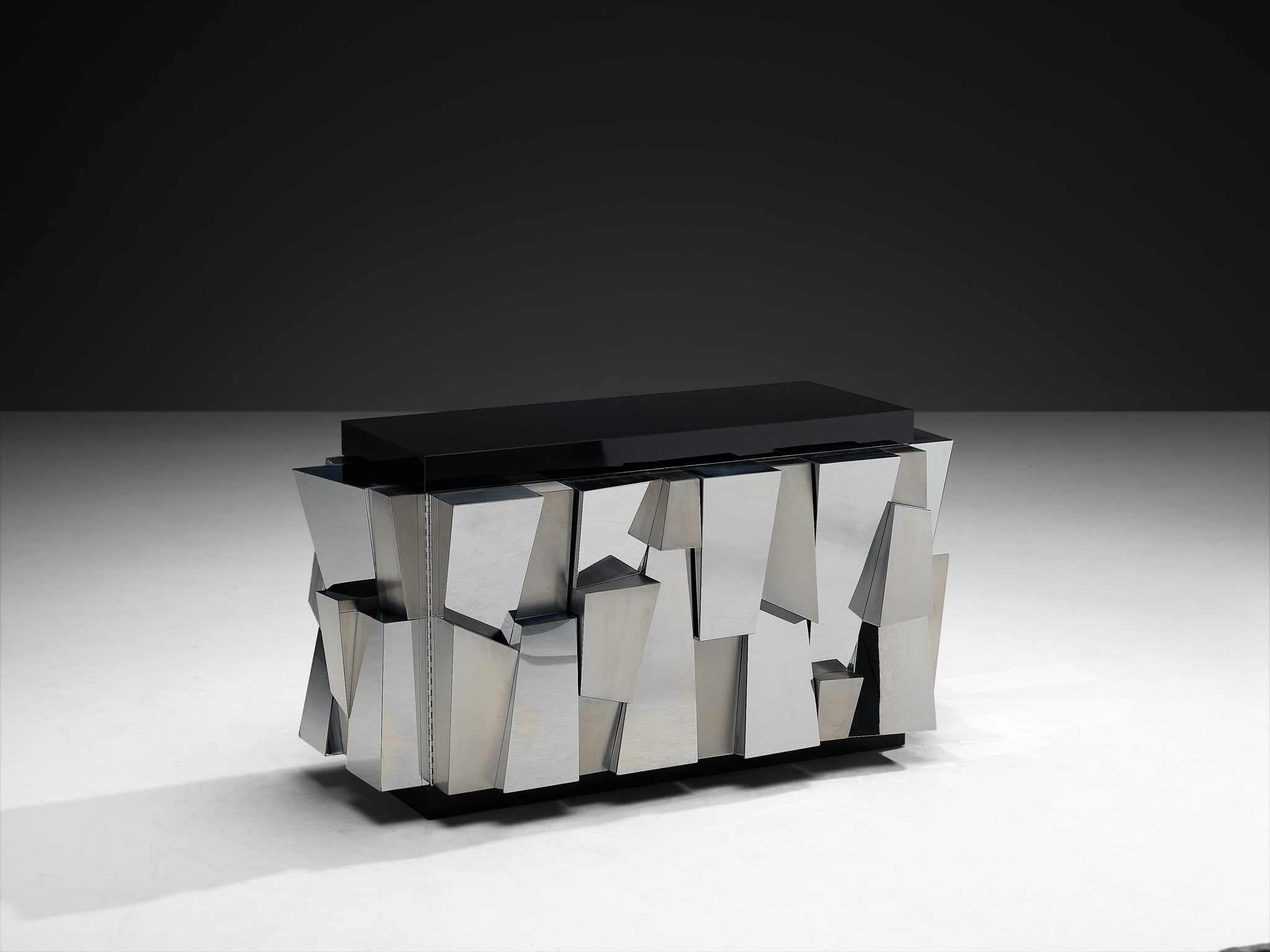
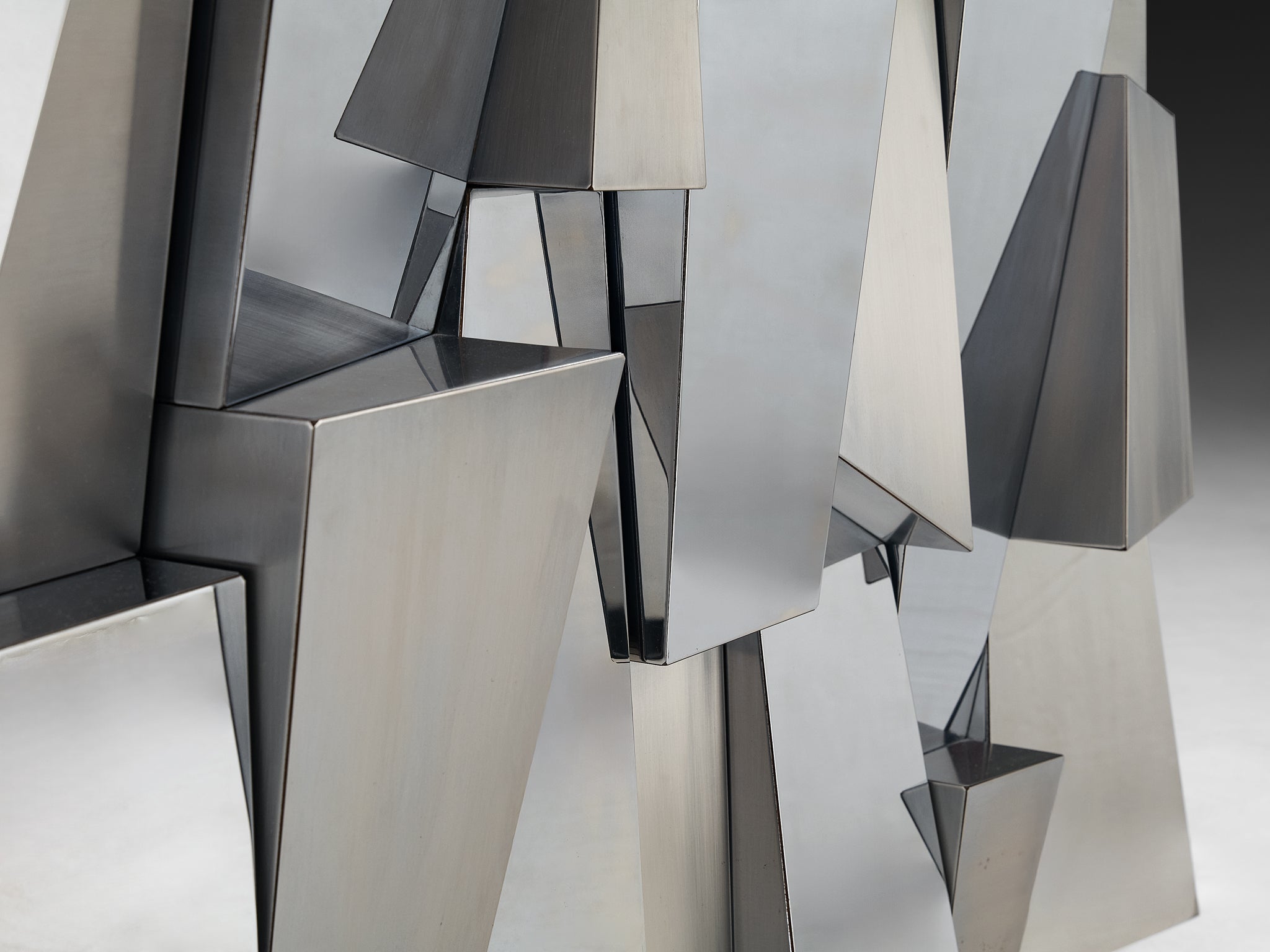
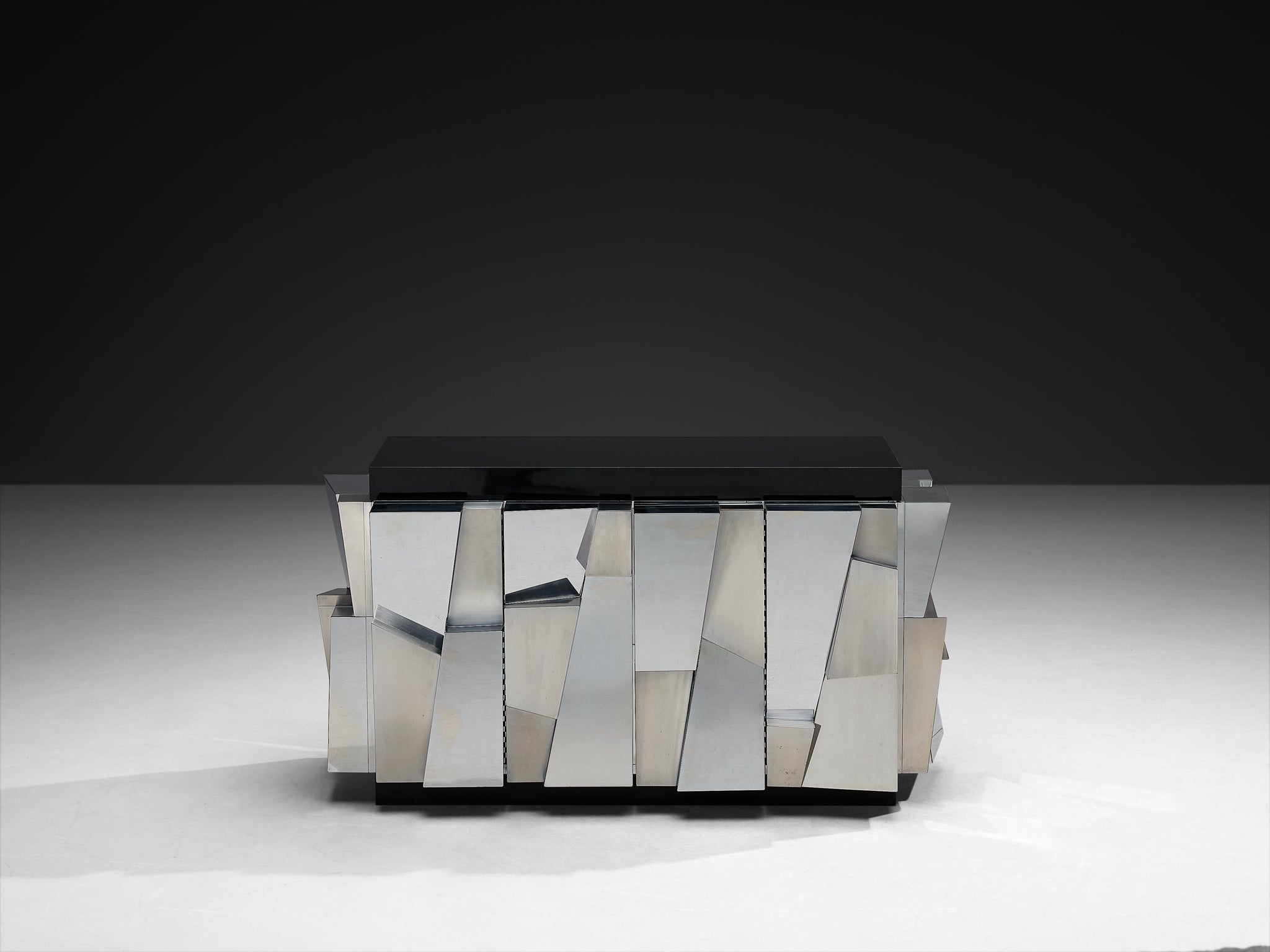
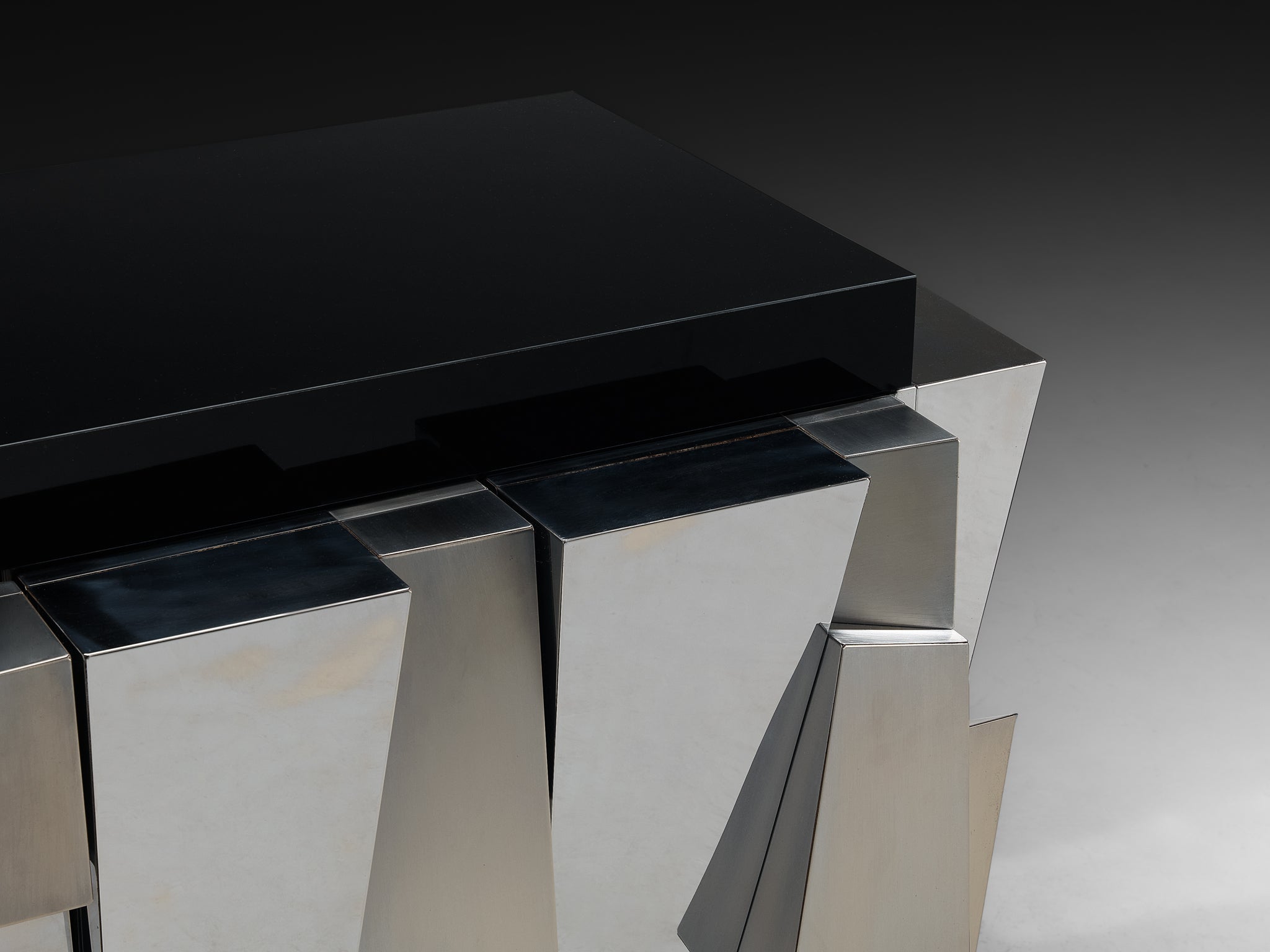
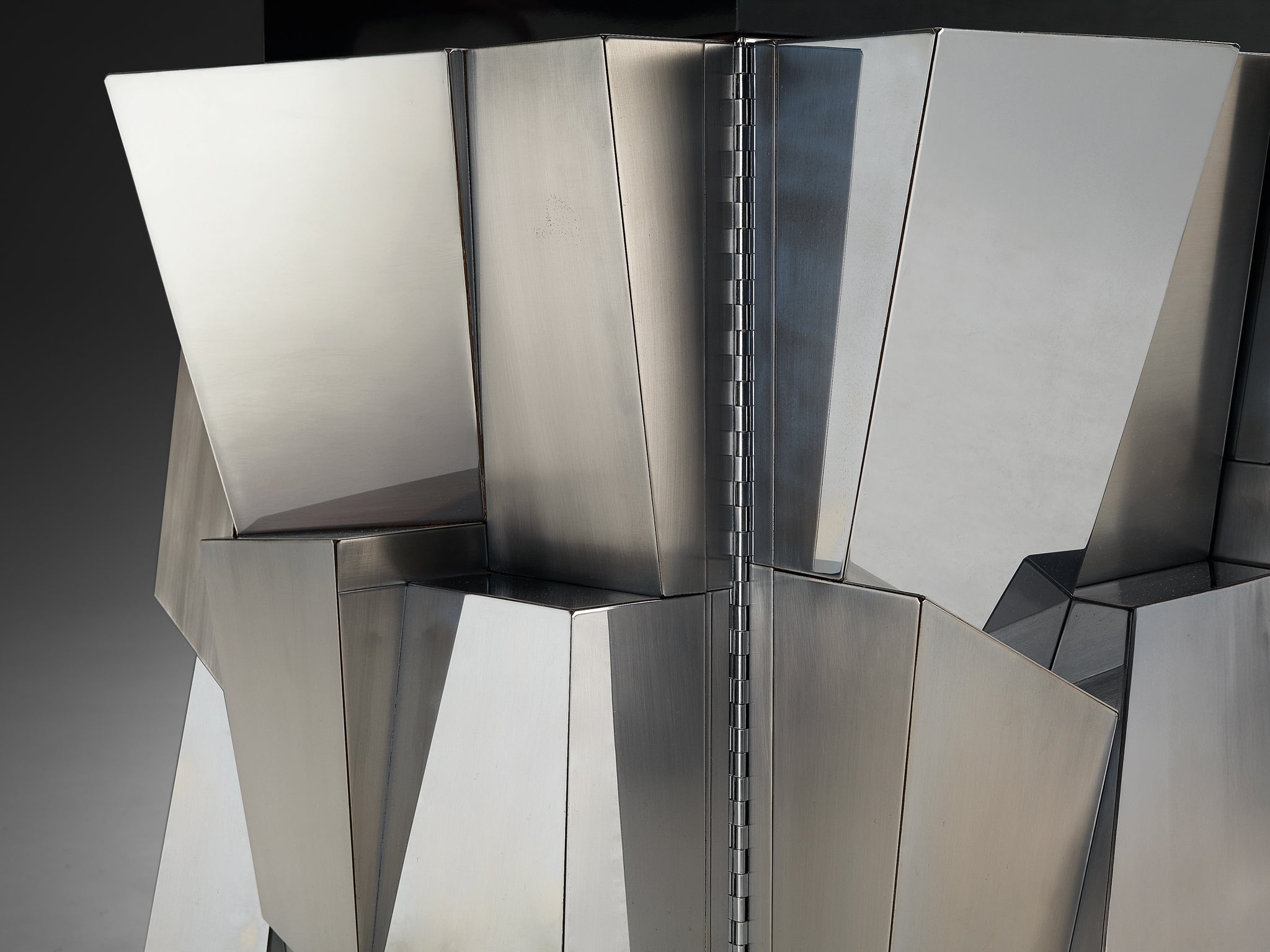
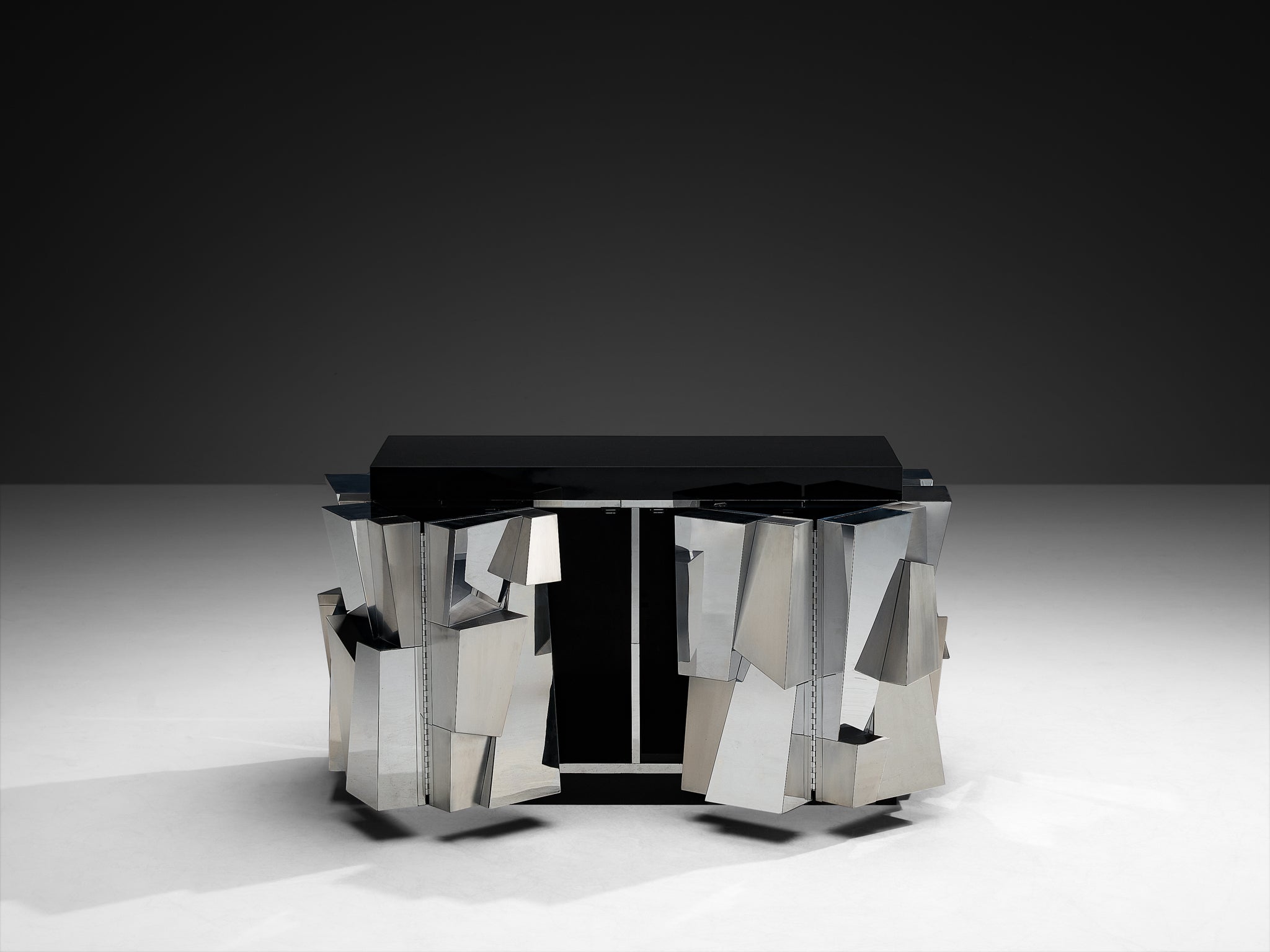
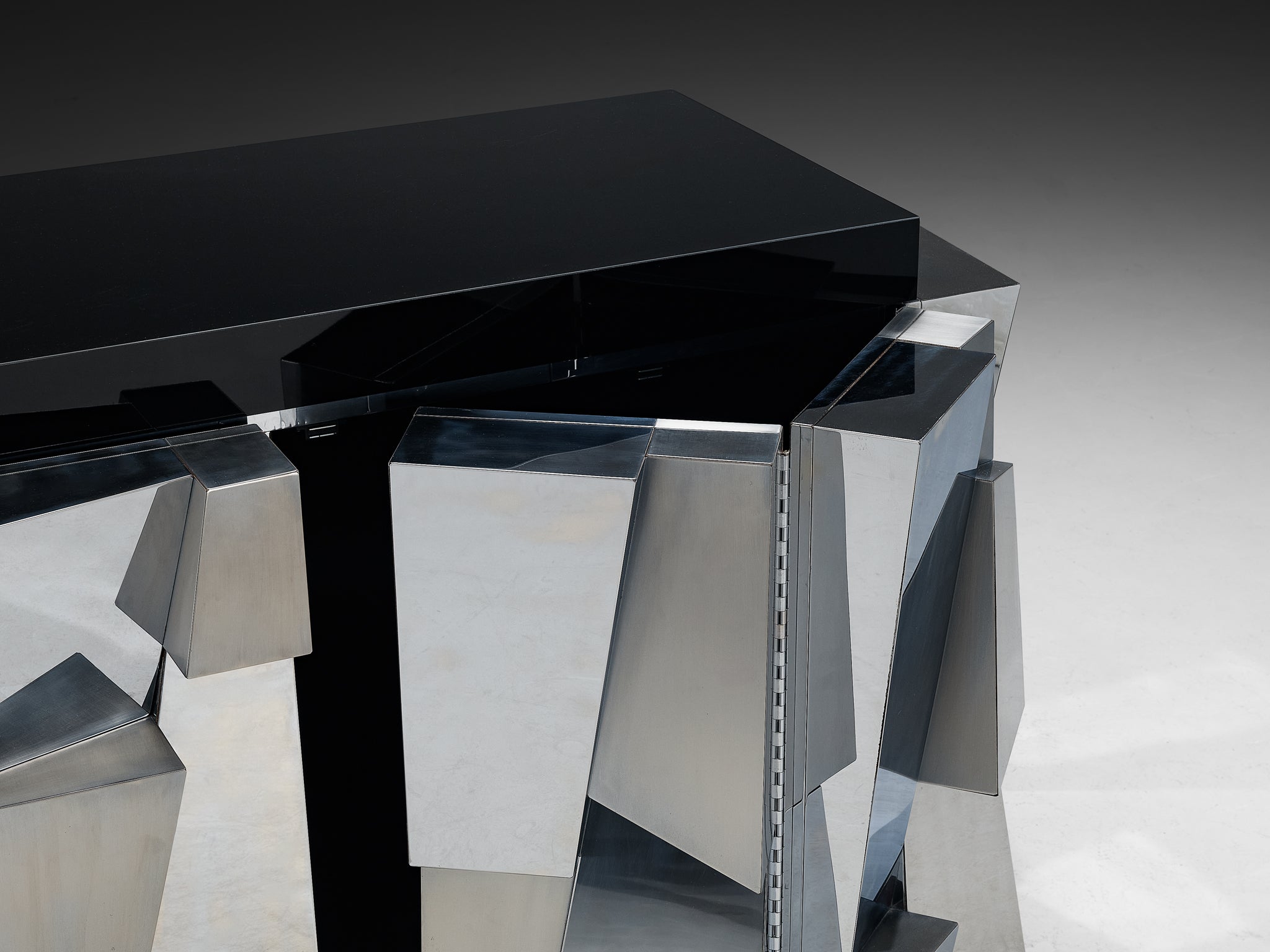
Paul Evans for Directional Faceted 'PE 300' Cabinet in Steel
Tearsheet
×
Receive a copy in your email or download directly:
I accept emails from Morentz.
 Open here
Paul Evans, Paul Evans Studio for Directional, ‘Faceted Cityscape II’ (PE 300 series), chrome-plated steel, brushed steel, High Pressure Laminate, United States, circa 1970
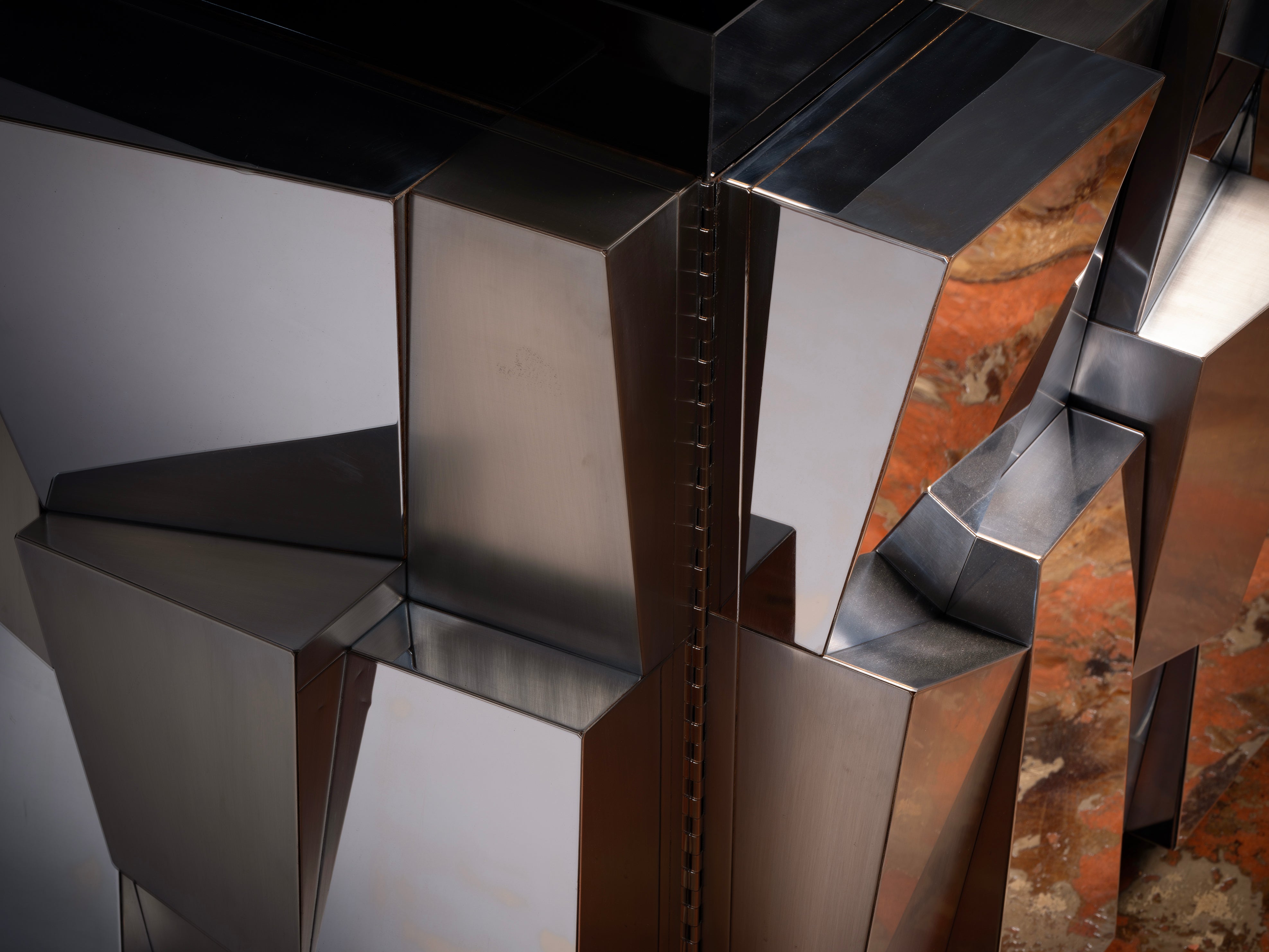
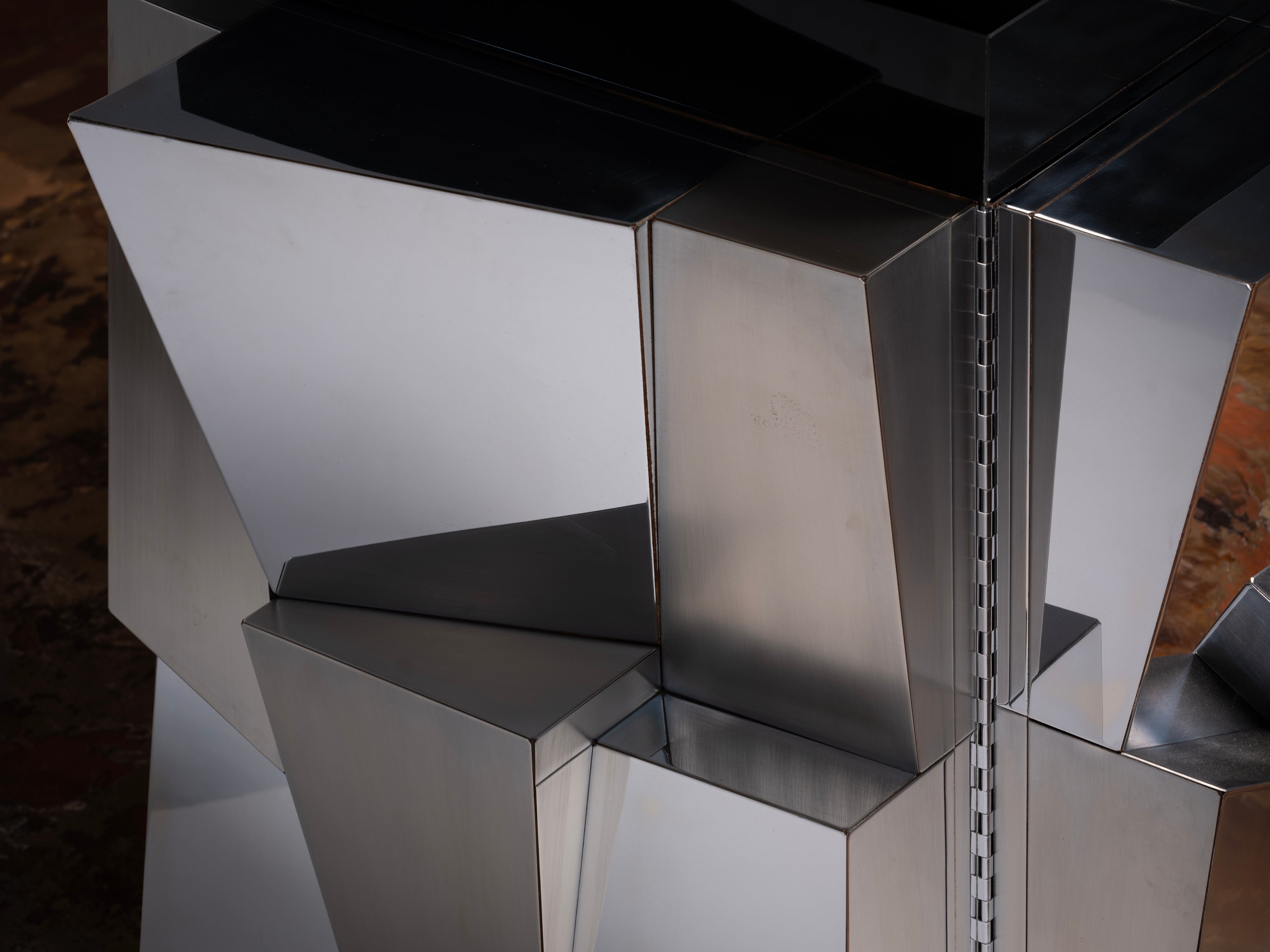
This sideboard from the Cityscape II (PE 300) line was designed by Paul Evans for Directional and hand-crafted in his own studio. The Cityscape pieces are among Evans’s most successful and admired designs, celebrated for their luxurious, modern aesthetic achieved through a sophisticated mix of materials and bold geometric forms. The PE 300 series, in particular, is distinguished by its three-dimensional, faceted surfaces composed of asymmetrical panels in varying sizes and materials – chrome-plated steel, brass, and burlwood were used interchangeably. The intricate application of these sculptural metal surfaces to the bi-fold doors exemplifies Evans’s meticulous craftsmanship, requiring time-intensive, hands-on artistry.
To create the variously sized elements, fiberglass molds were filled with high-density foam – a strong yet lightweight resin material – which was then covered with metal or wood; in this case, chrome-plated steel and brushed steel. Nine distinct sizes and forms were produced, allowing for a dynamic composition: by rotating and reorienting each piece, Evans achieved a richly varied, asymmetrical mosaic. Ensuring that all elements were perfectly flush to eliminate gaps was a meticulous and time-consuming process. Each section was pre-fitted before assembly, meaning that every chrome-covered piece had to be precisely aligned and marked prior to plating. After the chrome was applied individually, the pieces were reassembled in their exact configuration. Directional highlighted this aspect of the design in its catalog, describing it as offering “a play of depth and dimension.” When illuminated, the cabinet’s surface shimmers and glows, evoking the glamour and reflective energy of the disco era.
The origin of Evans’ Cityscape series with its gleaming façades is based on the exploring of a material new to the Evans studio: chromed steel. The research and development for the series started in 1970 and took place over a six-month period. Before that, Evans had done a lot of preliminary examination by using a constructivist approach to design, which was, as art critic Glenn Adamson puts it, ‘based on the repetition and variation of geometrical modules, typically built from discrete metal plates, welded together and then embellished.’ As the handling of the material required a lot of technical competence and precision, Evans was faced with a great challenge during this period. Not only the visual characteristics of the material carries a sense of deluxe, but also Evans’ great craftsmanship and creativity give the potential that the Cityscape furniture could be considered as refined and exceptional. Evans himself described the series as ‘an elegant and unconventional statement, the ultimate in high fashion contemporary furniture.’.
Although Evans had a background in metalwork, the Cityscape series seems equally relevant to the Art Deco period of the 1920s and ‘30s. Evans was among others strongly inspired by the Viennese Art Deco designer Paul Frankl (1886-1958) who is known for his designs that resemble the New York architectural skyscrapers. As the title “Cityscape” suggests, the mirrored surface of the sideboards graphically represents a skyline. Other shapes within the series were also present resulting in a more general sphere of urbanity. Another source of inspiration could be the compositions prevailing within black-and-white movies of the Art Deco era, which played a major in the stylistic features of the art movement. Hollywood set designers used the juxtaposition of different kind of materials – mirrors, chromed steel, high-polish lacquer and silver-gilt wood – that contained a mirrored, sheen, and reflective finish, as means of creating these surfaces of high-contrast.
Paul Evans (1931-1987) was among one of the most important American Studio Craft Movement members. Together with artists such as Wharton Esherick and George Nakashima, he helped to make the Philadelphia region a prominent center for the Studio Craft in the late 1960s. Born in Newton, Pennsylvania, Evans studied at a few different institutions such as the Philadelphia Textile Institute, the Rochester Institute of Technology, School for American Craftsman, and the Cranbrook Academy of Art. Eventually, he was drawn to New Hope, Pennsylvania, in 1955 where he collaborated and shared a showroom with Phillip Lloyd Powell until 1966. Powell’s woodwork and Evans's metal craftsmanship combined into a creative partnership. During this period, he started to create furniture with metal and sculpture by which he manipulated materials to achieve expressive surface effects. In 1964, Evans started working for the Directional Furniture company where he pursued a new phase of his career. Directional offered him new opportunities for selling his work throughout the US and he continuously introduced new lines. However, his line proved to be too expensive and by the end of the seventies, he ended his relationship with the company. It was also throughout the seventies that Evans started to replace these crusty, textured surfaced, that were patinated with paint and acid, with dazzling, reflective metal surfaces that were sometimes mixed with woods. Evans’s oeuvre has an impressive size especially when regarding all pieces were handmade. On March 6, 1987, the artist shut down his business and, unfortunately, died the next day due to a heart attack.
This sideboard from the Cityscape II (PE 300) line was designed by Paul Evans for Directional and hand-crafted in his own studio. The Cityscape pieces are among Evans’s most successful and admired designs, celebrated for their luxurious, modern aesthetic achieved through a sophisticated mix of materials and bold geometric forms. The PE 300 series, in particular, is distinguished by its three-dimensional, faceted surfaces composed of asymmetrical panels in varying sizes and materials – chrome-plated steel, brass, and burlwood were used interchangeably. The intricate application of these sculptural metal surfaces to the bi-fold doors exemplifies Evans’s meticulous craftsmanship, requiring time-intensive, hands-on artistry.
To create the variously sized elements, fiberglass molds were filled with high-density foam – a strong yet lightweight resin material – which was then covered with metal or wood; in this case, chrome-plated steel and brushed steel. Nine distinct sizes and forms were produced, allowing for a dynamic composition: by rotating and reorienting each piece, Evans achieved a richly varied, asymmetrical mosaic. Ensuring that all elements were perfectly flush to eliminate gaps was a meticulous and time-consuming process. Each section was pre-fitted before assembly, meaning that every chrome-covered piece had to be precisely aligned and marked prior to plating. After the chrome was applied individually, the pieces were reassembled in their exact configuration. Directional highlighted this aspect of the design in its catalog, describing it as offering “a play of depth and dimension.” When illuminated, the cabinet’s surface shimmers and glows, evoking the glamour and reflective energy of the disco era.
The origin of Evans’ Cityscape series with its gleaming façades is based on the exploring of a material new to the Evans studio: chromed steel. The research and development for the series started in 1970 and took place over a six-month period. Before that, Evans had done a lot of preliminary examination by using a constructivist approach to design, which was, as art critic Glenn Adamson puts it, ‘based on the repetition and variation of geometrical modules, typically built from discrete metal plates, welded together and then embellished.’ As the handling of the material required a lot of technical competence and precision, Evans was faced with a great challenge during this period. Not only the visual characteristics of the material carries a sense of deluxe, but also Evans’ great craftsmanship and creativity give the potential that the Cityscape furniture could be considered as refined and exceptional. Evans himself described the series as ‘an elegant and unconventional statement, the ultimate in high fashion contemporary furniture.’.
Although Evans had a background in metalwork, the Cityscape series seems equally relevant to the Art Deco period of the 1920s and ‘30s. Evans was among others strongly inspired by the Viennese Art Deco designer Paul Frankl (1886-1958) who is known for his designs that resemble the New York architectural skyscrapers. As the title “Cityscape” suggests, the mirrored surface of the sideboards graphically represents a skyline. Other shapes within the series were also present resulting in a more general sphere of urbanity. Another source of inspiration could be the compositions prevailing within black-and-white movies of the Art Deco era, which played a major in the stylistic features of the art movement. Hollywood set designers used the juxtaposition of different kind of materials – mirrors, chromed steel, high-polish lacquer and silver-gilt wood – that contained a mirrored, sheen, and reflective finish, as means of creating these surfaces of high-contrast.
Paul Evans (1931-1987) was among one of the most important American Studio Craft Movement members. Together with artists such as Wharton Esherick and George Nakashima, he helped to make the Philadelphia region a prominent center for the Studio Craft in the late 1960s. Born in Newton, Pennsylvania, Evans studied at a few different institutions such as the Philadelphia Textile Institute, the Rochester Institute of Technology, School for American Craftsman, and the Cranbrook Academy of Art. Eventually, he was drawn to New Hope, Pennsylvania, in 1955 where he collaborated and shared a showroom with Phillip Lloyd Powell until 1966. Powell’s woodwork and Evans's metal craftsmanship combined into a creative partnership. During this period, he started to create furniture with metal and sculpture by which he manipulated materials to achieve expressive surface effects. In 1964, Evans started working for the Directional Furniture company where he pursued a new phase of his career. Directional offered him new opportunities for selling his work throughout the US and he continuously introduced new lines. However, his line proved to be too expensive and by the end of the seventies, he ended his relationship with the company. It was also throughout the seventies that Evans started to replace these crusty, textured surfaced, that were patinated with paint and acid, with dazzling, reflective metal surfaces that were sometimes mixed with woods. Evans’s oeuvre has an impressive size especially when regarding all pieces were handmade. On March 6, 1987, the artist shut down his business and, unfortunately, died the next day due to a heart attack.
,%20chrome-plated%20steel,%20brushed%20steel,%20High%20Pressure%20Laminate,%20United%20States,%20circa%201970This%20sideboard%20from%20the%20C...)
Choose options
Paul Evans for Directional Faceted 'PE 300' Cabinet in Steel
Sale price$95,000.00
Regular price
Tearsheet
×
Receive a copy in your email or download directly:
I accept emails from Morentz.
VAT within the EU: When buying or delivering an item within the EU, VAT usually applies and will be added.
Product Details