
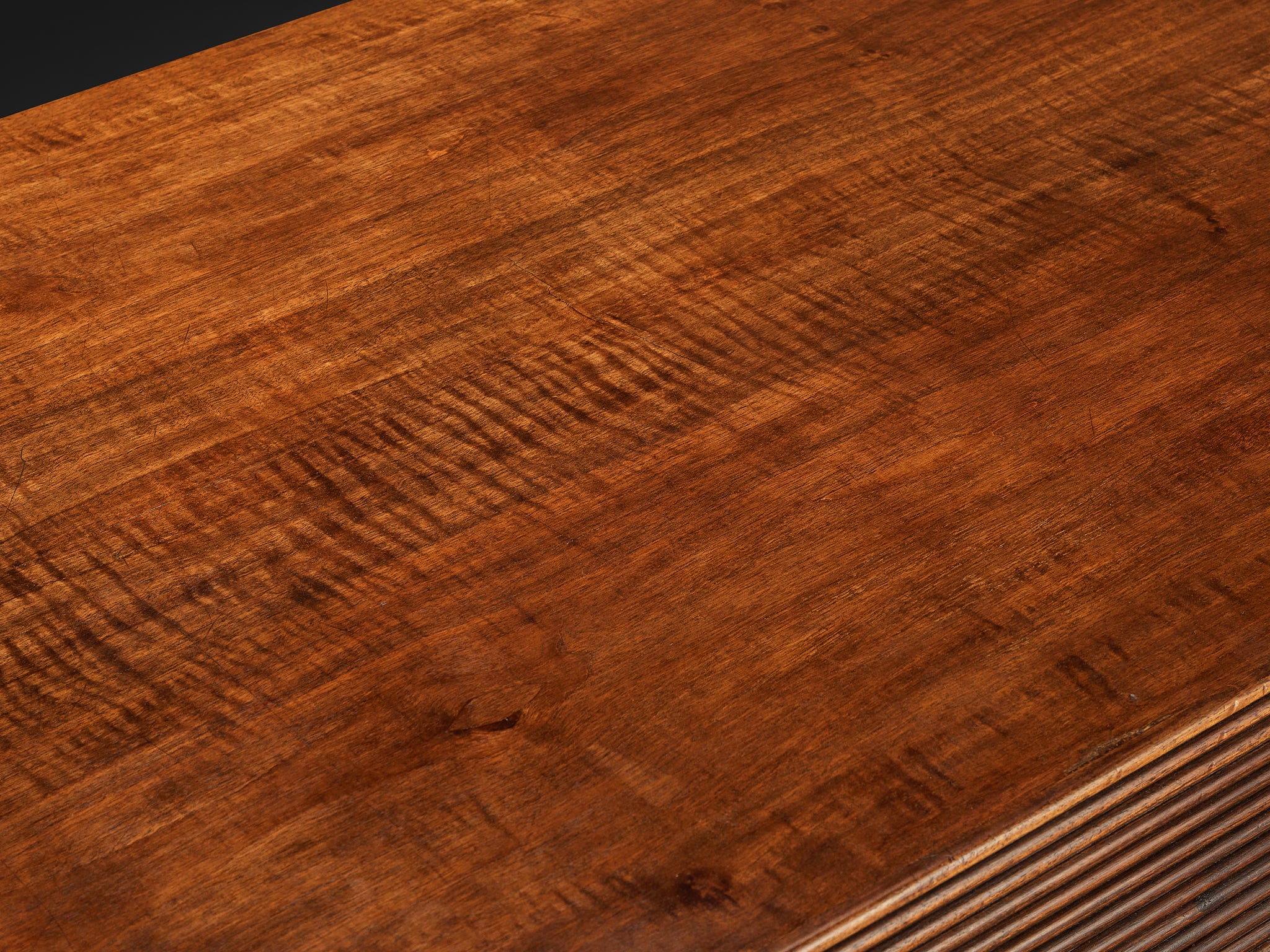
Paolo Buffa for Galdino Maspero Writing Desk in Walnut
Tearsheet
×
Receive a copy in your email or download directly:
I accept emails from Morentz.
 Open here
Paolo Buffa for Galdino Maspero, writing desk, walnut, Italy, late 1930s/early 1940s
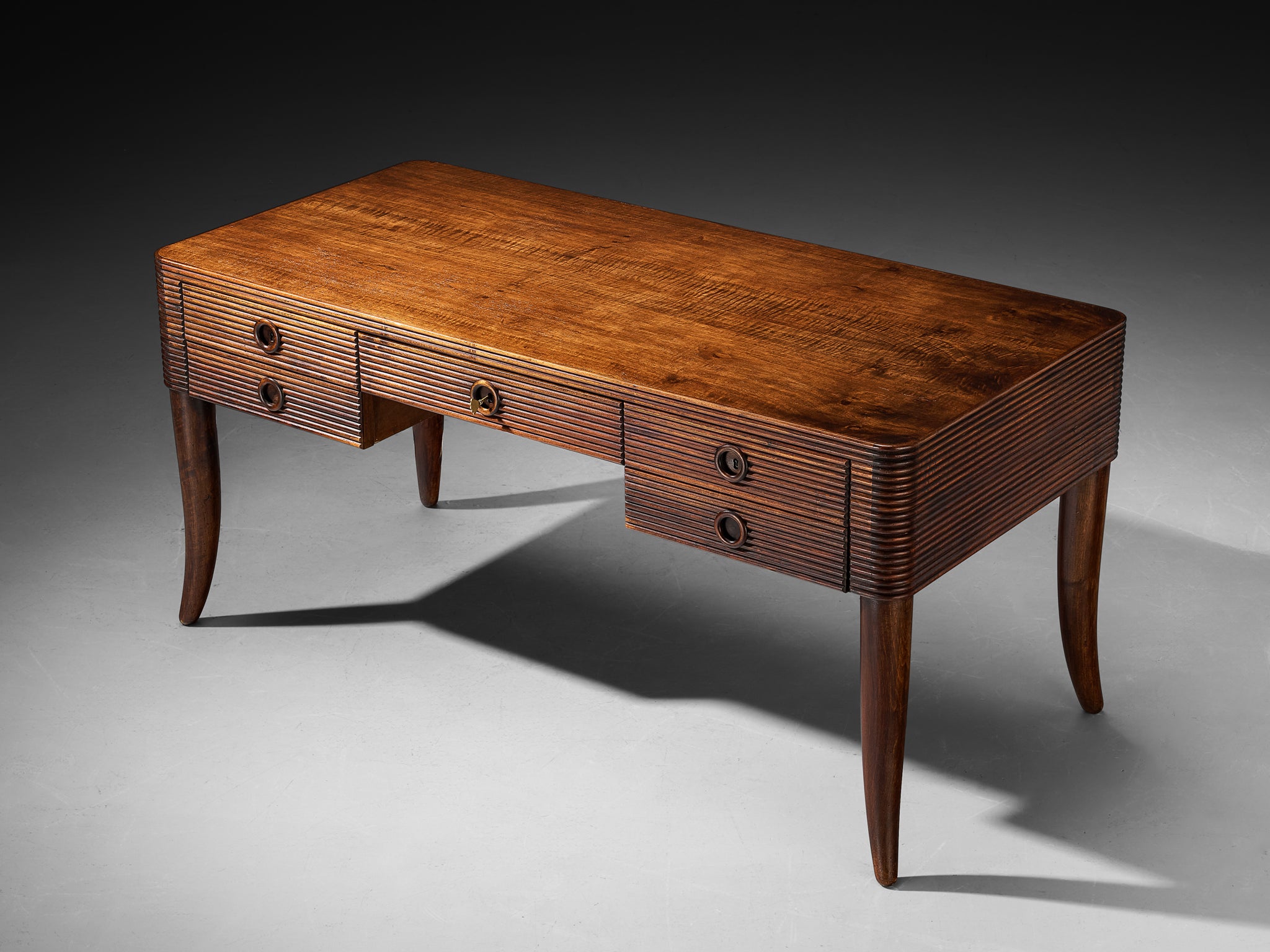
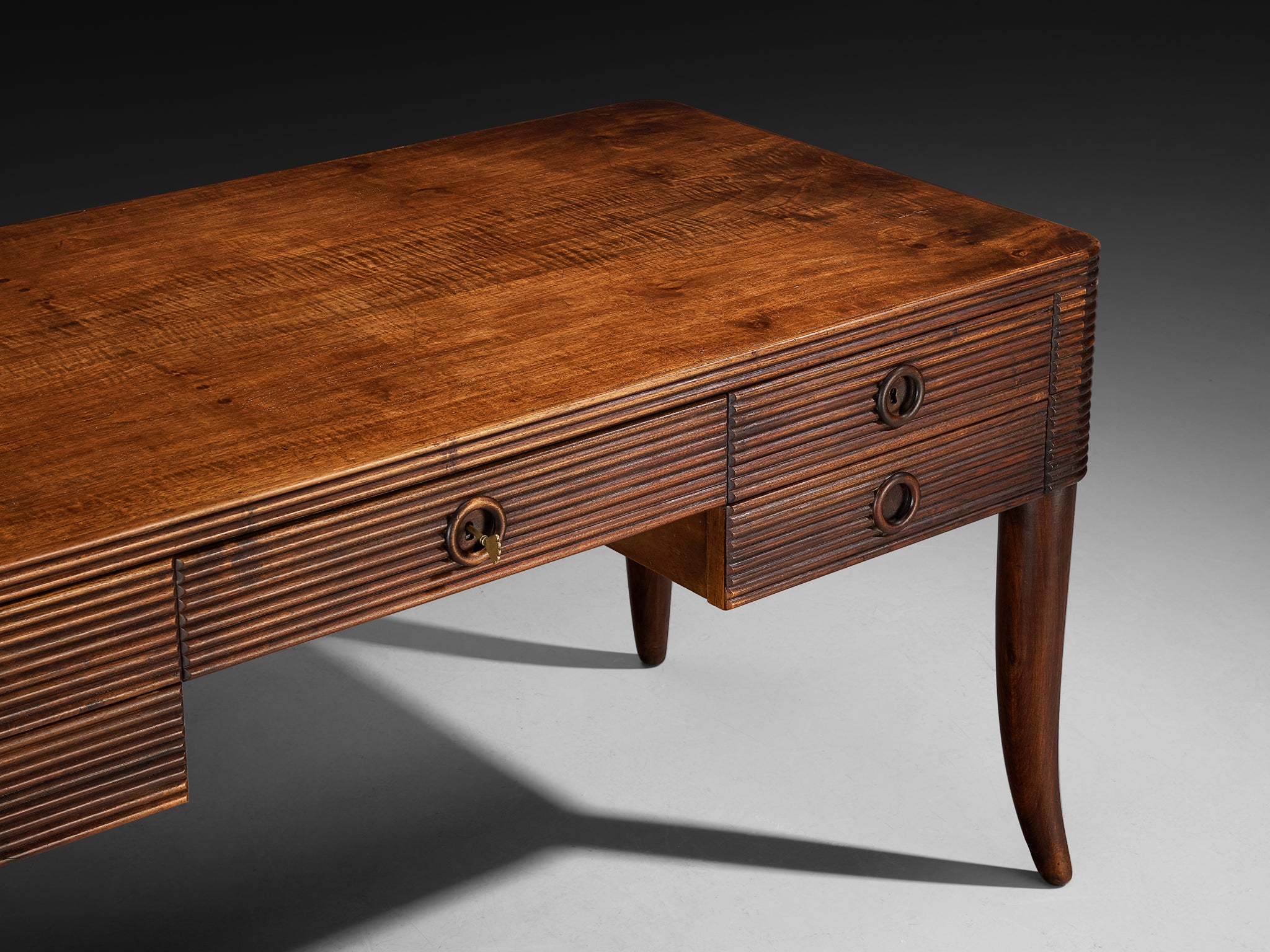
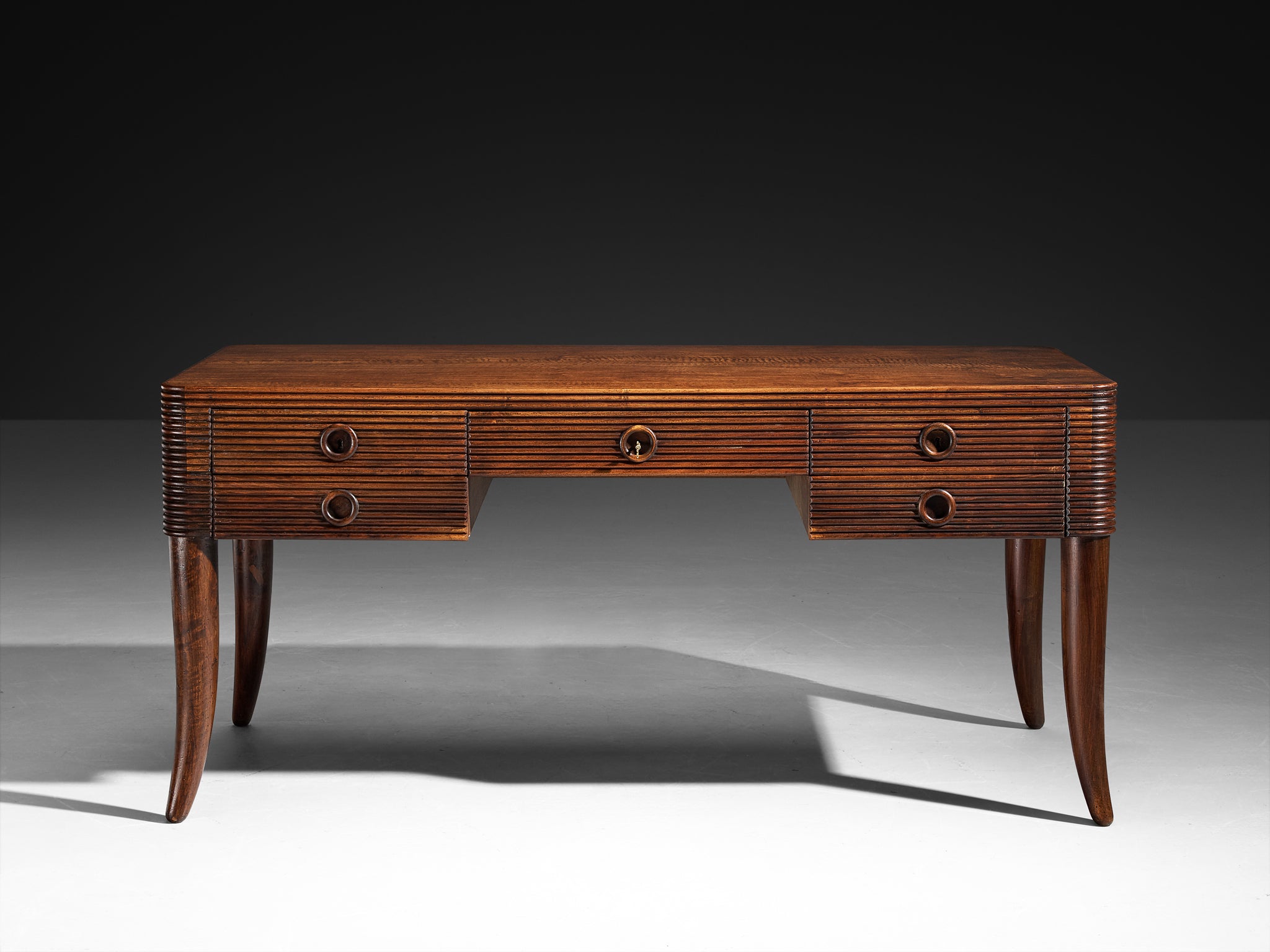
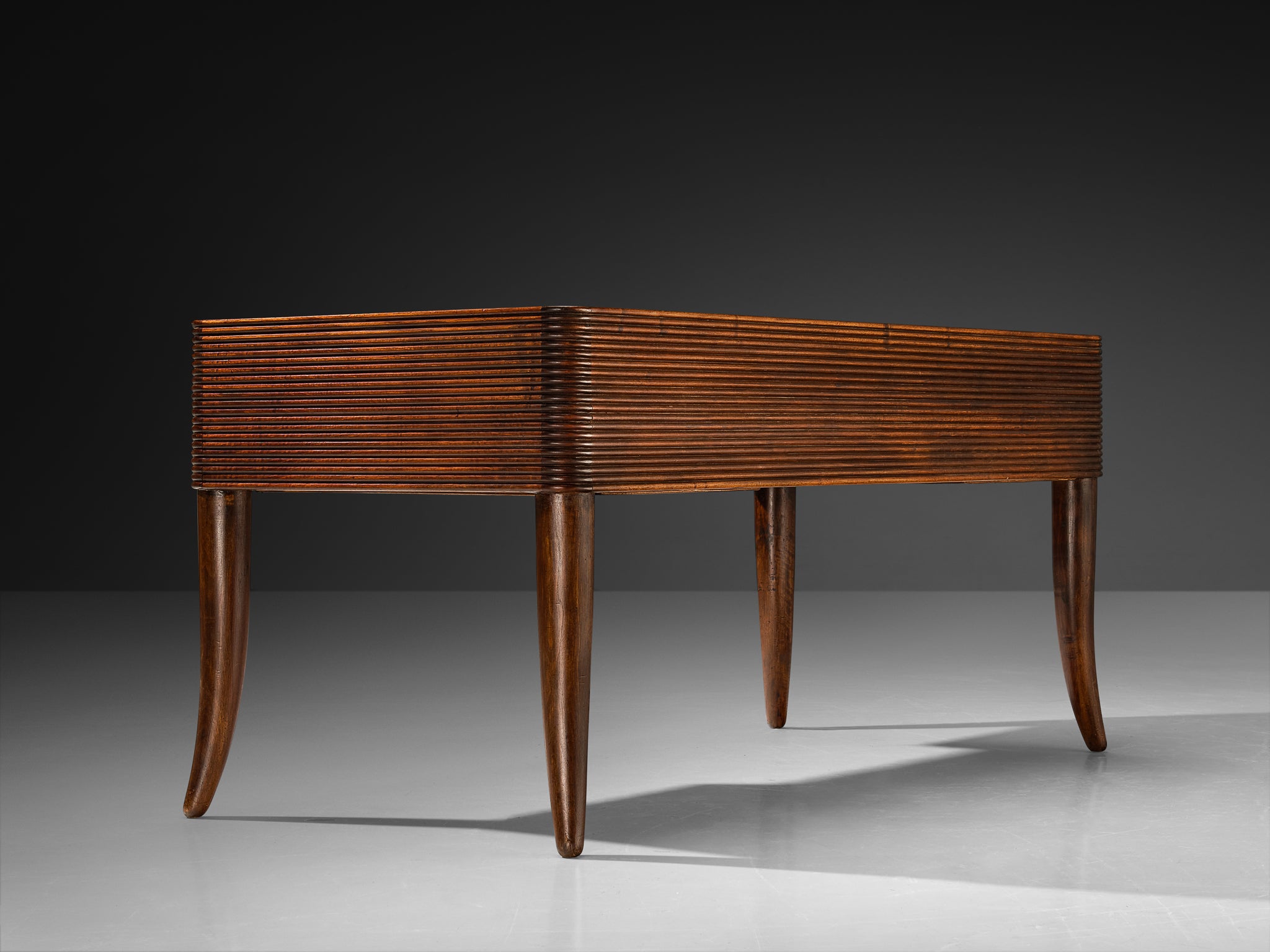
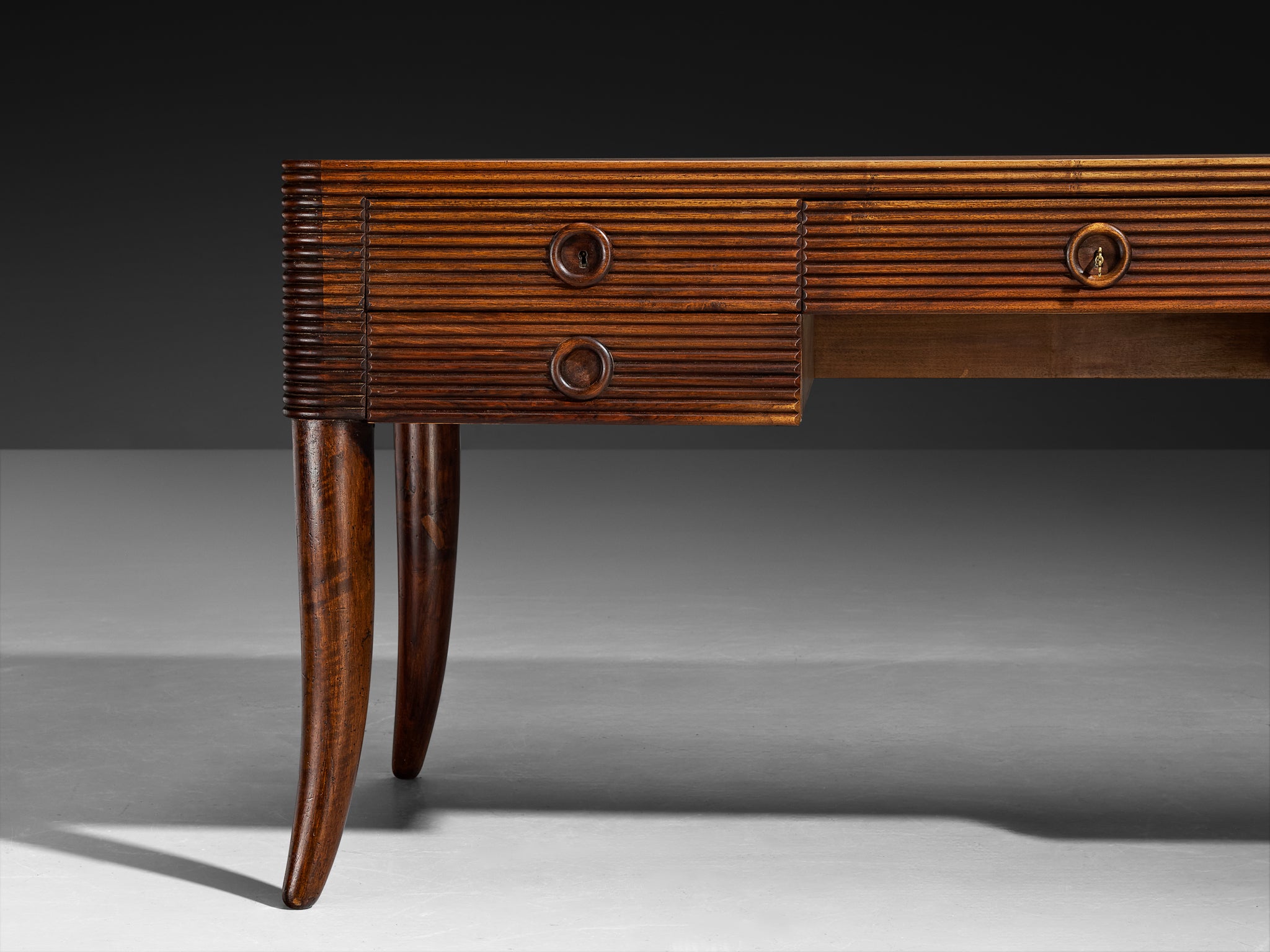
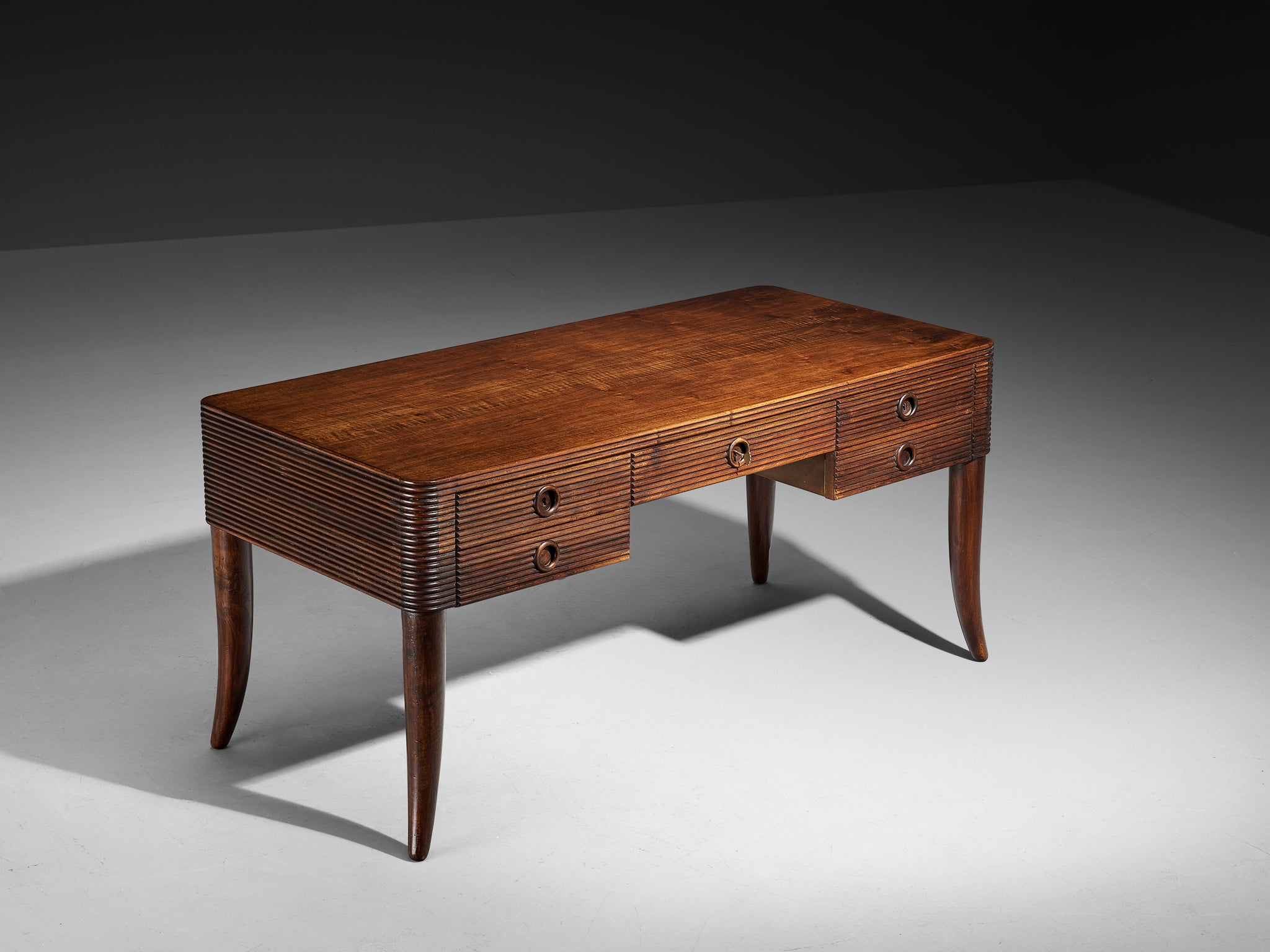
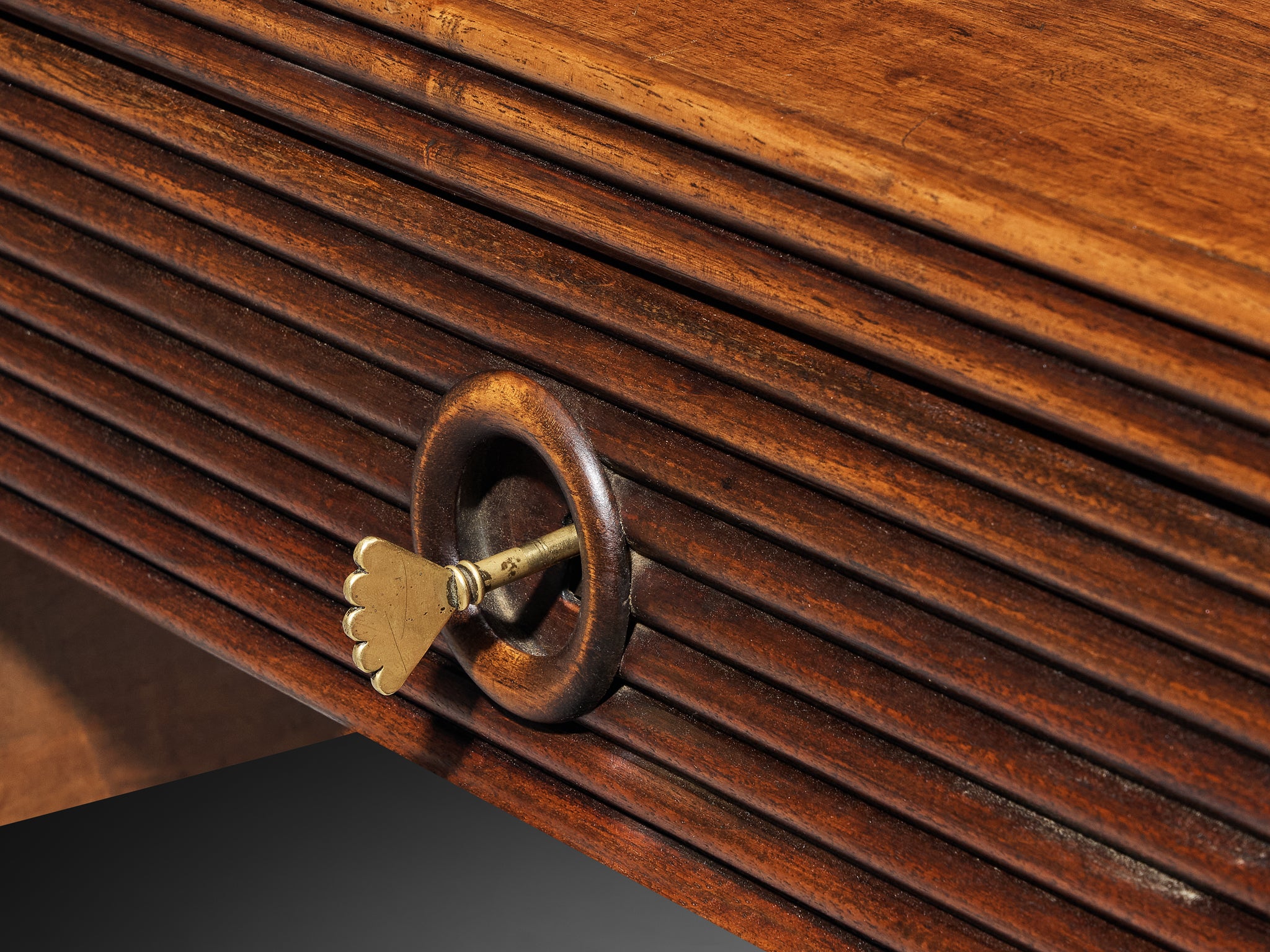
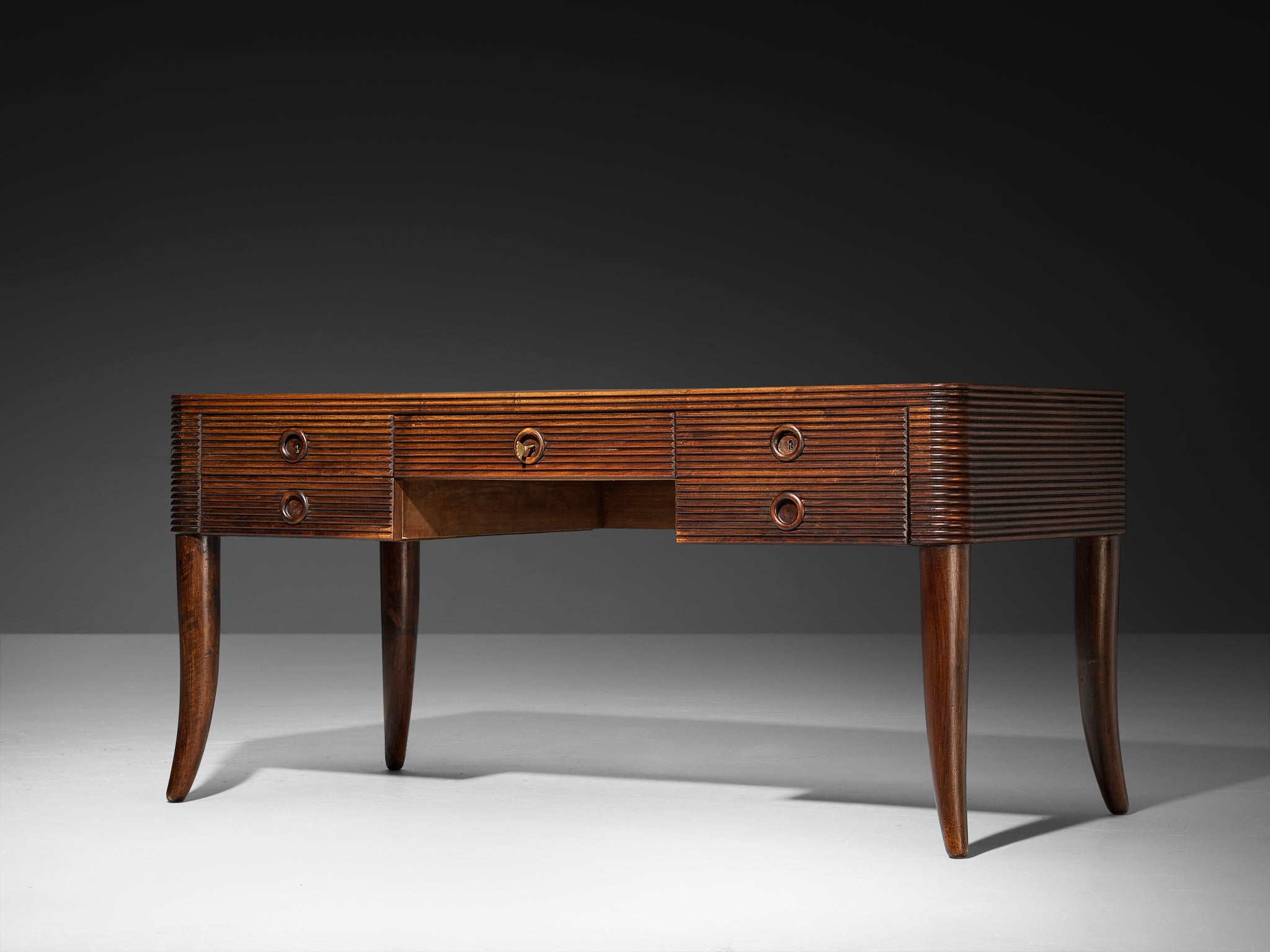
This writing desk, designed by Paolo Buffa and meticulously crafted by Galdino Maspero in the late 1930s or early 1940s, is a powerful example of the designer’s skill to merge rural warmth with modernist clarity. The shape is compact yet stately, defined by a confident horizontality and softened geometry. The rigidness of the rectangular top is softened by rounded corners, resting on four turned, tapering legs that splay just slightly to lend the piece grace. The most visually distinctive feature is the use of grissinato carvings. Parallel ridges run horizontally across the entire facade and wrap around the sides and drawer fronts. Recessed circular keyholes punctuate this texture with quiet precision. They are small, subtle gestures that refuse ornamentation in the traditional sense, yet they act as formal anchors in the otherwise flowing surface. Altogether, the shape of this desk is one of refined restraint, and unmistakably Italian in spirit.
Biography
Paolo Buffa (born 1903, Milan – died 1970, Milan), a distinguished figure in the world of Italian furniture design and architecture, graced the scene with his unmistakable style for a span of almost fifty years. Buffa’s artistic repertoire is notably distinguished by his expert fusion of neoclassical and sleek Art Deco formal elements. Crafted with finesse and elegance, Buffa’s premium-quality pieces were fashioned from refined materials, with the explicit purpose of furnishing the homes of a discerning and affluent clientele. These furniture creations were tailored to meet the demands of individuals who were inclined towards contemporary aesthetics, functionalism, and comfort. Buffa’s creative repertoire extended beyond furniture design to architecture, and he undertook an array of commissions that spanned public buildings, as well as villas and country homes.
Paolo Buffa’s formative years were spent amidst an artistic milieu, having been born to Giovanni Buffa, a renowned draftsman of ex- ceptional talent. Giovanni Buffa shared ownership of a highly pros- perous workshop dedicated to the creation of exquisite stained glass artistry. Among his notable works are the stained glass windows of the illustrious Duomo di Milano, a historic cathedral located in Milan. Such a creative household fostered an environ- ment of artistic excellence, which undoubtedly played a crucial role in shaping Paolo Buffa’s artistic sensibilities.
Buffa’s artistic training commenced at the prestigious Accademia di Belle Arti di Brera, and he eventually obtained his degree from the Politecnico
di Milano in 1927. After gaining experience working in his father’s studio, Buffa went on to work as an apprentice at the Ponti e Lancia studio, which was jointly owned by the celebrated architects Gio Ponti (1891- 1979) and Emilio Lancia (1890-1973). This experience proved to be a significant turning point in Buffa’s career, as he drew inspiration from Lombard Neoclassicism and was exposed to the ideas and concepts of some of the most prominent architects of the region. He assimilated these teachings and employed them in his own work, which was characterized by a fusion of traditional Lombard woodworking techniques and modern design aesthetics.
In 1928, Paolo Buffa founded his own design studio in Milan in partner- ship with architect Antonio Cassi Ramelli (1905-1980). Here, they pro- duced an extensive collection of furniture designs that drew inspiration from the classical revival style, albeit with a softened touch. In 1936, Buffa branched out on his own to establish an independent studio. He made a name for himself by showcasing his work at exhibitions, including the prestigious Triennale di Milano. Buffa’s furnishings were numerous and varied, but always tailored to the specific needs and desires of his discerning clients. Each piece was crafted to perfection by highly skilled artisans, such as cabinetmakers Turri Mosè, Fratelli Lietti, Quarti, Serafino Arrighi, Colico, and Angelo Marelli. Buffa’s passion for design persisted throughout his life, and he remained actively engaged in the field until his death in 1970.
This writing desk, designed by Paolo Buffa and meticulously crafted by Galdino Maspero in the late 1930s or early 1940s, is a powerful example of the designer’s skill to merge rural warmth with modernist clarity. The shape is compact yet stately, defined by a confident horizontality and softened geometry. The rigidness of the rectangular top is softened by rounded corners, resting on four turned, tapering legs that splay just slightly to lend the piece grace. The most visually distinctive feature is the use of grissinato carvings. Parallel ridges run horizontally across the entire facade and wrap around the sides and drawer fronts. Recessed circular keyholes punctuate this texture with quiet precision. They are small, subtle gestures that refuse ornamentation in the traditional sense, yet they act as formal anchors in the otherwise flowing surface. Altogether, the shape of this desk is one of refined restraint, and unmistakably Italian in spirit.
Biography
Paolo Buffa (born 1903, Milan – died 1970, Milan), a distinguished figure in the world of Italian furniture design and architecture, graced the scene with his unmistakable style for a span of almost fifty years. Buffa’s artistic repertoire is notably distinguished by his expert fusion of neoclassical and sleek Art Deco formal elements. Crafted with finesse and elegance, Buffa’s premium-quality pieces were fashioned from refined materials, with the explicit purpose of furnishing the homes of a discerning and affluent clientele. These furniture creations were tailored to meet the demands of individuals who were inclined towards contemporary aesthetics, functionalism, and comfort. Buffa’s creative repertoire extended beyond furniture design to architecture, and he undertook an array of commissions that spanned public buildings, as well as villas and country homes.
Paolo Buffa’s formative years were spent amidst an artistic milieu, having been born to Giovanni Buffa, a renowned draftsman of ex- ceptional talent. Giovanni Buffa shared ownership of a highly pros- perous workshop dedicated to the creation of exquisite stained glass artistry. Among his notable works are the stained glass windows of the illustrious Duomo di Milano, a historic cathedral located in Milan. Such a creative household fostered an environ- ment of artistic excellence, which undoubtedly played a crucial role in shaping Paolo Buffa’s artistic sensibilities.
Buffa’s artistic training commenced at the prestigious Accademia di Belle Arti di Brera, and he eventually obtained his degree from the Politecnico
di Milano in 1927. After gaining experience working in his father’s studio, Buffa went on to work as an apprentice at the Ponti e Lancia studio, which was jointly owned by the celebrated architects Gio Ponti (1891- 1979) and Emilio Lancia (1890-1973). This experience proved to be a significant turning point in Buffa’s career, as he drew inspiration from Lombard Neoclassicism and was exposed to the ideas and concepts of some of the most prominent architects of the region. He assimilated these teachings and employed them in his own work, which was characterized by a fusion of traditional Lombard woodworking techniques and modern design aesthetics.
In 1928, Paolo Buffa founded his own design studio in Milan in partner- ship with architect Antonio Cassi Ramelli (1905-1980). Here, they pro- duced an extensive collection of furniture designs that drew inspiration from the classical revival style, albeit with a softened touch. In 1936, Buffa branched out on his own to establish an independent studio. He made a name for himself by showcasing his work at exhibitions, including the prestigious Triennale di Milano. Buffa’s furnishings were numerous and varied, but always tailored to the specific needs and desires of his discerning clients. Each piece was crafted to perfection by highly skilled artisans, such as cabinetmakers Turri Mosè, Fratelli Lietti, Quarti, Serafino Arrighi, Colico, and Angelo Marelli. Buffa’s passion for design persisted throughout his life, and he remained actively engaged in the field until his death in 1970.

Choose options
Paolo Buffa for Galdino Maspero Writing Desk in Walnut
Sale price$39,500.00
Regular price
Tearsheet
×
Receive a copy in your email or download directly:
I accept emails from Morentz.
Product Details
VAT within the EU: When buying or delivering an item within the EU, VAT usually applies and will be added.