





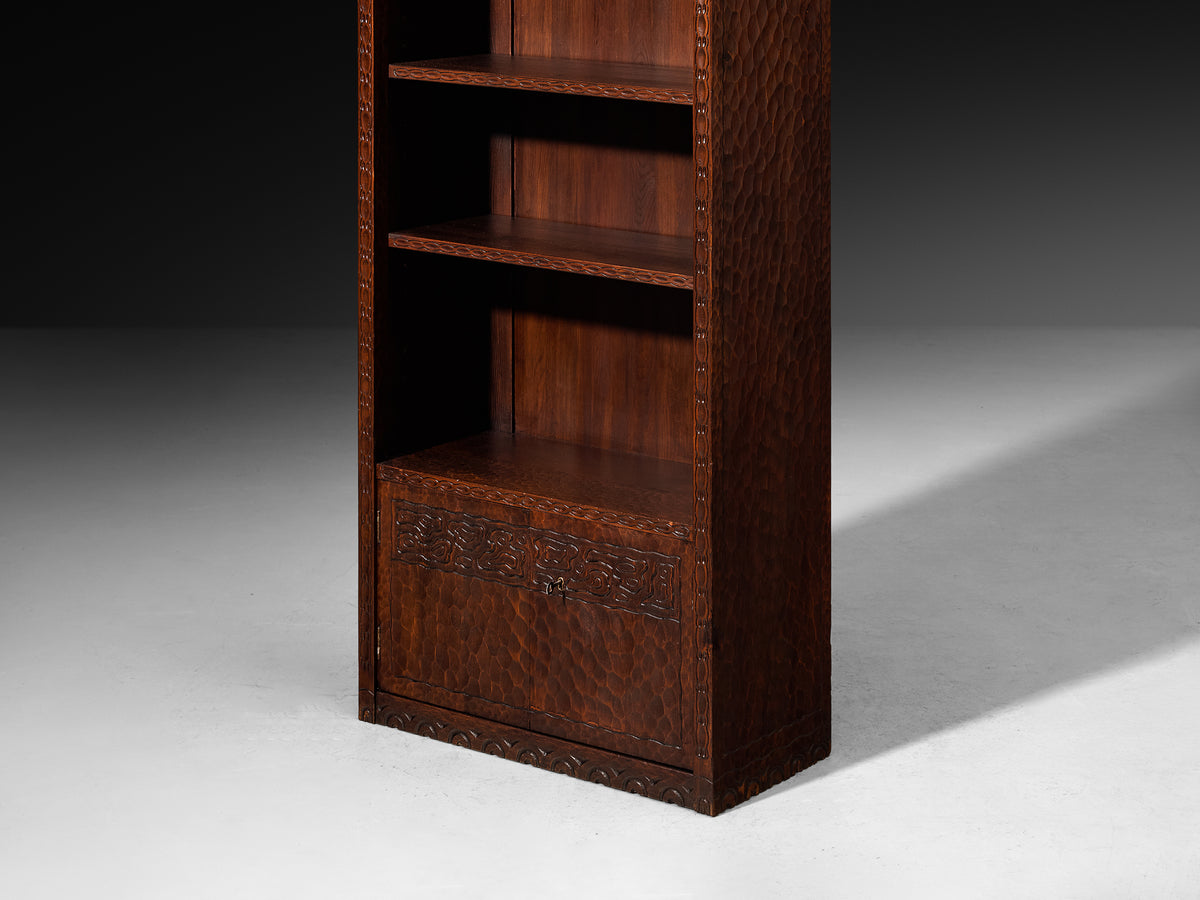


Otto Wretling Bookcase in Carved Pine
 Open here
Otto Wretling for Firma Otto Wretling för Modern Rumskonst, bookcase, carved and stained pine, Sweden, circa 1910
The Piece at a Glance
This exceptionally rare bookcase, dating from circa 1910, represents an early and highly expressive phase of Otto Wretling’s furniture production. Rather than following the sinuous, cosmopolitan Art Nouveau associated with France and Belgium, the cabinet belongs to a distinctly Scandinavian National Romantic tradition. Its form looks back to Scandinavian vernacular traditions and to the medieval and Old Norse past that fascinated National Romantic artists around 1900. Revived in Swedish furniture design around the turn of the twentieth century, such forms suited the National Romantic ambition to create furniture with an unmistakably Nordic identity. The hand-gouged decoration reveals a high level of craftsmanship, while also reflecting the Arts & Crafts ideal of visible handwork. As a bookcase from the formative years of Wretling’s furniture practice, it is a remarkable survivor of this distinctly Scandinavian moment in design.
Carved Surface
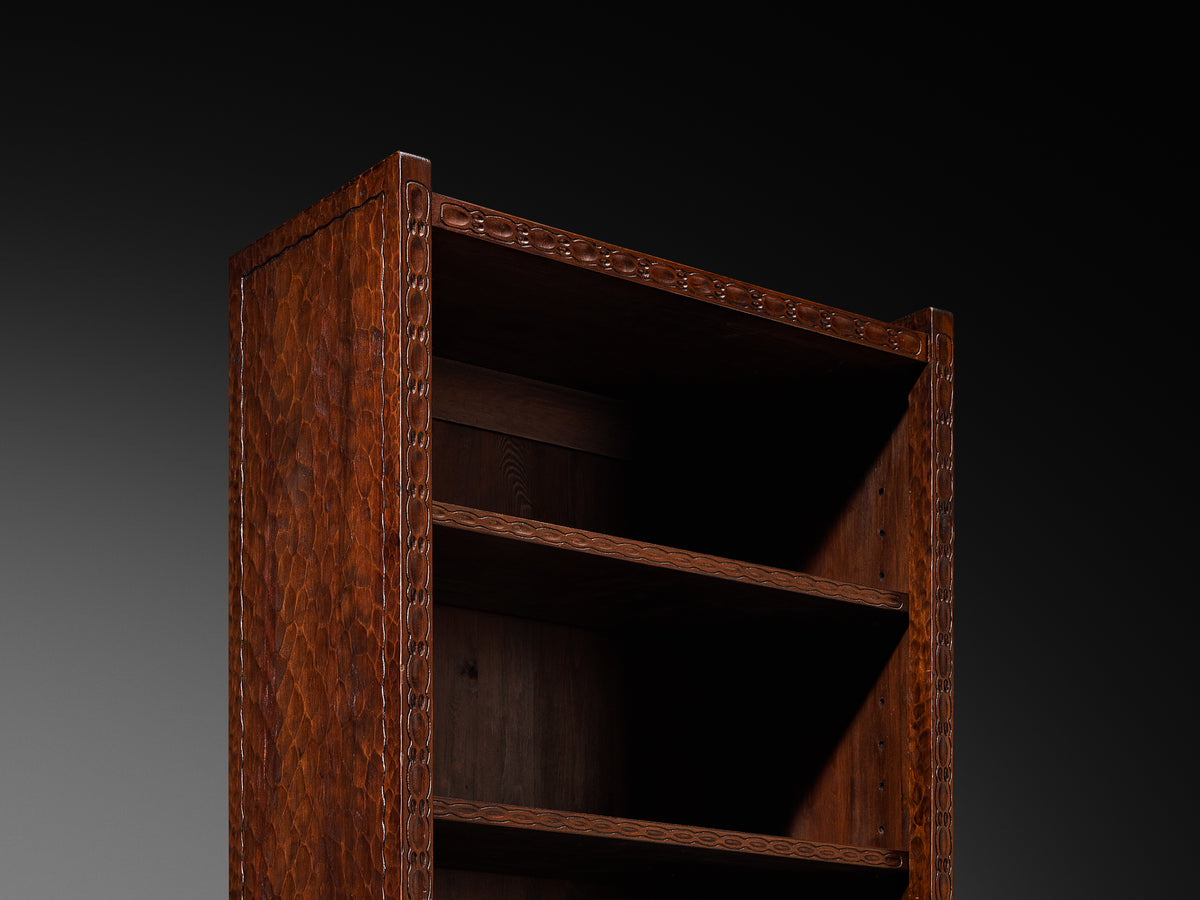
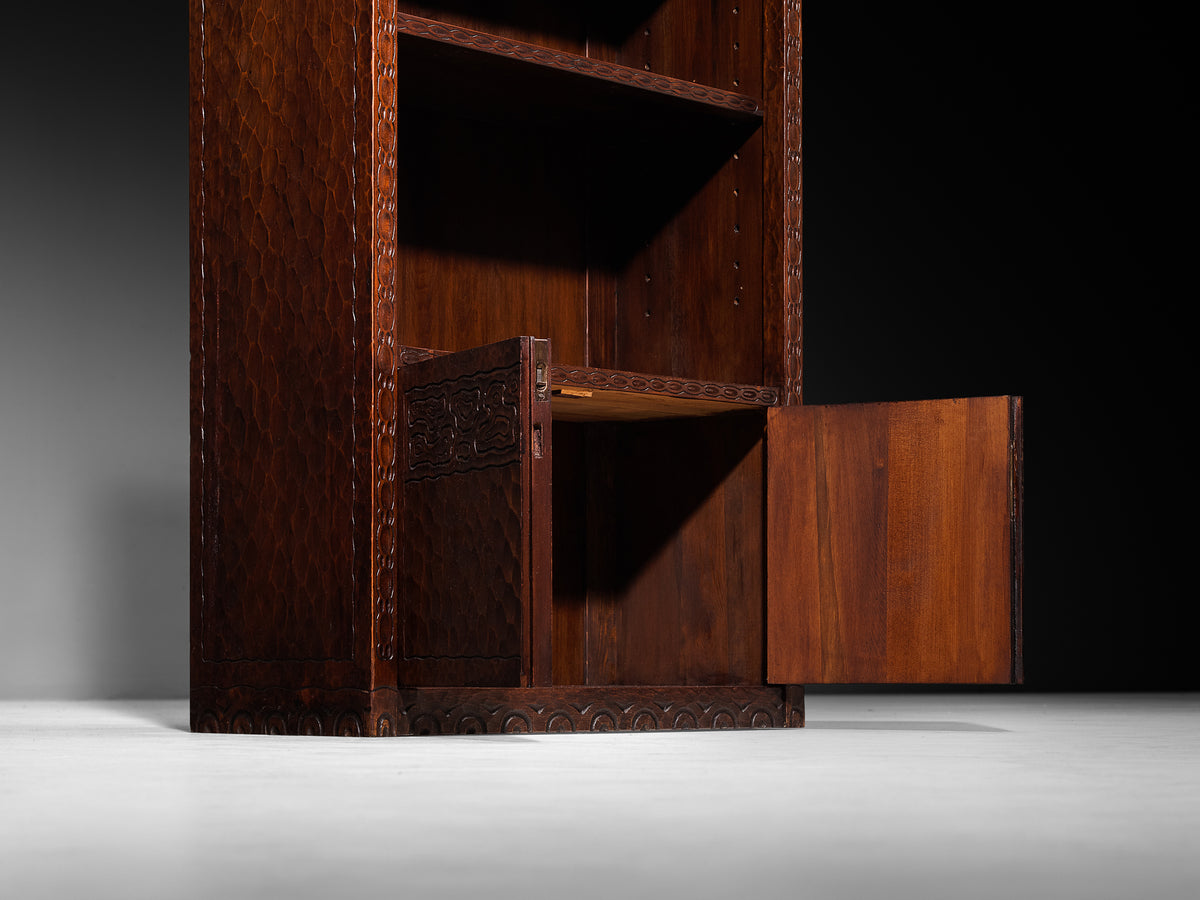
The cabinet is defined by a tall, narrow and rectilinear form, with a simple vertical construction organized into an open shelving section above and a closed storage compartment below. The upper section contains a series of adjustable shelves, allowing the internal arrangement to be altered according to use. Below, a two-door compartment provides enclosed storage and visually anchors the composition.
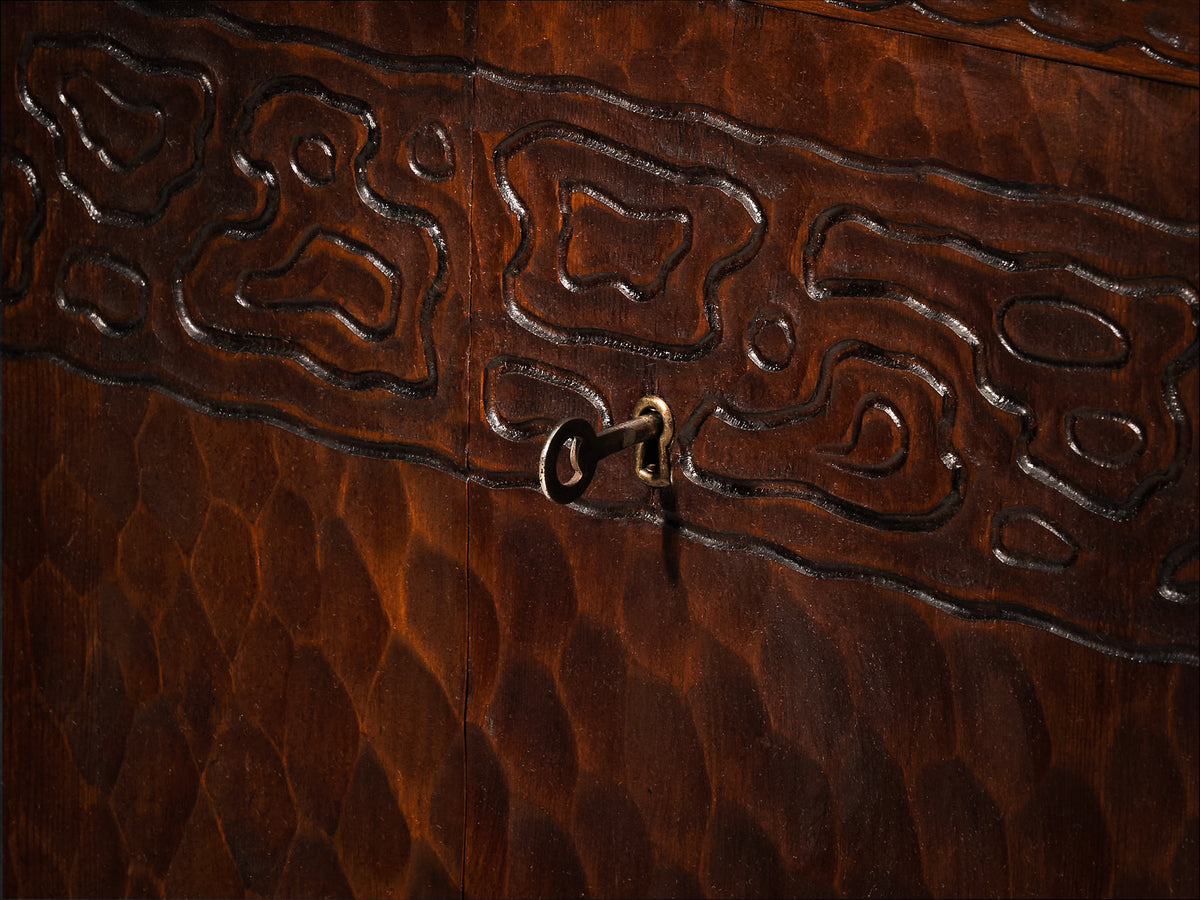
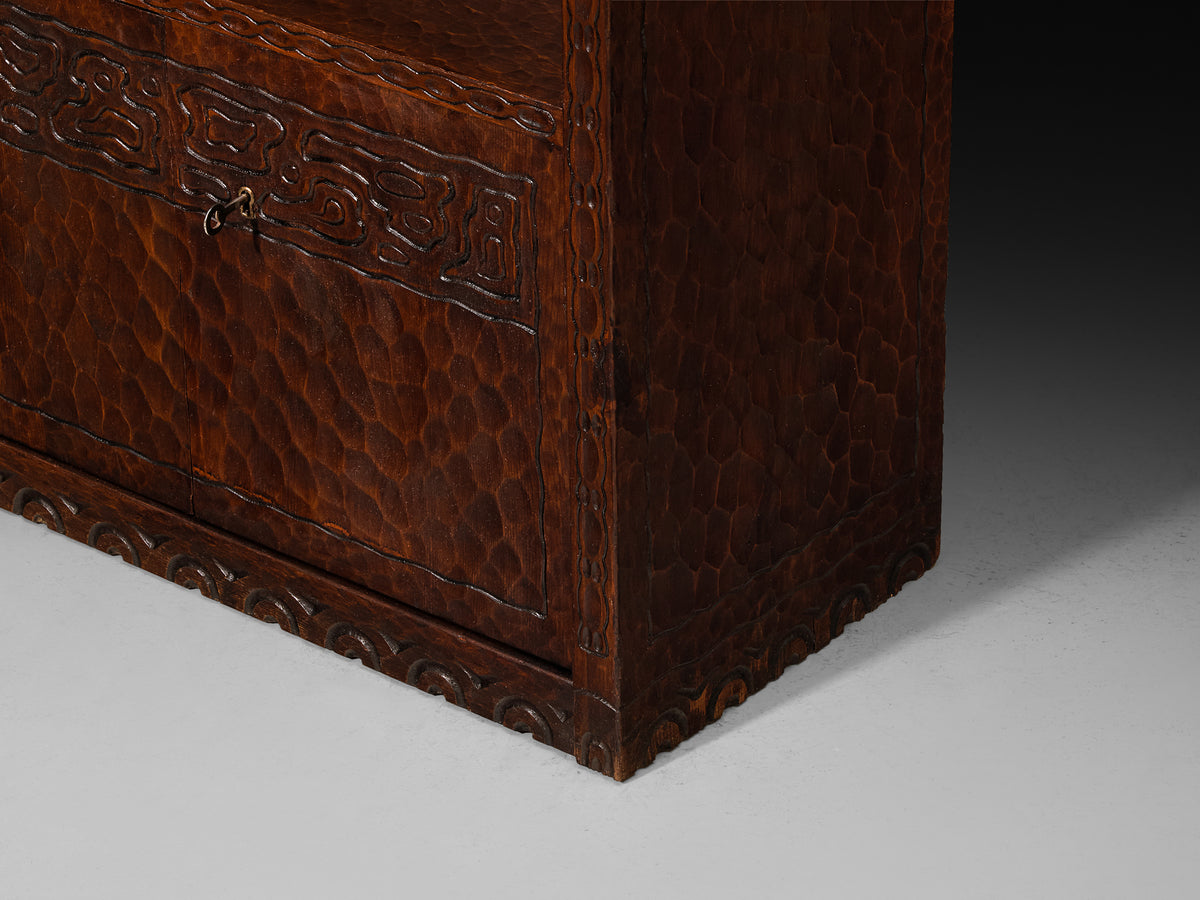
The exterior of the bookcase is complemented by an exceptionally rich treatment of the wooden surface. Rather than being left smooth, it has been extensively worked by hand with gouges, leaving a dense pattern of shallow, faceted cuts across the wood. These visible gouge marks give the surface a strongly tactile quality and allow the dark stain to settle unevenly into the carved areas, accentuating their depth and variation. On the door panels, the freely worked surface is combined with an elaborate band of incised, meandering lines, while the vertical edges are articulated with a repeated series of rounded and oval carved motifs. The lower rim of the base is similarly finished with carved round-contoured decoration. It is believed that Otto Wretling himself crafted these pieces in his atelier, showcasing his remarkable skill as both designer and craftsman. A period photograph of a lounge chair documents this distinctive surface treatment, showing that the combination of gouged texture and incised decoration formed part of Wretling’s original conception.
Craft, Heritage and National Identity
Wretling’s cabinet can be situated within a broader development in Swedish art and design around the turn of the twentieth century, when artists, designers, and architects increasingly looked to vernacular craftsmanship, local materials, and Sweden’s historical traditions in search of a distinctly national expression. This tendency developed alongside the influence of the British Arts & Crafts movement, whose emphasis on handcraft and resistance to industrial uniformity found a particularly strong response in Sweden. This period can be described as one in which craftsmanship and peasant traditions were deliberately revived and combined with new design.
A particularly close parallel can be found in the furniture of Gustaf Fjaestad (1868–1948), a leading figure of the Rackstad artists’ colony in Värmland. Fjaestad had been carving stabbestolar since 1894 and became known for his hand-carved wooden furniture in the National Romantic style, in which Scandinavian vernacular forms were reinterpreted through highly individual craftsmanship. His work also influenced his elder brother, Knut Fjaestad (1860–1937), who began carving furniture around 1907 after seeing a stabbestol Gustaf had made for the collector Ernest Thiel. Knut subsequently developed his own highly sculptural interpretations of the type, including the celebrated Seven Years’ Throne.
The same artistic environment also produced the remarkably rare furniture designs of Gustaf’s wife, Maja Fjaestad (1873–1961). Best known as a painter and textile artist, Maja was one of the pioneering members of the Rackstad colony, yet she also occasionally turned her attention to furniture. For the Baltic Exhibition in Malmö in 1914, she designed a library furniture ensemble for Bröderna Erikssons Möbelverkstad in Taserud. The oak armchairs, richly carved with stylized vegetal decoration, demonstrate how nature, craftsmanship and furniture design converged within the Swedish Jugend and National Romantic tradition.
Seen together, the furniture of Gustaf, Knut and Maja Fjaestad illustrates a wider Swedish design culture in which vernacular traditions, natural forms and intensive hand craftsmanship provided an alternative to industrial production. Wretling’s bookcase belongs convincingly within this same artistic climate.
Biography
In the early 20th century, located in the northern Swedish city of Umeå, a unique artistic enterprise emerged that blended craftsmanship, family tradition, and modern design sensibilities. Known as Firma Otto Wretling för Modern Rumskonst (Otto Wretling Company for Modern Interior Art), this workshop grew from modest roots into a vibrant creative hub. The story begins with Otto Wilhelm Wretling (b. 1845), who originally registered a painting business in 1877. What started as a traditional painters' firm would, by the turn of the century, evolve into a multifaceted workshop that combined painting, furniture making, textile arts, and design – what could be called a Gesamtkunstwerk in workshop form.
The transition into furniture-making began in 1905, when the company expanded its focus, embracing interior art in a broader sense. After a decade of joint leadership between Otto's sons Vilhelm and Otto (the younger), the latter – Otto Wretling (1876–1971) – assumed full control in 1915. His tenure marked a turning point: under his guidance, the company grew into a family-centered artistic collective, drawing in his wife Frida, their children, and later even grandchildren. One descendant would later describe it as a "collaborative creative collective," a phrase that captures both the spirit and structure of the enterprise. The Wretling firm operated in the spirit of the old guild system, long after its formal dissolution in Sweden. Although Otto Wretling the younger began his training in 1889, well after the guilds had lost legal authority, the ethos remained: skills were handed down generationally, and children often apprenticed under their parents. This gave the workshop a continuity of knowledge and style, while also allowing space for individual artistic growth.
Frida Wretling, Otto's wife, managed the weaving workshop, where custom upholstery fabrics and rugs were crafted, ensuring that textiles and furniture were designed in harmony. Their son David, who had studied under the renowned sculptor Carl Milles, brought fine art sensibility into the workshop’s output, embellishing furniture and also pursuing a career as a sculptor. Other children contributed in diverse ways: Prior to his career as an architect, and eventual appointment as Umeå’s city architect, Kjell Wretling contributed furniture designs to the family firm; Stig was a painter and decorative artist, embellishing and decorating furniture; Anna focused on textile design; Britta oversaw the company’s sales and exhibition space; and Bo, perhaps the most dedicated to the family business, eventually took over its operations.
The stylistic evolution of the firm’s furniture mirrored larger design trends of the time. Early pieces drew inspiration from folk art, followed by the floral and flowing forms of Art Nouveau in the 1910s. In the 1920s, the firm shifted toward a more classical aesthetic, often incorporating elaborate marquetry of high artistic merit. By the 1930s, as functionalism gained traction in Swedish design, Otto Wretling’s workshop responded with modernist innovations of their own – including the so-called "Ideal Table," patented in 1936.
Beyond his contributions to furniture and interior art, Otto Wretling was also a painter, with several ceiling paintings still extant in Umeå’s public and private buildings. His home served as a salon of sorts – a meeting place for artists and cultural figures – cementing his status not only as a craftsman, but as a local cultural patron.
What makes the Otto Wretling firm particularly compelling is how it combined artistry and domesticity, professionalism and intimacy. It was a place where the boundaries between work, art, and family blurred, producing a legacy that helped shape Umeå’s cultural identity well into the mid-20th century.

Choose options
Otto Wretling Bookcase in Carved Pine
Sale price$33,000.00
Regular price
Product Details
VAT within the EU: When buying or delivering an item within the EU, VAT usually applies and will be added.