


Hans Wegner for Carl Hansen & Søn 'Sawbuck' Dining Chair in Teak
 Open here
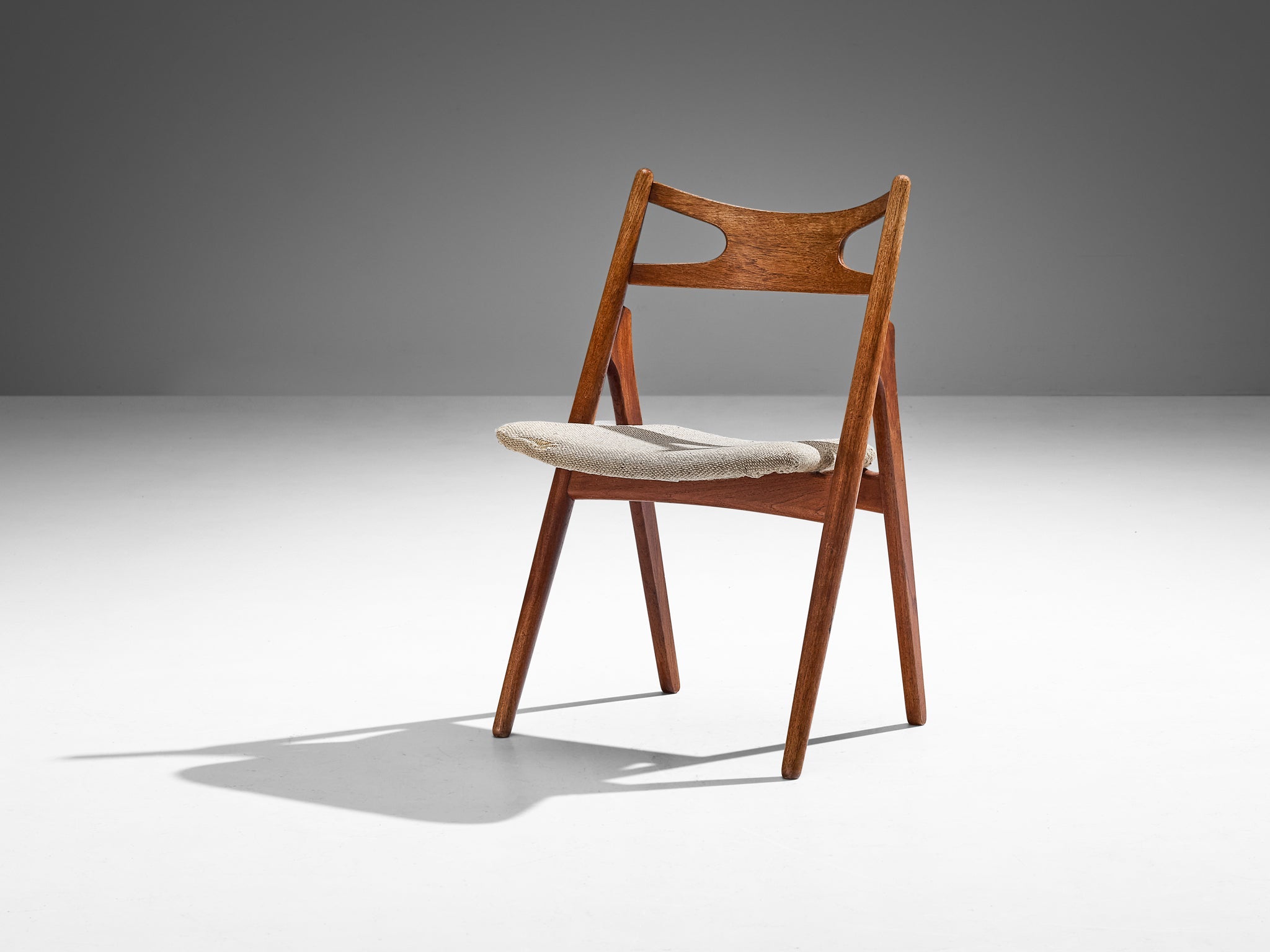
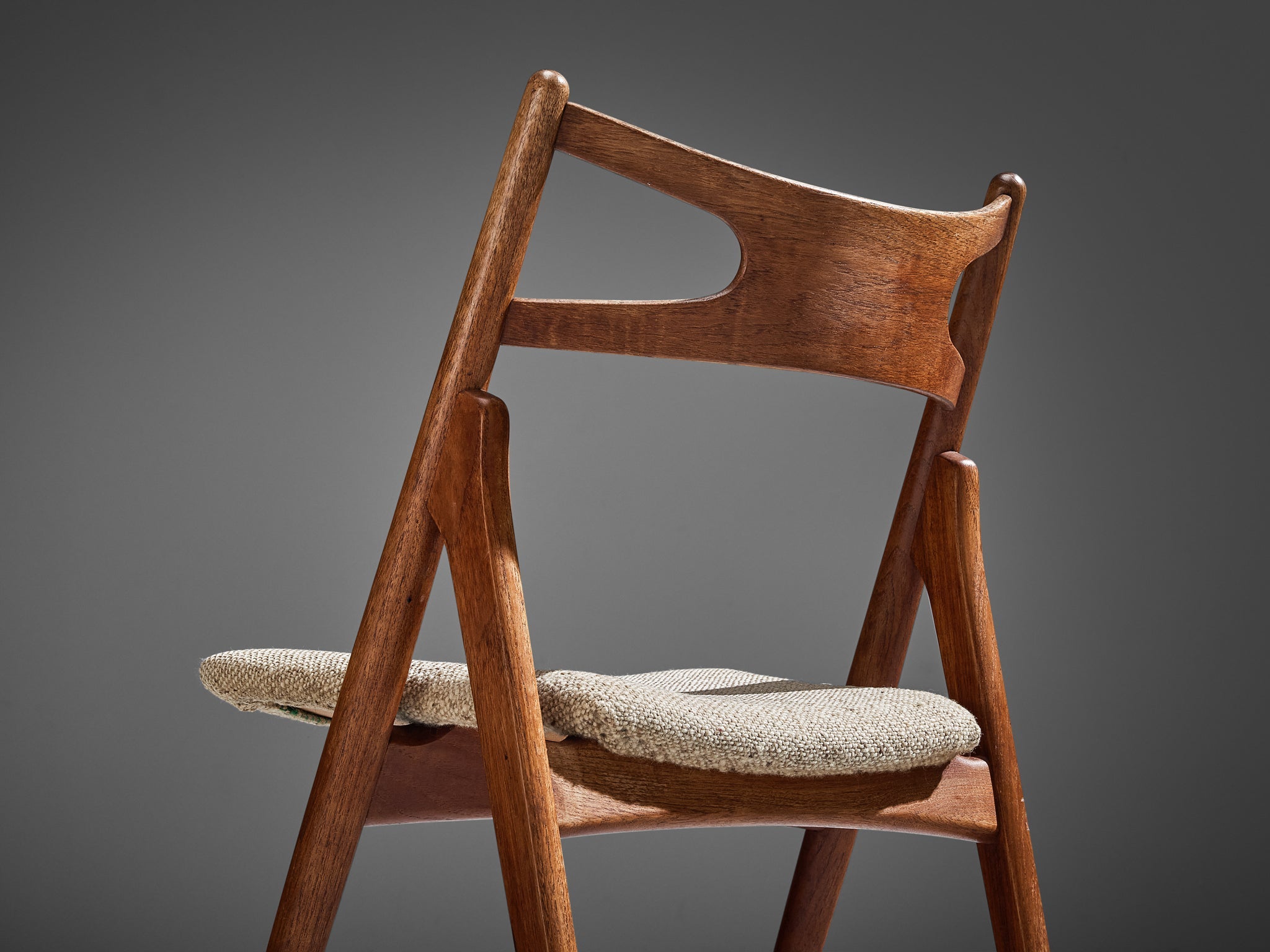
Hans J. Wegner for Carl Hansen & Søn, 'Sawbuck' dining chair, model CH29, teak, beige fabric, Denmark, design 1952
Hans Wegner's chair exemplifies a solid construction, despite its minimalistic appearance. The chair's distinct feature is its concave carvings on the backrest, while its slightly slanted position enhances comfort. The chair is akin to folding chairs, except that it remains fixed in an open position. The A-shaped frame visible from the side is named after the sawbucks or sawhorses in Wegner's workshop, which intrigued many cabinetmakers. The design's strength lies in its simplicity, requiring only a few parts and minimal materials.
Hans Wegner (1914-2007) is one of the most prolific furniture designers of the world. Wegner was born in 1914 in Denmark and began his apprenticeship with Danish master cabinetmaker H.F. Stahlberg when he was fourteen years old. Afterwards, he moved to Copenhagen and attended the School of Arts and Crafts between 1936 and 1938. In 1938, he was approached by the architects and designers Arne Jacobsen and Erik Møller. It was also during this period that he started to collaborate with cabinetmaker Johannes Hansen. In 1943, he established his own studio, and he became one of the most renowned and creative Danish furniture designers. Wegner's furniture was designed with the greatest understanding of materials, construction techniques, and use. Wegner is known to have thorough understanding of the materials he worked with, yet his greatest aim was to create expressive and exciting design. Although Wegner was a functionalist, he was not a rational dogmatist such as Kaare Klint, of whom he was a student. Instead, his designs sparkle with inventiveness and sculptural sense. But this never meant that his organic and sensuous forms left the strict rules of functionalism. At heart, Wegner was an idealist. He was relentless in his quest for the best chair: 'there is never one damn thing that cannot be made better'. However, Wegner was aware that he could not create the 'perfect' chair, which gave him the freedom to produce as much as possible. He left behind more than 3500 drawings and about 500 of his designs went into production. His designs feature in the UN Building and Seagram Building in New York, UNESCO's headquarters. NATO's headquarters in Paris, and several buildings by the architects Skidmore, Owings & Merrill.
Please note that the fabric contains tears. Reupholstery is possible before shipping by our experienced craftspeople in our own in-house restoration atelier. With high attention for the original, they make sure every piece retains its value and is ready for the many years to come. We kindly ask you to contact our design experts for further information about the endless possibilities our restoration and upholstery atelier has to offer. Of course, a locally organized reupholstery is possible as well.
VAT within the EU: When buying or delivering an item within the EU, VAT usually applies and will be added.

Choose options
Product Details

From an apprenticeship in Tønder to 'The Chair'
Born in the southern Danish town of Tønder, the son of a shoemaker, Wegner began training as a cabinetmaker at fourteen and had completed four years under master H.F. Stahlberg by the time he turned eighteen. He moved to Copenhagen to study at the School of Arts and Crafts from 1936 to 1938, then joined architects Arne Jacobsen and Erik Møller in Aarhus to design furniture for the new Aarhus City Hall — his first serious commission.
It was in this period that master joiner Johannes Hansen began following Wegner's progress; their collaboration, formalised through the 1940s, produced showpieces built for Copenhagen's Cabinetmakers' Guild exhibitions, among them the Round Chair of 1949, developed from Wegner's studies of Ming dynasty portrait chairs. In 1950, a separate partnership with Carl Hansen & Søn brought the related Wishbone Chair (CH24) into continuous production, a chair still made to Wegner's original drawings today.
VAT within the EU: When buying or delivering an item within the EU, VAT usually applies and will be added.