


Franco Albini and Franca Helg for Poggi 'TL30' Round Table in Walnut and Black Steel
 Open here
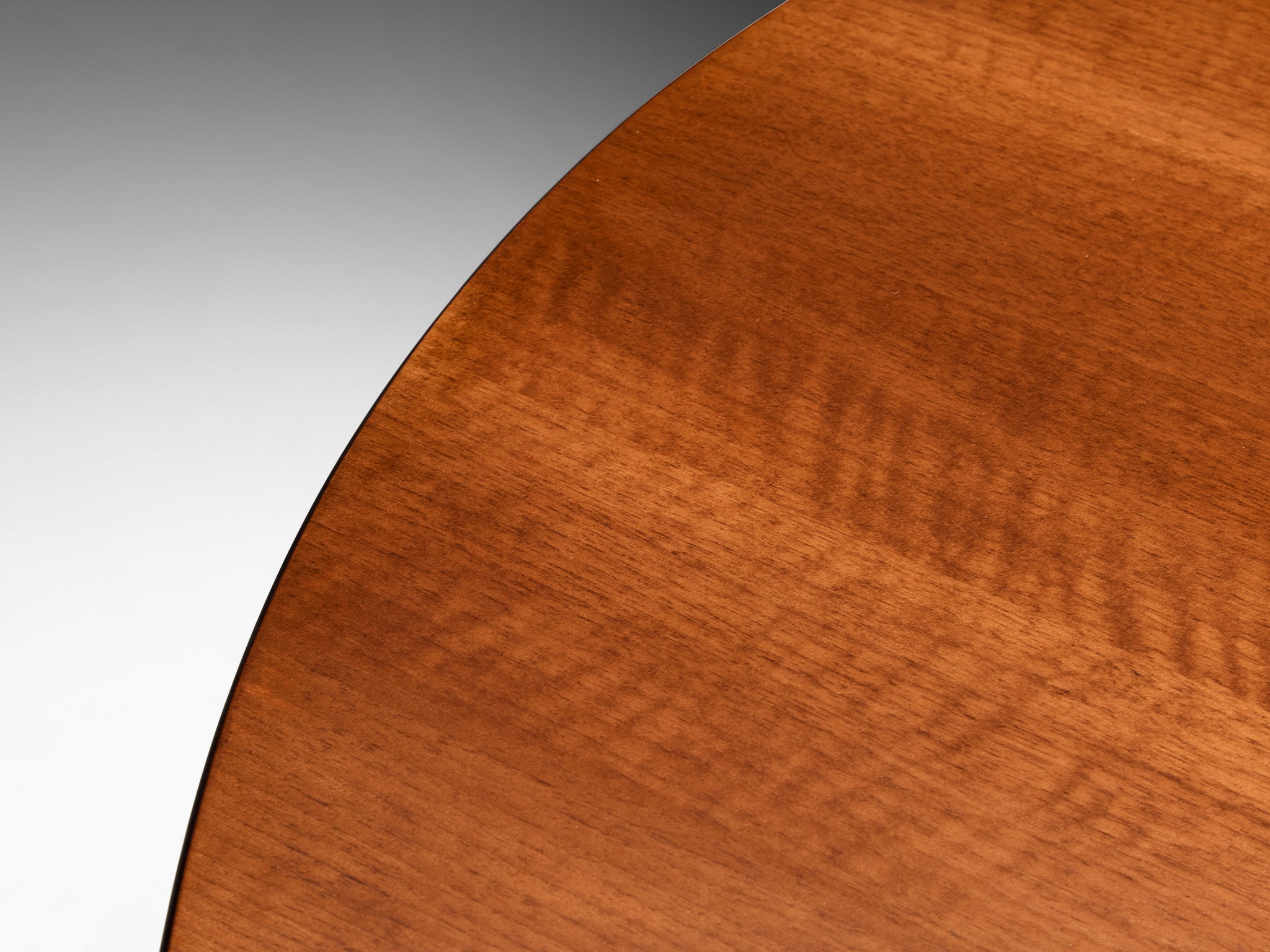
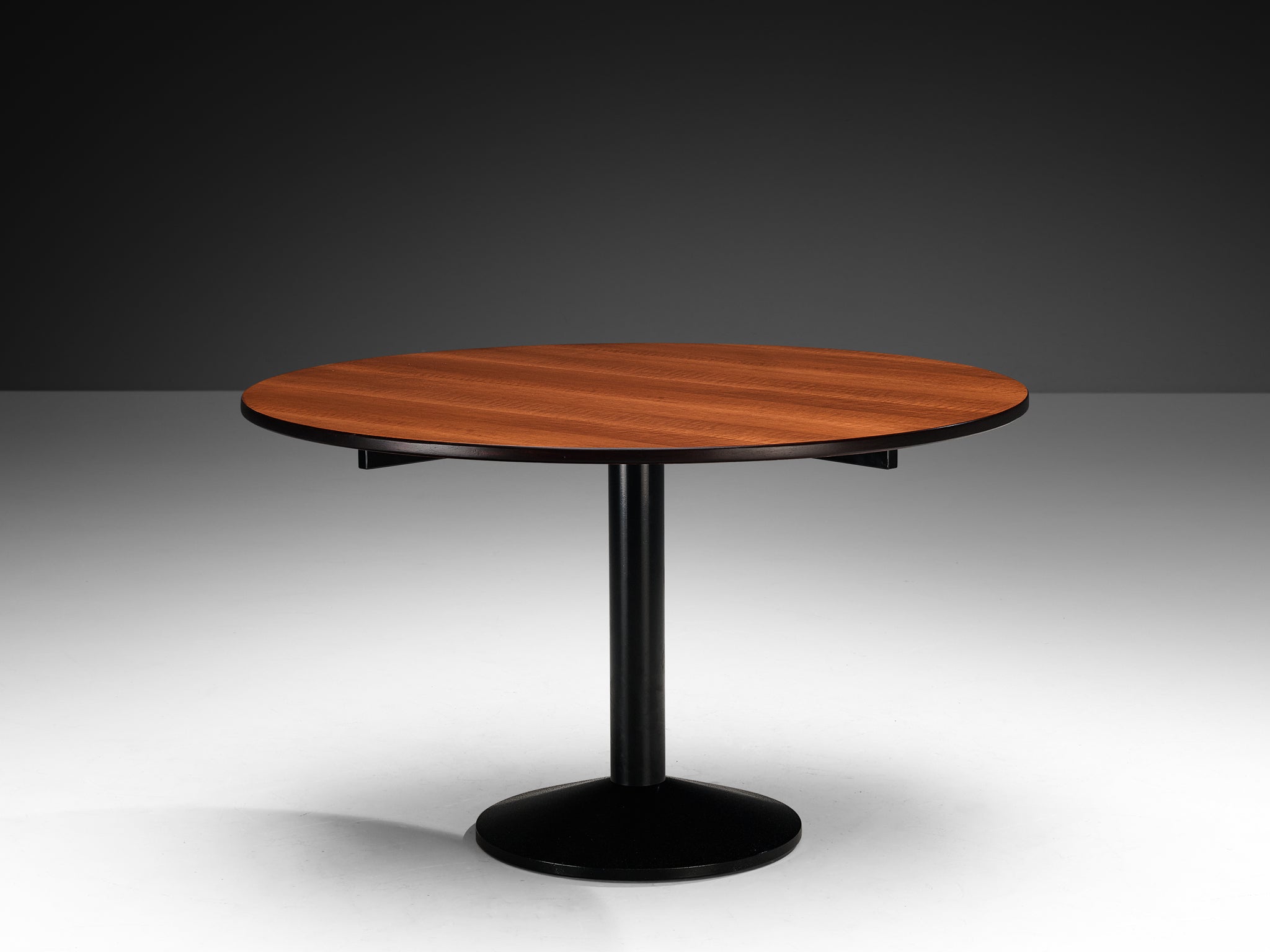
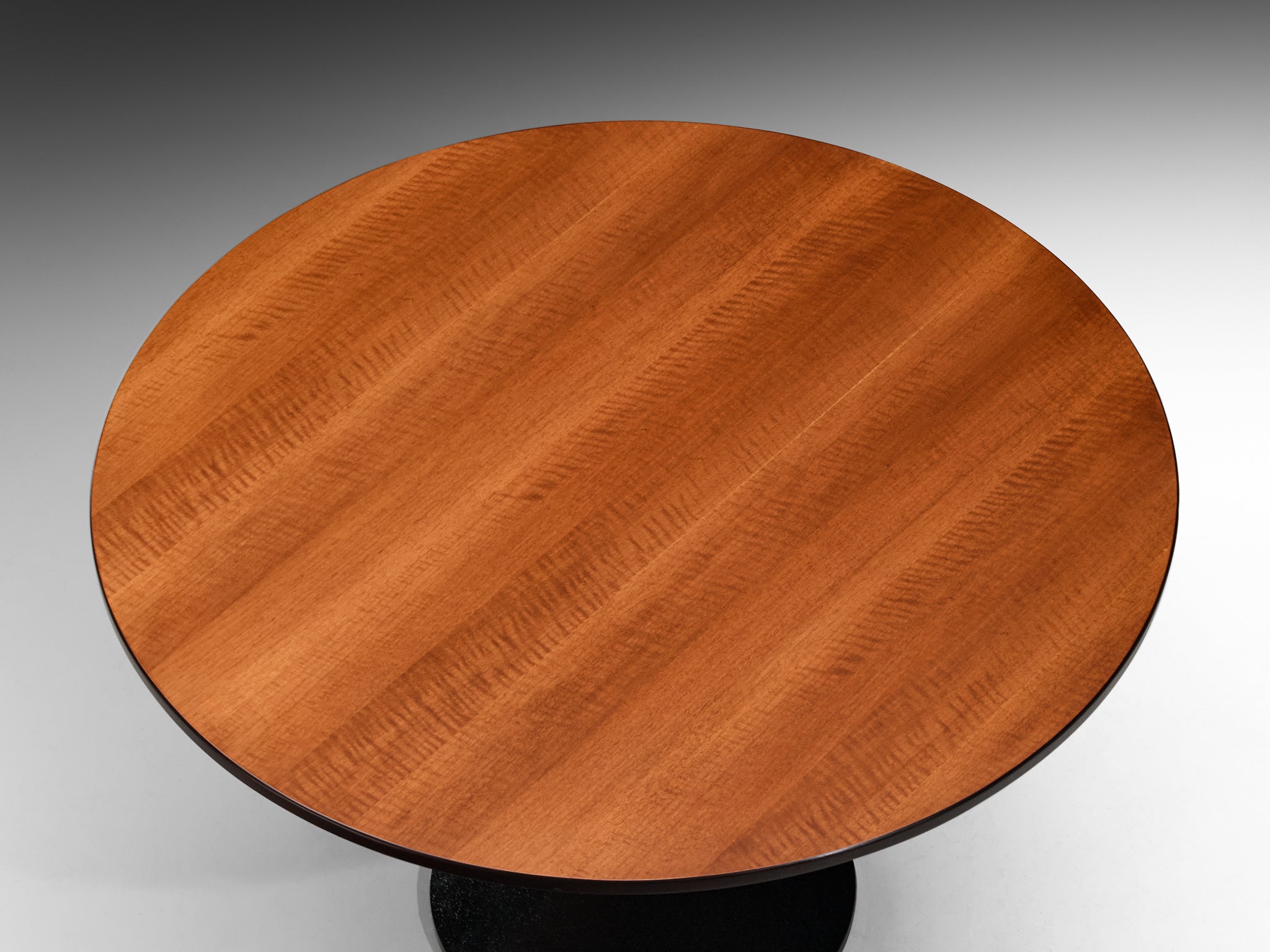
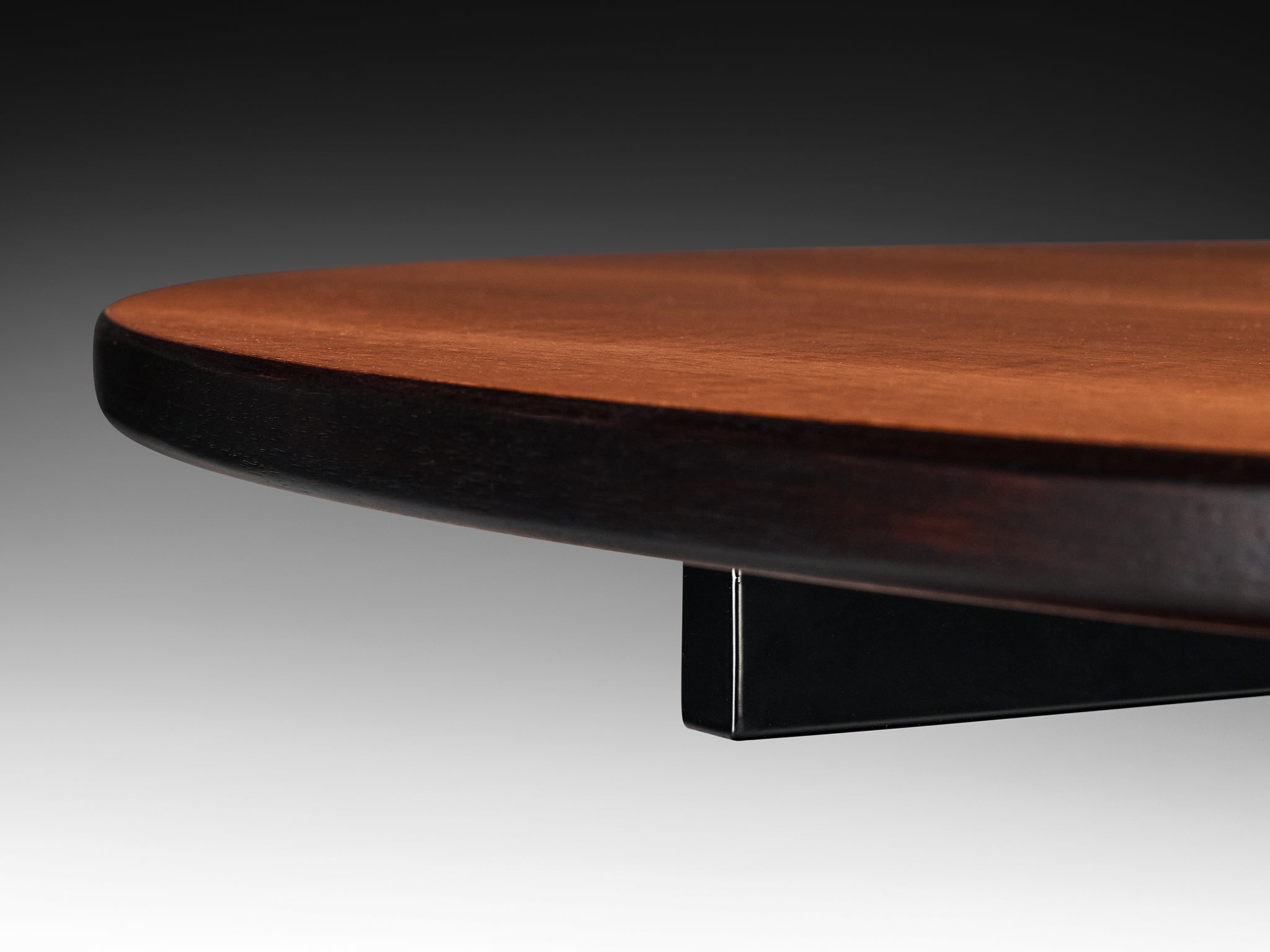
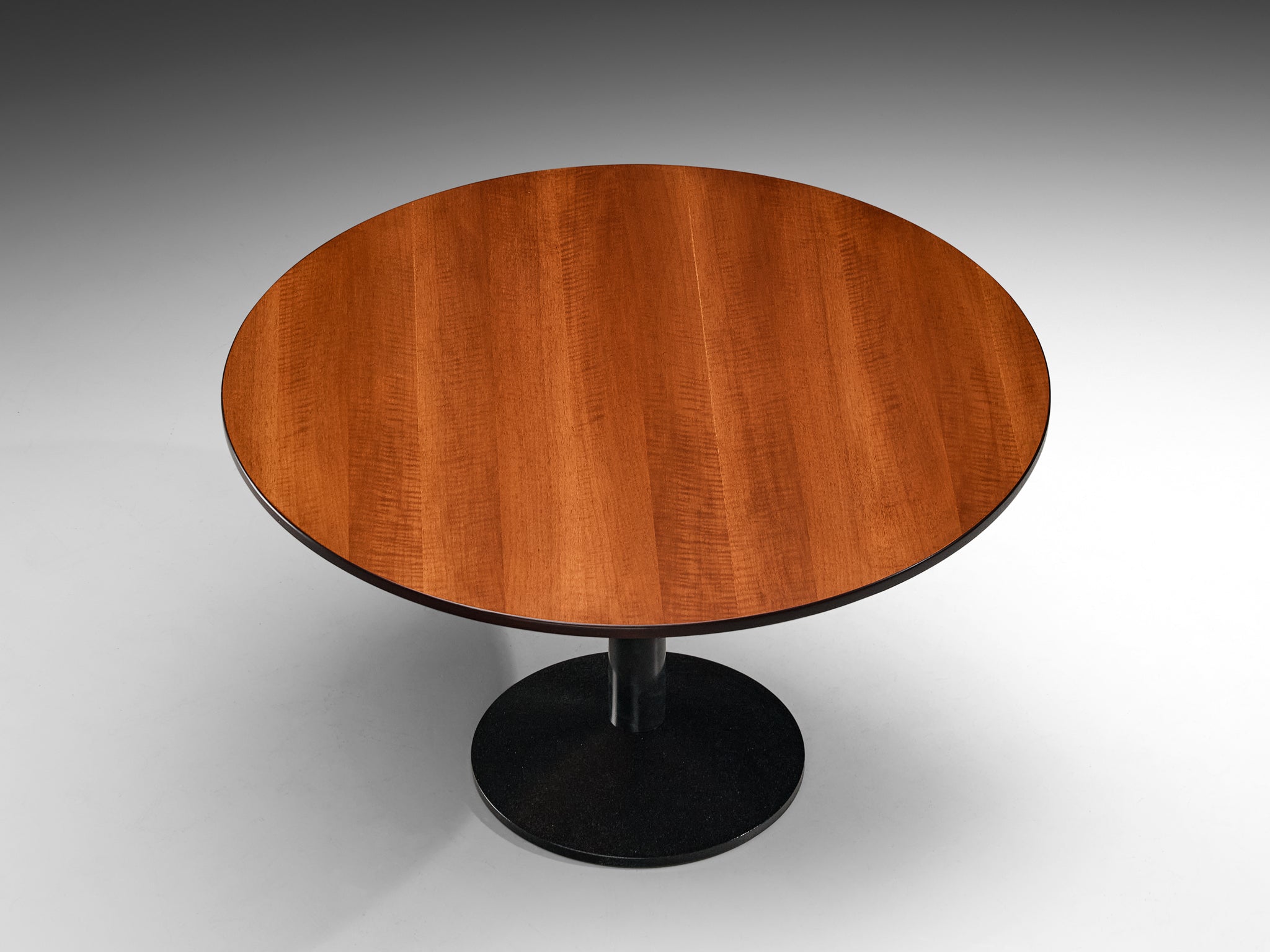
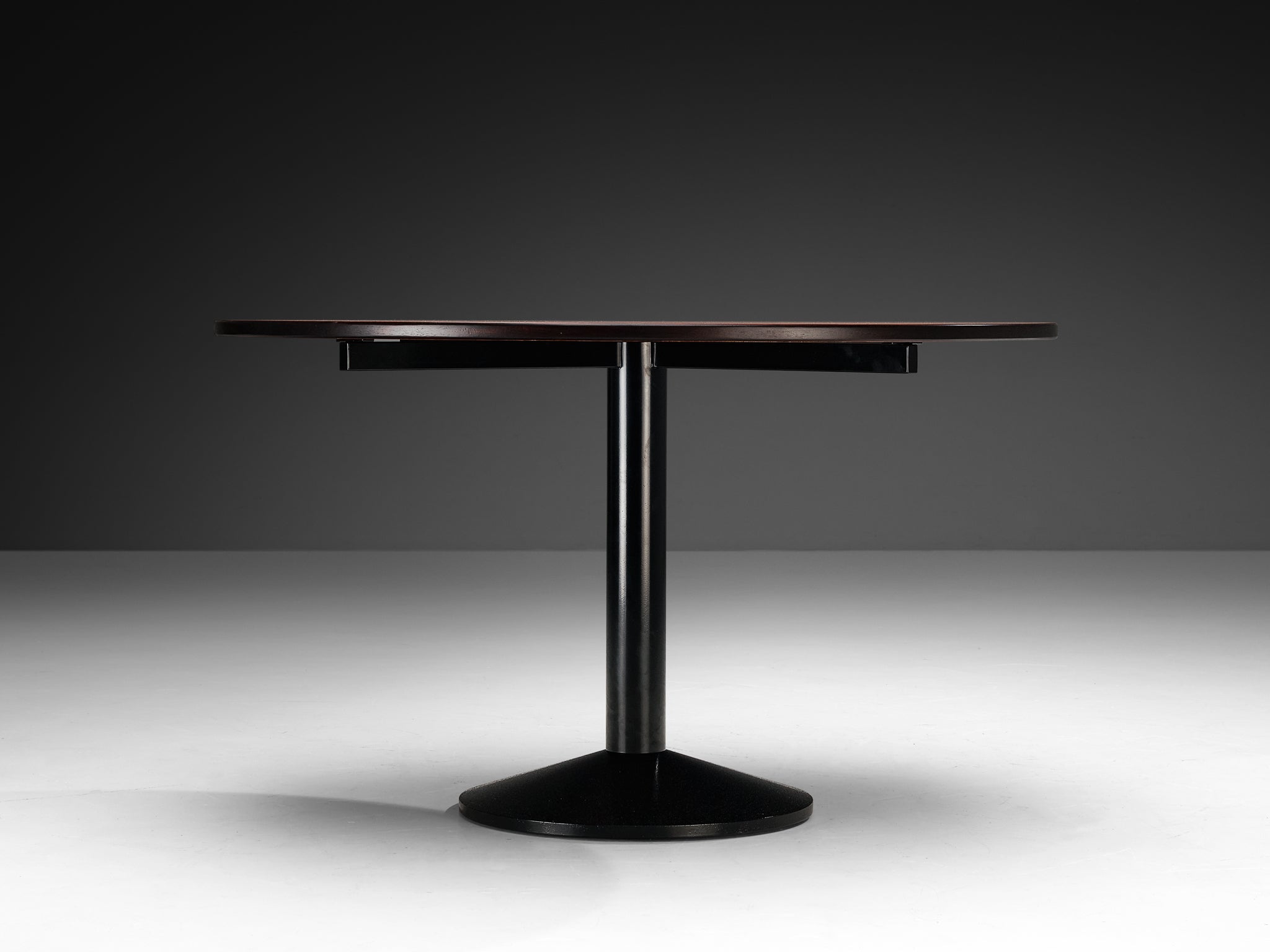
Franco Albini and Franca Helg for Poggi, pedestal table, model 'TL30', walnut, lacquered steel, Italy, 1961
The TL30 pedestal table, designed by Franco Albini and Franca Helg for Poggi in 1961, is a quintessential example of modernist restraint. The piece is deceptively simple: a circular tabletop in warm-toned walnut rests atop a single central support in lacquered steel. But this apparent simplicity belies a deep sensitivity to proportion, balance, and material contrast. What is most compelling is how the circular motifs repeat without redundancy: the table top, the pedestal, and the base all echo each other in form, but vary in scale and function. The decision to elevate the top on a single pedestal rather than four legs is not just stylistic; it emphasizes openness and fluidity of space. It also suggests an underlying interest in efficiency and clarity of construction, themes that were central to both Albini’s architecture and Helg’s design sensibilities.
Biography
Born on October 17, 1905, in Robbiate (Como), Franco Albini grew up in the picturesque landscape of Brianza. His early years, spent in the family’s countryside home, nurtured his appreciation for nature and its harmonious forms. Later, when his family relocated to Milan, Albini pursued his passion for architecture at the Polytechnic University of Milan, earning his degree in 1929. His career began in the studios of Gio Ponti and Emilio Lancia, where he was initially influenced by the 20th-century classical approach to furniture design. That same year, he traveled to Barcelona for the International Exhibition and then to Paris, where he is believed to have visited Le Corbusier’s atelier.
Albini’s early work focused on interior design, but a pivotal moment in his career came after a discussion with Edoardo Persico, a key figure in Italian Rationalism. This conversation marked his transition toward modernist principles, leading him to join the editorial team of Casabella, a crucial platform for architectural debate and experimentation. Influenced by the European avant-garde, Albini integrated elements from the Wiener Werkstätte, French Art Deco, and De Stijl, enriching the Italian discourse on rationalist architecture.
In 1931, he established his first studio with Renato Camus and Giancarlo Palanti, focusing on social housing and urban planning. His projects often reflected the clarity and structure championed by Walter Gropius, with a preference for linear, factory-inspired buildings arranged in precise geometric grids. This approach sought to introduce air, light, and green spaces into urban environments, countering the chaotic expansion of the city. His first personal residence, the Pestarini Villa (1938) in Milan, showcased these ideals and was featured prominently in Casabella under the editorial direction of Giuseppe Pagano.
Throughout the 1930s, Albini designed numerous installations for the Milan Triennale and trade fairs, using these temporary structures to explore innovative ideas. His work often featured Cartesian spaces arranged in geometric grids, skeletal metal frameworks, and transparent walls of glass or fabric, as seen in the INA Pavilions at the Milan Trade Fair and the Levante Fair in Bari. These projects allowed him to experiment with spatial organization and materials in ways that would later influence his permanent architectural works.
After World War II, Albini’s career expanded significantly as Italy embarked on reconstruction. His practice grew in scope, particularly with the addition of Franca Helg as a partner in 1952, a collaboration that would last for the rest of his career. Albini’s architectural contributions were diverse. This included social housing, such as the Mangiagalli neighborhood in Milan (1950-1952), together with Ignazio Gardella, and the employees housing for the Gres company in Colognola, Bergamo (1954-1956). Albini also worked on high-profile commissions, where furniture pieces such as the Poltroncina Adriana (1940), the Luisa armchair (1955), and the Tre Pezzi armchair (1959), became integral elements of the interiors.
In 1962, the Albini-Helg studio expanded with the inclusion of Antonio Piva, followed by Marco Albini in 1965, evolving into the Studio di Architettura Franco Albini, Franca Helg, Antonio Piva, Marco Albini. This period marked a deepening engagement with urban planning and infrastructure, as well as continued refinement of his architectural philosophy.
Beyond his built work and furniture design, Albini was deeply committed to education. From 1954 to 1974, he taught Composition and Architecture at institutions including the Polytechnic University of Turin, the IUAV in Venice, and later the Polytechnic University of Milan. His teaching style was characterized by intellectual rigor, emphasizing clarity in design choices and the ethical responsibility of architecture. He mentored many students who went on to become prominent architects. Albini believed that architecture should serve not only a functional purpose but also carry cultural and intellectual significance. This philosophy shaped both his work and his teachings, ensuring his influence endured long after his passing. Franco Albini died in Milan on November 1, 1977, but his legacy as a visionary architect, designer, and educator continues to inspire modern architectural thought.
The TL30 pedestal table, designed by Franco Albini and Franca Helg for Poggi in 1961, is a quintessential example of modernist restraint. The piece is deceptively simple: a circular tabletop in warm-toned walnut rests atop a single central support in lacquered steel. But this apparent simplicity belies a deep sensitivity to proportion, balance, and material contrast. What is most compelling is how the circular motifs repeat without redundancy: the table top, the pedestal, and the base all echo each other in form, but vary in scale and function. The decision to elevate the top on a single pedestal rather than four legs is not just stylistic; it emphasizes openness and fluidity of space. It also suggests an underlying interest in efficiency and clarity of construction, themes that were central to both Albini’s architecture and Helg’s design sensibilities.
Biography
Born on October 17, 1905, in Robbiate (Como), Franco Albini grew up in the picturesque landscape of Brianza. His early years, spent in the family’s countryside home, nurtured his appreciation for nature and its harmonious forms. Later, when his family relocated to Milan, Albini pursued his passion for architecture at the Polytechnic University of Milan, earning his degree in 1929. His career began in the studios of Gio Ponti and Emilio Lancia, where he was initially influenced by the 20th-century classical approach to furniture design. That same year, he traveled to Barcelona for the International Exhibition and then to Paris, where he is believed to have visited Le Corbusier’s atelier.
Albini’s early work focused on interior design, but a pivotal moment in his career came after a discussion with Edoardo Persico, a key figure in Italian Rationalism. This conversation marked his transition toward modernist principles, leading him to join the editorial team of Casabella, a crucial platform for architectural debate and experimentation. Influenced by the European avant-garde, Albini integrated elements from the Wiener Werkstätte, French Art Deco, and De Stijl, enriching the Italian discourse on rationalist architecture.
In 1931, he established his first studio with Renato Camus and Giancarlo Palanti, focusing on social housing and urban planning. His projects often reflected the clarity and structure championed by Walter Gropius, with a preference for linear, factory-inspired buildings arranged in precise geometric grids. This approach sought to introduce air, light, and green spaces into urban environments, countering the chaotic expansion of the city. His first personal residence, the Pestarini Villa (1938) in Milan, showcased these ideals and was featured prominently in Casabella under the editorial direction of Giuseppe Pagano.
Throughout the 1930s, Albini designed numerous installations for the Milan Triennale and trade fairs, using these temporary structures to explore innovative ideas. His work often featured Cartesian spaces arranged in geometric grids, skeletal metal frameworks, and transparent walls of glass or fabric, as seen in the INA Pavilions at the Milan Trade Fair and the Levante Fair in Bari. These projects allowed him to experiment with spatial organization and materials in ways that would later influence his permanent architectural works.
After World War II, Albini’s career expanded significantly as Italy embarked on reconstruction. His practice grew in scope, particularly with the addition of Franca Helg as a partner in 1952, a collaboration that would last for the rest of his career. Albini’s architectural contributions were diverse. This included social housing, such as the Mangiagalli neighborhood in Milan (1950-1952), together with Ignazio Gardella, and the employees housing for the Gres company in Colognola, Bergamo (1954-1956). Albini also worked on high-profile commissions, where furniture pieces such as the Poltroncina Adriana (1940), the Luisa armchair (1955), and the Tre Pezzi armchair (1959), became integral elements of the interiors.
In 1962, the Albini-Helg studio expanded with the inclusion of Antonio Piva, followed by Marco Albini in 1965, evolving into the Studio di Architettura Franco Albini, Franca Helg, Antonio Piva, Marco Albini. This period marked a deepening engagement with urban planning and infrastructure, as well as continued refinement of his architectural philosophy.
Beyond his built work and furniture design, Albini was deeply committed to education. From 1954 to 1974, he taught Composition and Architecture at institutions including the Polytechnic University of Turin, the IUAV in Venice, and later the Polytechnic University of Milan. His teaching style was characterized by intellectual rigor, emphasizing clarity in design choices and the ethical responsibility of architecture. He mentored many students who went on to become prominent architects. Albini believed that architecture should serve not only a functional purpose but also carry cultural and intellectual significance. This philosophy shaped both his work and his teachings, ensuring his influence endured long after his passing. Franco Albini died in Milan on November 1, 1977, but his legacy as a visionary architect, designer, and educator continues to inspire modern architectural thought.

Choose options
Franco Albini and Franca Helg for Poggi 'TL30' Round Table in Walnut and Black Steel
Sale price$8,450.00
Regular price
Product Details
VAT within the EU: When buying or delivering an item within the EU, VAT usually applies and will be added.