
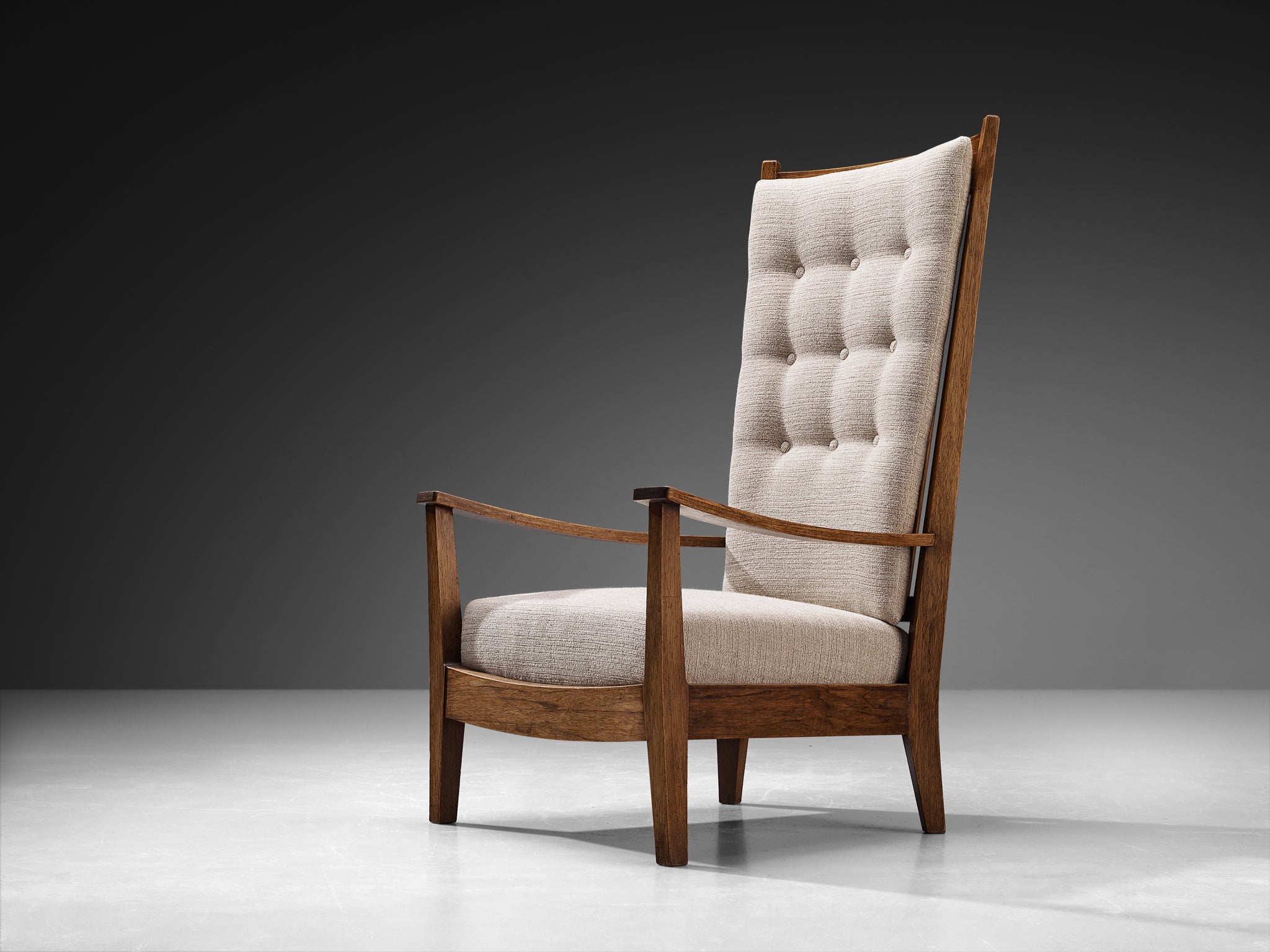


Dutch 1940s Lounge Chair in Solid Oak with Reupholstered Creme Cushions
Tearsheet
×
Receive a copy in your email or download directly:
I accept emails from Morentz.
 Open here
Attributed to Bas van Pelt, lounge chair, solid oak, the Netherlands, 1940s
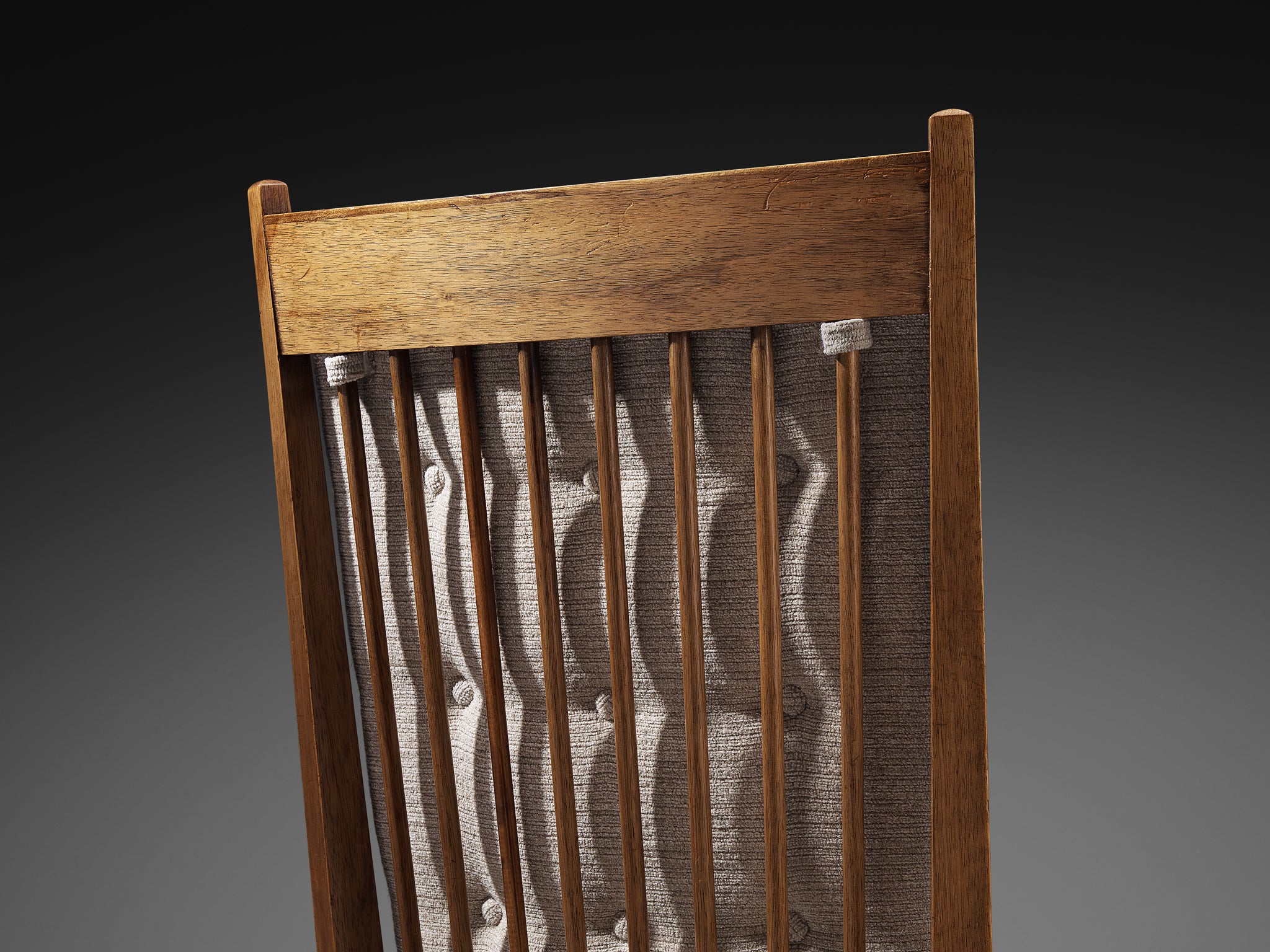
A finely proportioned armchair, attributable to the Dutch furniture and interior designer Bas van Pelt. Its defining feature is the tall backrest, composed of evenly spaced, slender vertical slats, framed by rear uprights that taper gently as they extend downward into the legs. The relatively low seat height lends the chair a grounded and stable presence. The armrests extend forward in a gentle downward slope from the back uprights, forming elongated, narrow planes.
Newly upholstered cushions in a cream, off-white tone harmonize subtly with the oak wood, contributing to an overall impression of serenity and calmness.
Biography
Bastiaan Johannes van Pelt (1900-1945) was a Dutch furniture designer and interior designer. As son of a book printer, he spend his time after school working in several printing companies in Holland. At that time he already engaged in topics like designing furniture, interiors, carpets and fabrics, graphic work and pottery. In 1927, he quit his old job and started to work at a furniture factory owned by his father-in-law J.C. Jansen in Overschie. Together with his brother-in-law, Jan Jansen, they produced various designs for furniture which were manufactured in series. During the first half of the 1930s, Van Pelt created a number of designs for tubular steel furniture, which were manufactured by the company D3 and E.M.S. Overschie. During this period, his designs evoke a strong resemblance to the ethos of the iconic Bauhaus. Simplicity and functionality were the core values within this movement, and Van Pelt managed to create furniture according to them, by the application of tubular steel, simple geometric forms, and materials which facilitated mass production. After 1938, Van Pelt turned away from the functionalist mindset and began designing in the style of the ‘Delfste school’, which was more engaged in historical shapes and traditional manufacturing methods.
Van Pelt always dreamed of having his own business and he did not hesitate when he got the opportunity to take over the store ‘My Home woninginrichting’ located on ‘De Lange Houtstraat’ in The Hague, in 1931. He transformed the store into a thriving company in the field of modern home furnishings. It functioned primarily as a show room where he exhibited a selected range of modern furniture and upholstery accessories. For instance, his collections consisted of specifically metal furniture and lamps by D3, E.M.S. Overschie, and Thonet in combination with his own designs. The success of the store resulted in opening three more showrooms in Maastricht (1934), Enschede (1936) and, Amsterdam (1938). His clientele consisted of the wealthy bourgeoisie and middle class, and in particular of lawyers and doctors. Diplomats who visited the royal city for a while, had the possibility to rent furniture from his store.
Bas van Pelt decided to actively participate during World War Two. His country house ‘De Pal’ in Emst served as a depot for ammunition and a hiding place between 1943 and 1945. Architect and industrial designer Willem Hendrik Gispen (1890-1981) arrived at Van Pelt’s place to hide from the Germans after he got released. From May 1944, he was imprisoned for a whole year in various concentration camps. On May 24, 1945, a few days after his liberation, Van Pelt died at the age of 44 in Stalag XB, a concentration camp near Hamburg. Van Pelt's successful design studio and interior store with various branches, has been taken over by his wife, and later their daughter.
A finely proportioned armchair, attributable to the Dutch furniture and interior designer Bas van Pelt. Its defining feature is the tall backrest, composed of evenly spaced, slender vertical slats, framed by rear uprights that taper gently as they extend downward into the legs. The relatively low seat height lends the chair a grounded and stable presence. The armrests extend forward in a gentle downward slope from the back uprights, forming elongated, narrow planes.
Newly upholstered cushions in a cream, off-white tone harmonize subtly with the oak wood, contributing to an overall impression of serenity and calmness.
Biography
Bastiaan Johannes van Pelt (1900-1945) was a Dutch furniture designer and interior designer. As son of a book printer, he spend his time after school working in several printing companies in Holland. At that time he already engaged in topics like designing furniture, interiors, carpets and fabrics, graphic work and pottery. In 1927, he quit his old job and started to work at a furniture factory owned by his father-in-law J.C. Jansen in Overschie. Together with his brother-in-law, Jan Jansen, they produced various designs for furniture which were manufactured in series. During the first half of the 1930s, Van Pelt created a number of designs for tubular steel furniture, which were manufactured by the company D3 and E.M.S. Overschie. During this period, his designs evoke a strong resemblance to the ethos of the iconic Bauhaus. Simplicity and functionality were the core values within this movement, and Van Pelt managed to create furniture according to them, by the application of tubular steel, simple geometric forms, and materials which facilitated mass production. After 1938, Van Pelt turned away from the functionalist mindset and began designing in the style of the ‘Delfste school’, which was more engaged in historical shapes and traditional manufacturing methods.
Van Pelt always dreamed of having his own business and he did not hesitate when he got the opportunity to take over the store ‘My Home woninginrichting’ located on ‘De Lange Houtstraat’ in The Hague, in 1931. He transformed the store into a thriving company in the field of modern home furnishings. It functioned primarily as a show room where he exhibited a selected range of modern furniture and upholstery accessories. For instance, his collections consisted of specifically metal furniture and lamps by D3, E.M.S. Overschie, and Thonet in combination with his own designs. The success of the store resulted in opening three more showrooms in Maastricht (1934), Enschede (1936) and, Amsterdam (1938). His clientele consisted of the wealthy bourgeoisie and middle class, and in particular of lawyers and doctors. Diplomats who visited the royal city for a while, had the possibility to rent furniture from his store.
Bas van Pelt decided to actively participate during World War Two. His country house ‘De Pal’ in Emst served as a depot for ammunition and a hiding place between 1943 and 1945. Architect and industrial designer Willem Hendrik Gispen (1890-1981) arrived at Van Pelt’s place to hide from the Germans after he got released. From May 1944, he was imprisoned for a whole year in various concentration camps. On May 24, 1945, a few days after his liberation, Van Pelt died at the age of 44 in Stalag XB, a concentration camp near Hamburg. Van Pelt's successful design studio and interior store with various branches, has been taken over by his wife, and later their daughter.

Choose options
Dutch 1940s Lounge Chair in Solid Oak with Reupholstered Creme Cushions
Sale price$6,450.00
Regular price
Tearsheet
×
Receive a copy in your email or download directly:
I accept emails from Morentz.
Product Details
VAT within the EU: When buying or delivering an item within the EU, VAT usually applies and will be added.