

Pietro Lingeri Rationalist 1930s Writing Desk in Briar Root Veneer
 Open here
Pietro Lingeri, writing desk, briar root veneer, glass, brass, metal, Italy, 1930s
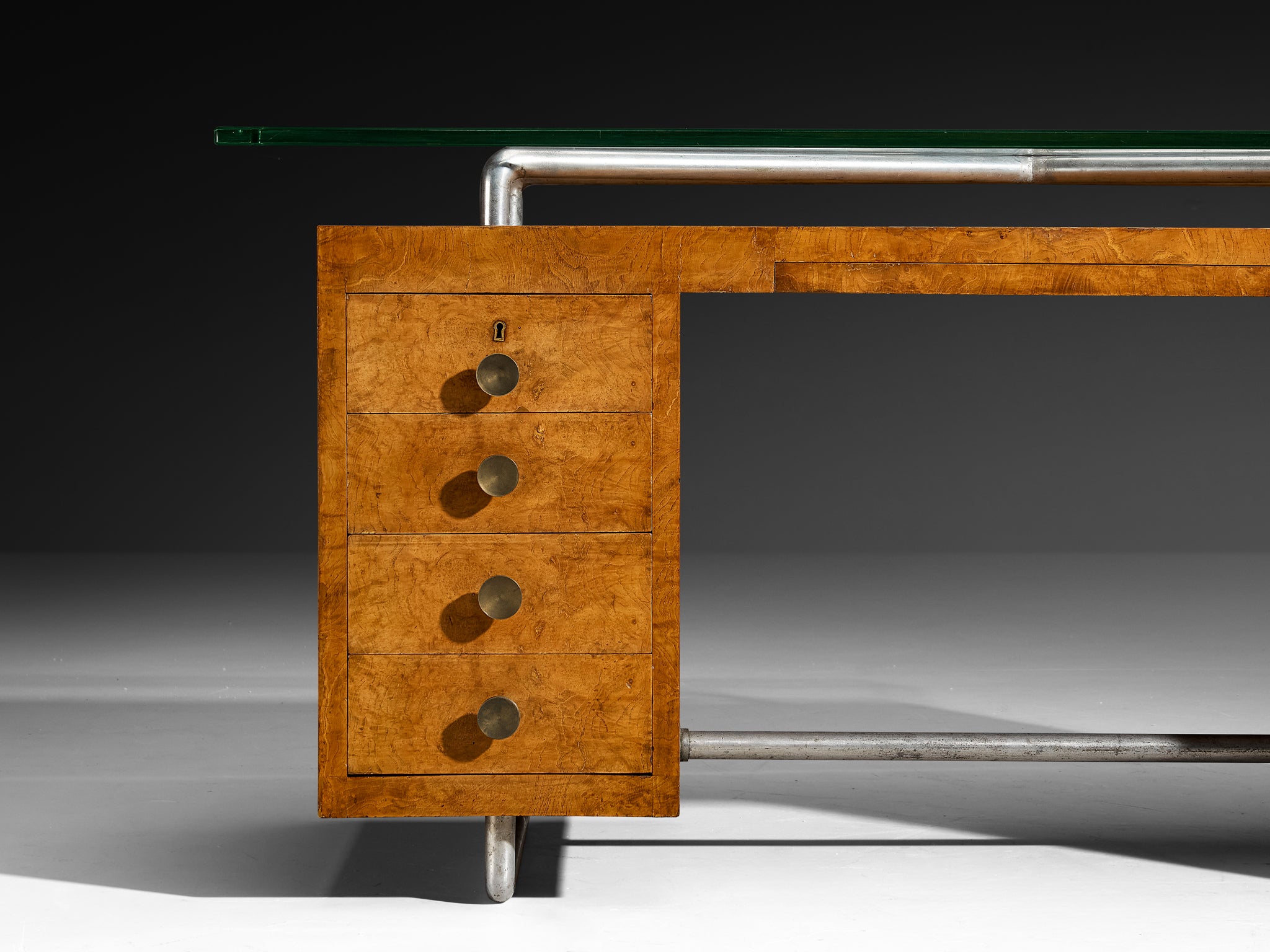
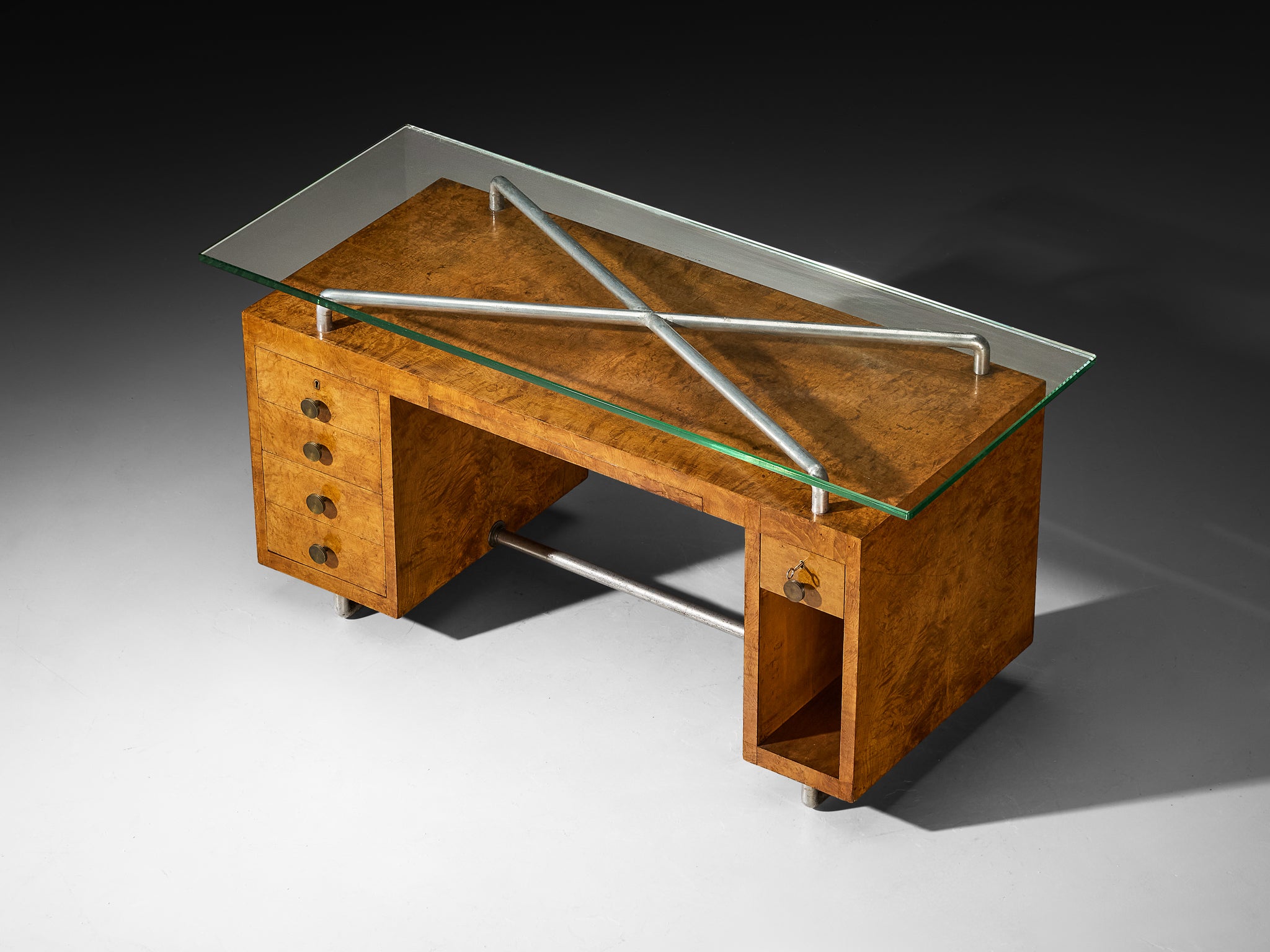
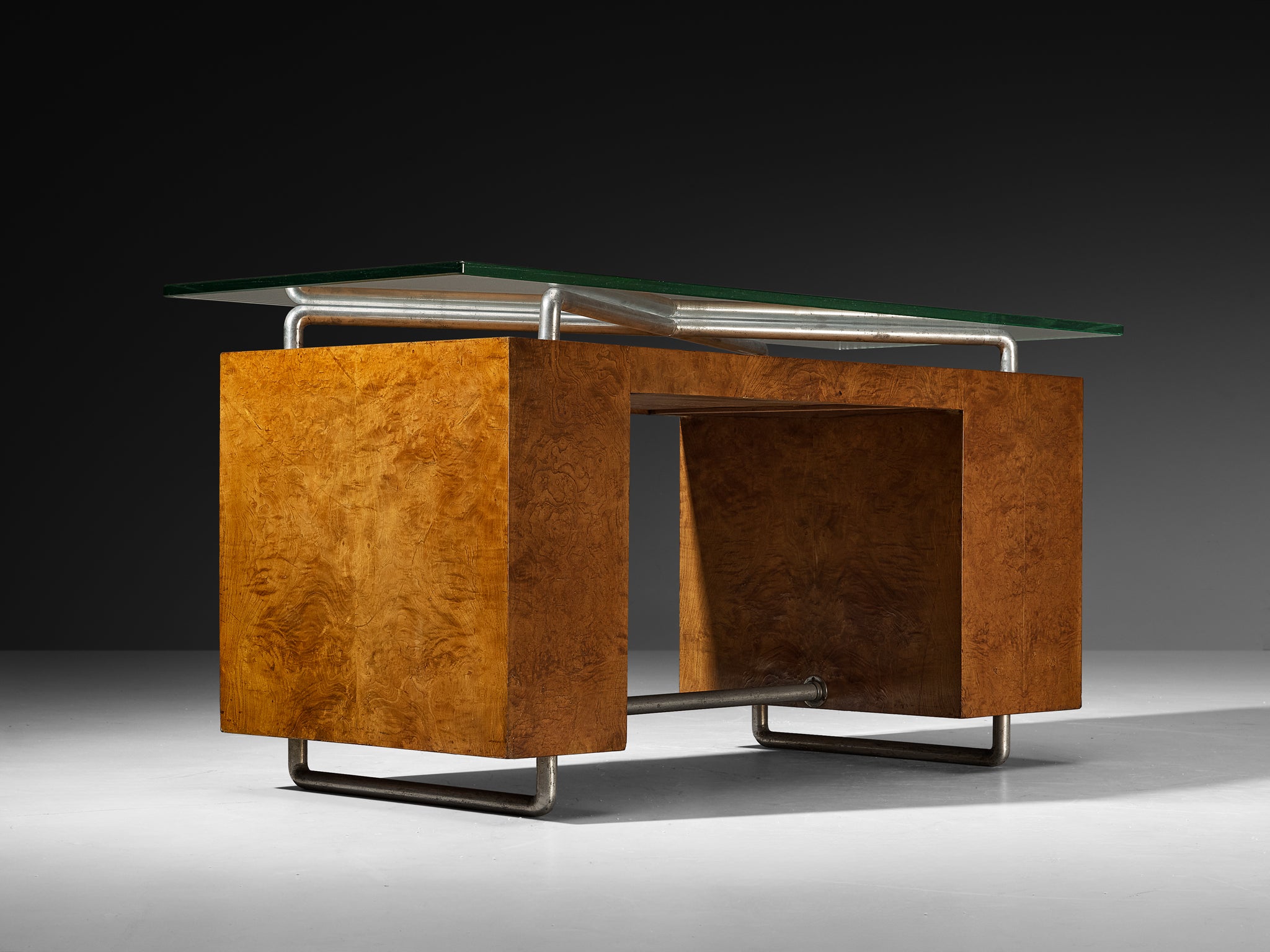
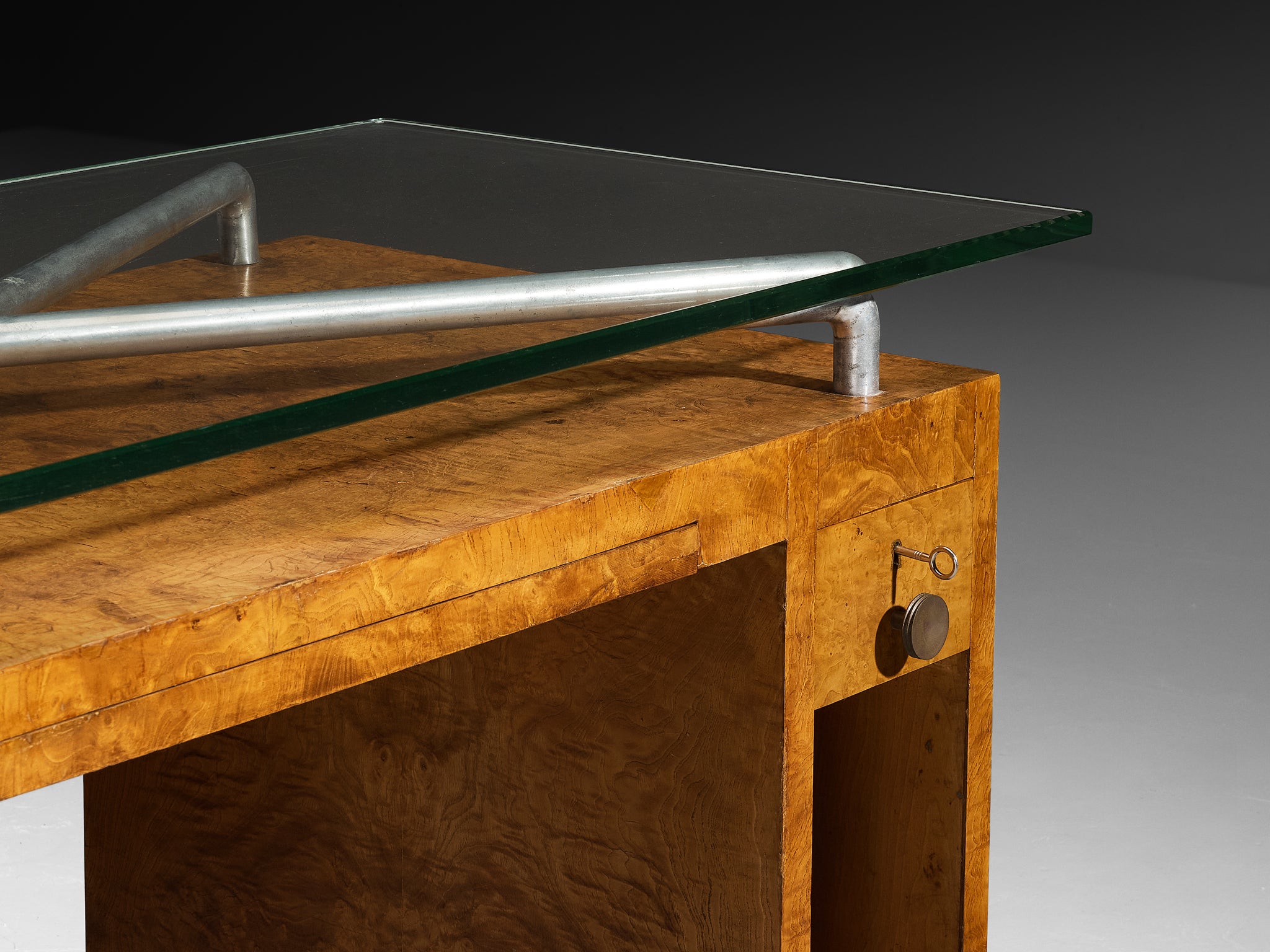
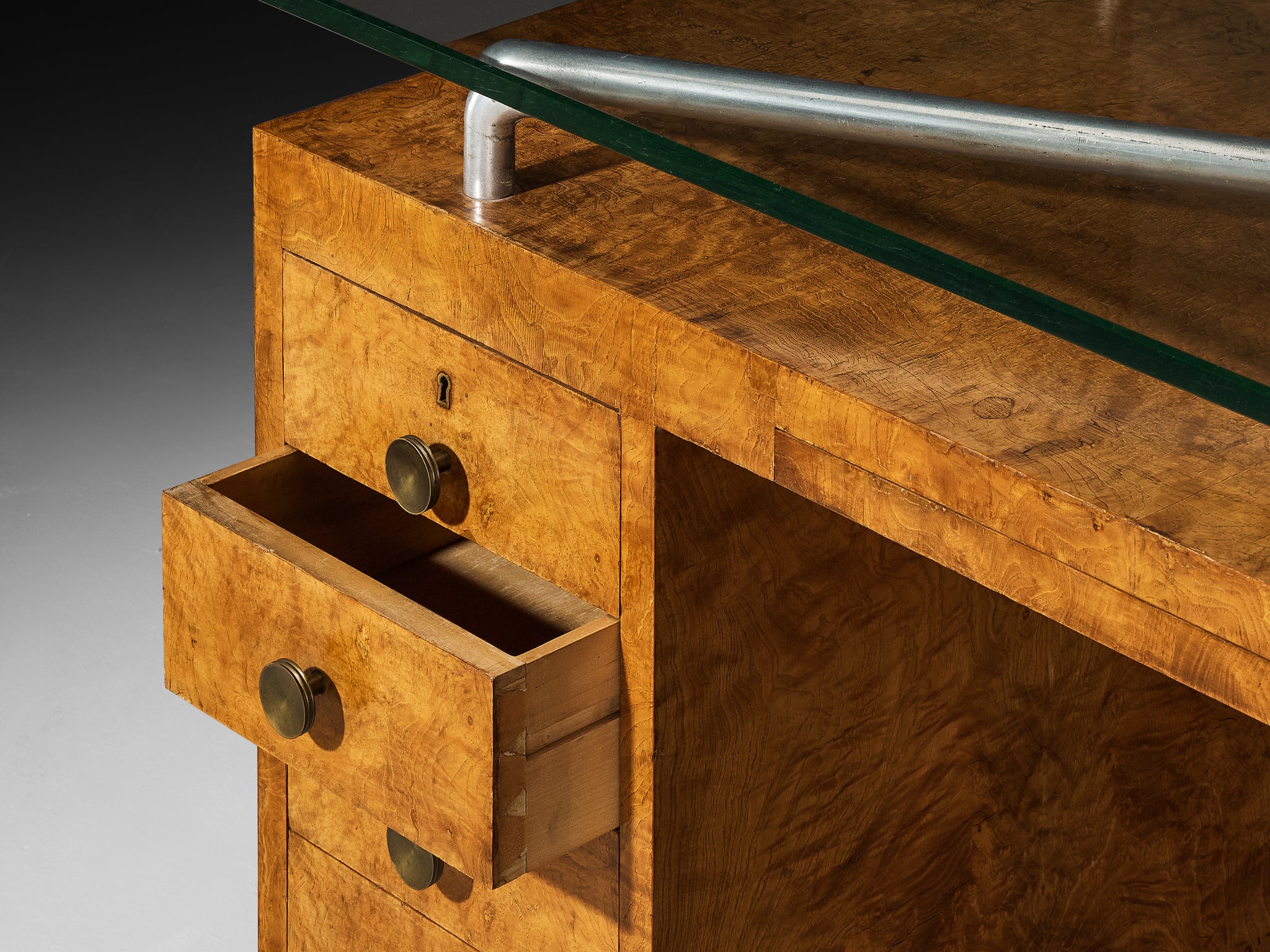
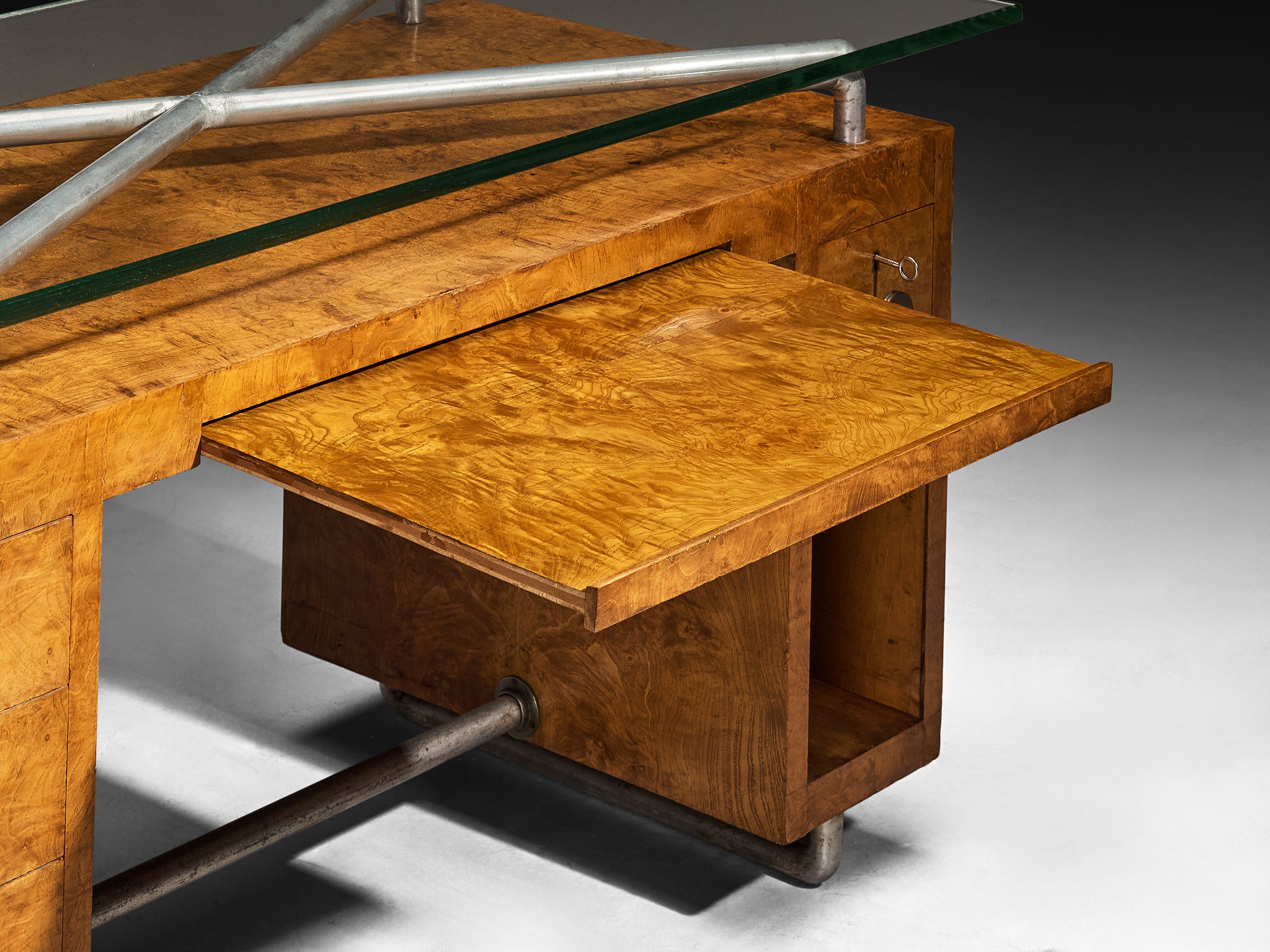
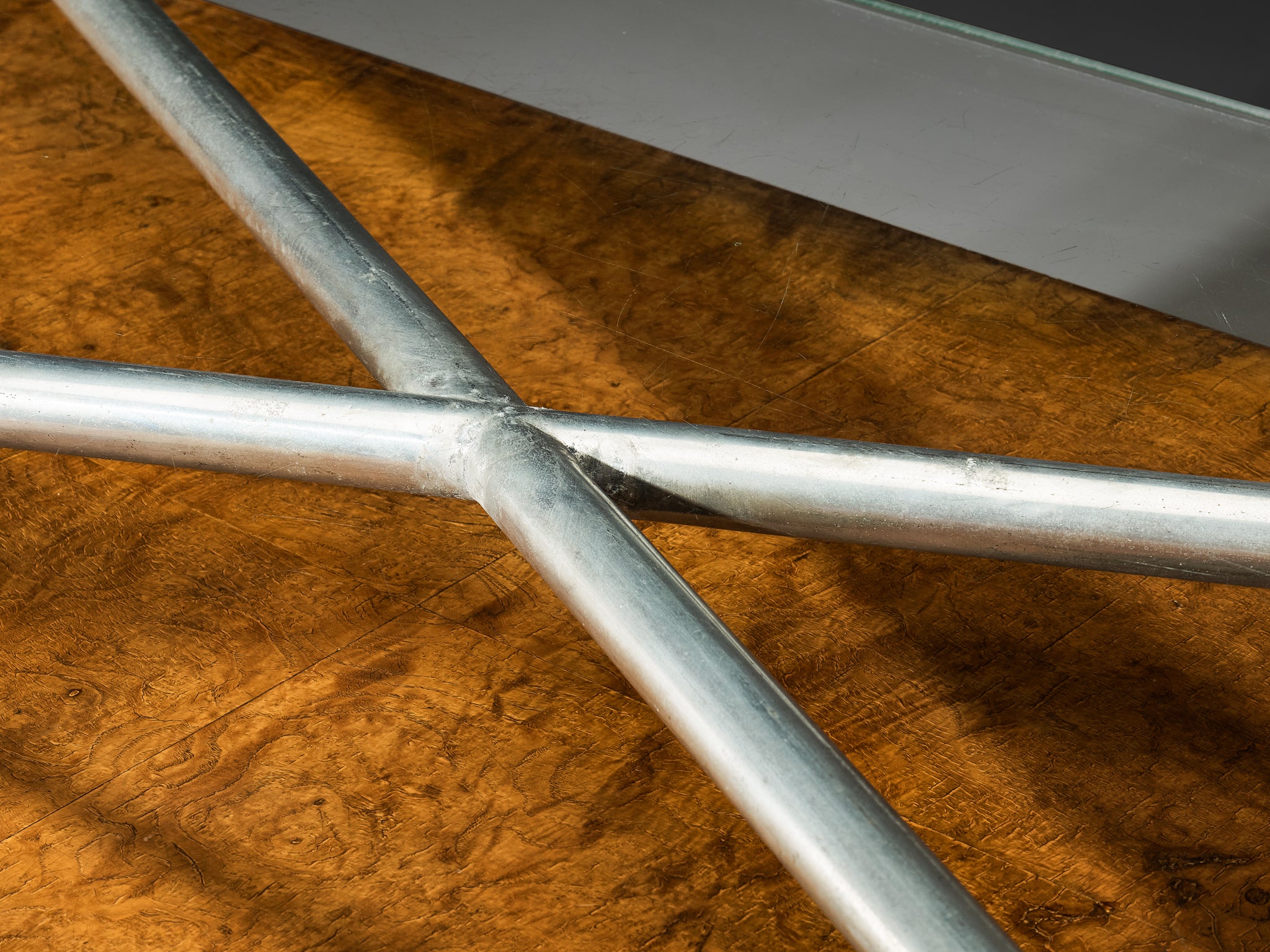
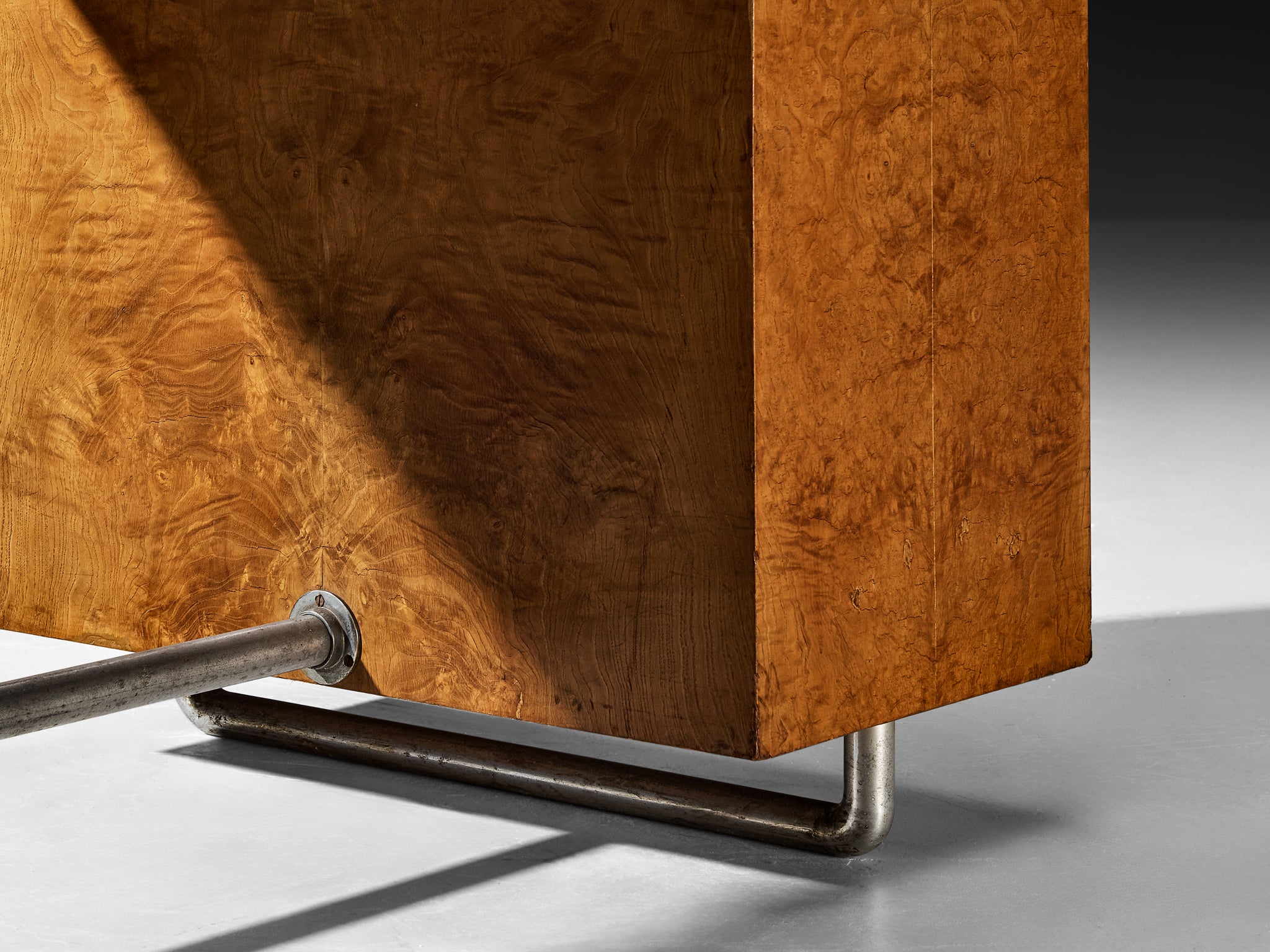
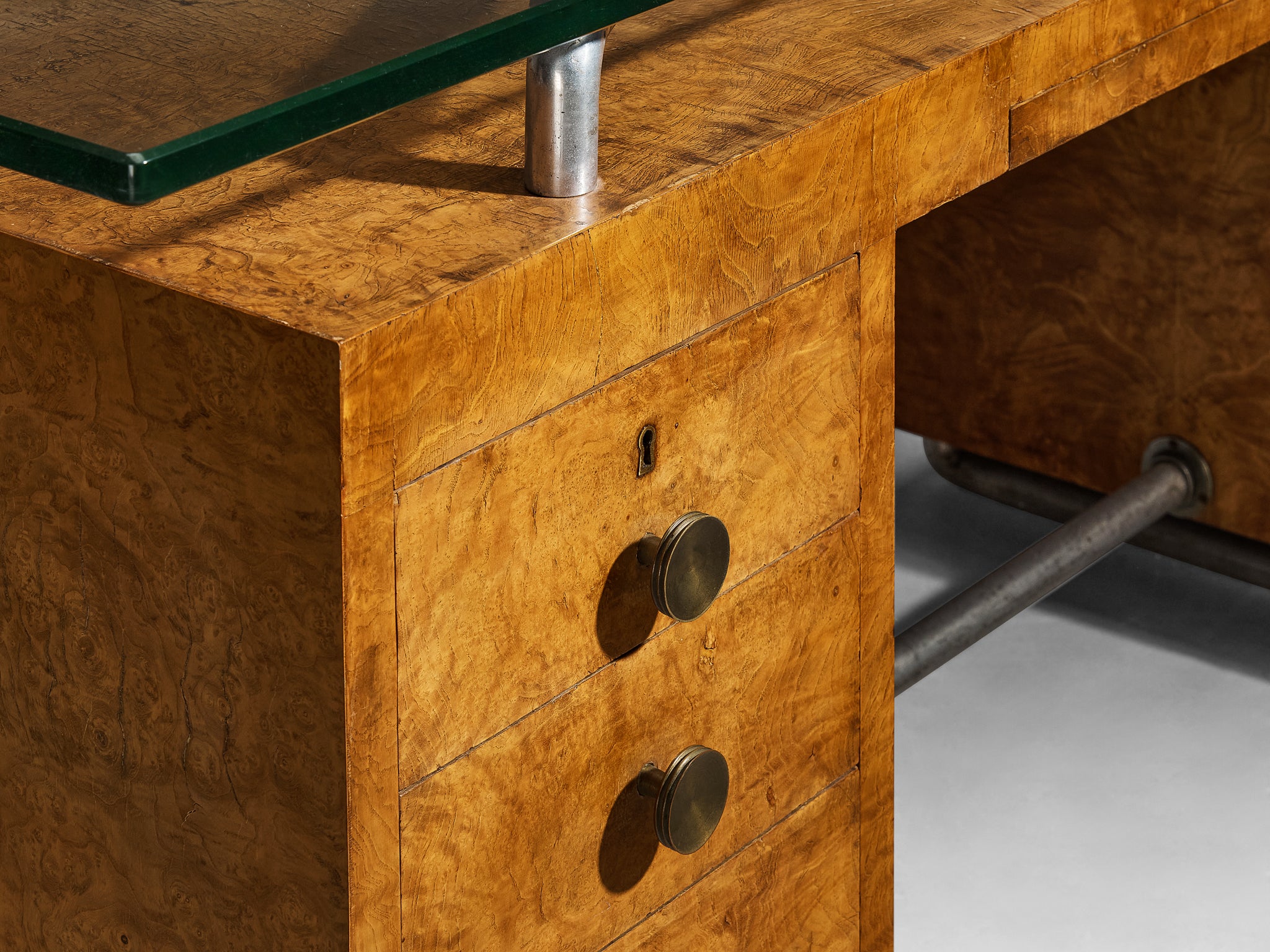
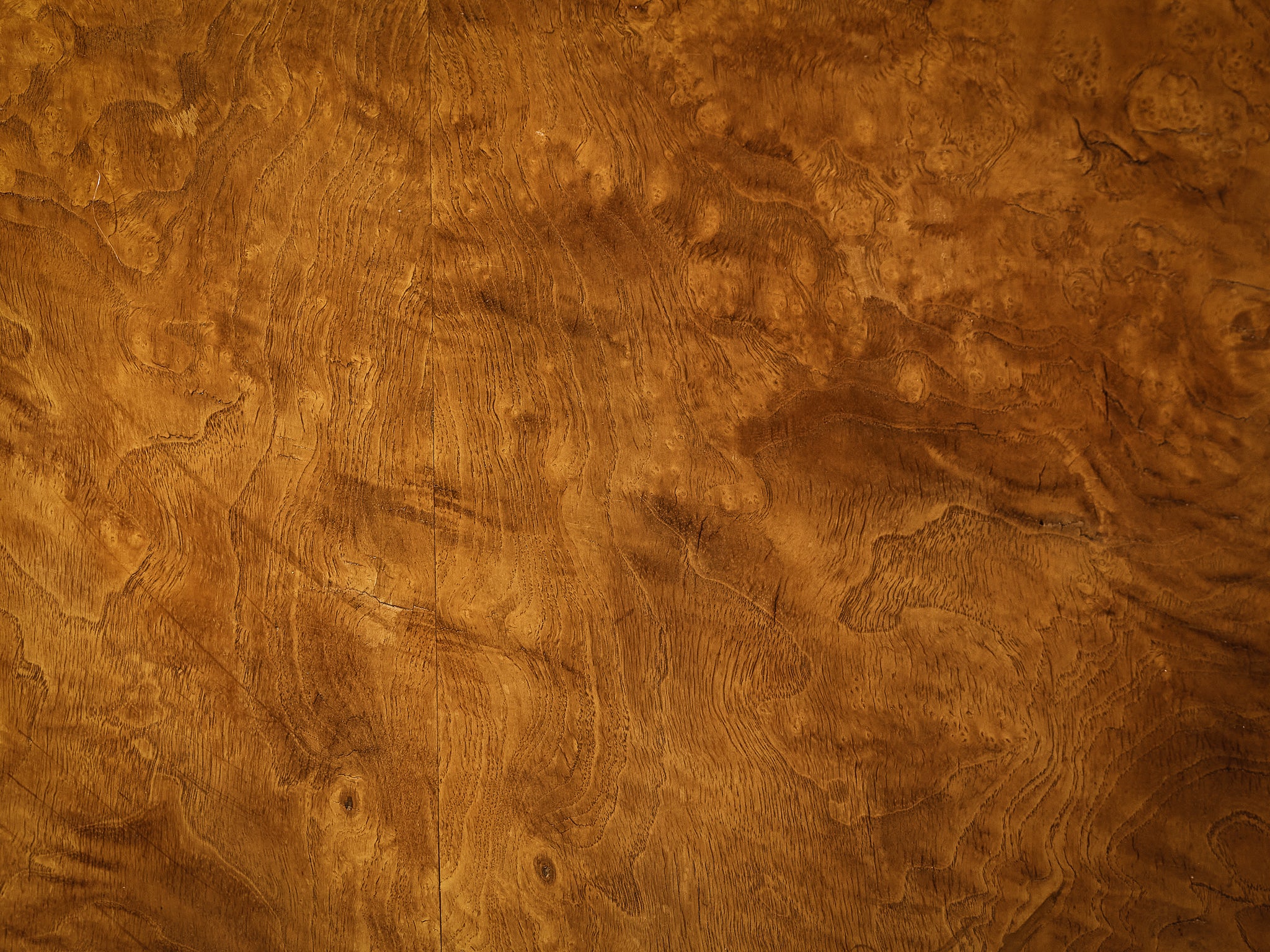
A beautiful example of Italian Rationalism, this desk is designed by architect Pietro Lingeri and dates back to the 1930s. Its form is guided by a strict geometrical logic: two vertical blocks anchor the structure, symmetrically spaced and rectilinear, like architectural volumes. Between them, a recessed void defines the user’s space. Each block serves a distinct function: on the left, a column of four drawers punctuated by circular brass pulls; on the right, an open niche beneath a single lockable drawer. The briar root veneer adds an organic depth to the otherwise rigorously orthogonal body. The swirling, almost chaotic grain of the wood serves as a counterpoint to the desk’s rationalist ethos. Above this wooden body floats a thick glass top, structurally and visually separated from the base by a system of exposed metal supports that intersect in the middle, forming an X-shape. Cylindrical and minimal in profile, the feet rise discreetly from the floor.
Pietro Lingeri (1894–1968) was a prominent Italian architect and a leading figure in the Italian Rationalist movement. He co-founded the influential Como Group and contributed as both a writer and editor for Quadrante, a key publication of the time. Italian Rationalism reached its peak between 1926 and 1940, during which Lingeri was involved in numerous significant projects, including the master plan for the city of Como. The movement drew inspiration from a 19th-century French concept that viewed architecture as a rational and calculated discipline—favoring clarity and structure over ornamentation and emotional expression.
A beautiful example of Italian Rationalism, this desk is designed by architect Pietro Lingeri and dates back to the 1930s. Its form is guided by a strict geometrical logic: two vertical blocks anchor the structure, symmetrically spaced and rectilinear, like architectural volumes. Between them, a recessed void defines the user’s space. Each block serves a distinct function: on the left, a column of four drawers punctuated by circular brass pulls; on the right, an open niche beneath a single lockable drawer. The briar root veneer adds an organic depth to the otherwise rigorously orthogonal body. The swirling, almost chaotic grain of the wood serves as a counterpoint to the desk’s rationalist ethos. Above this wooden body floats a thick glass top, structurally and visually separated from the base by a system of exposed metal supports that intersect in the middle, forming an X-shape. Cylindrical and minimal in profile, the feet rise discreetly from the floor.
Pietro Lingeri (1894–1968) was a prominent Italian architect and a leading figure in the Italian Rationalist movement. He co-founded the influential Como Group and contributed as both a writer and editor for Quadrante, a key publication of the time. Italian Rationalism reached its peak between 1926 and 1940, during which Lingeri was involved in numerous significant projects, including the master plan for the city of Como. The movement drew inspiration from a 19th-century French concept that viewed architecture as a rational and calculated discipline—favoring clarity and structure over ornamentation and emotional expression.

Choose options
Pietro Lingeri Rationalist 1930s Writing Desk in Briar Root Veneer
Sale price£10,826.61
Regular price
Product Details
VAT within the EU: When buying or delivering an item within the EU, VAT usually applies and will be added.