
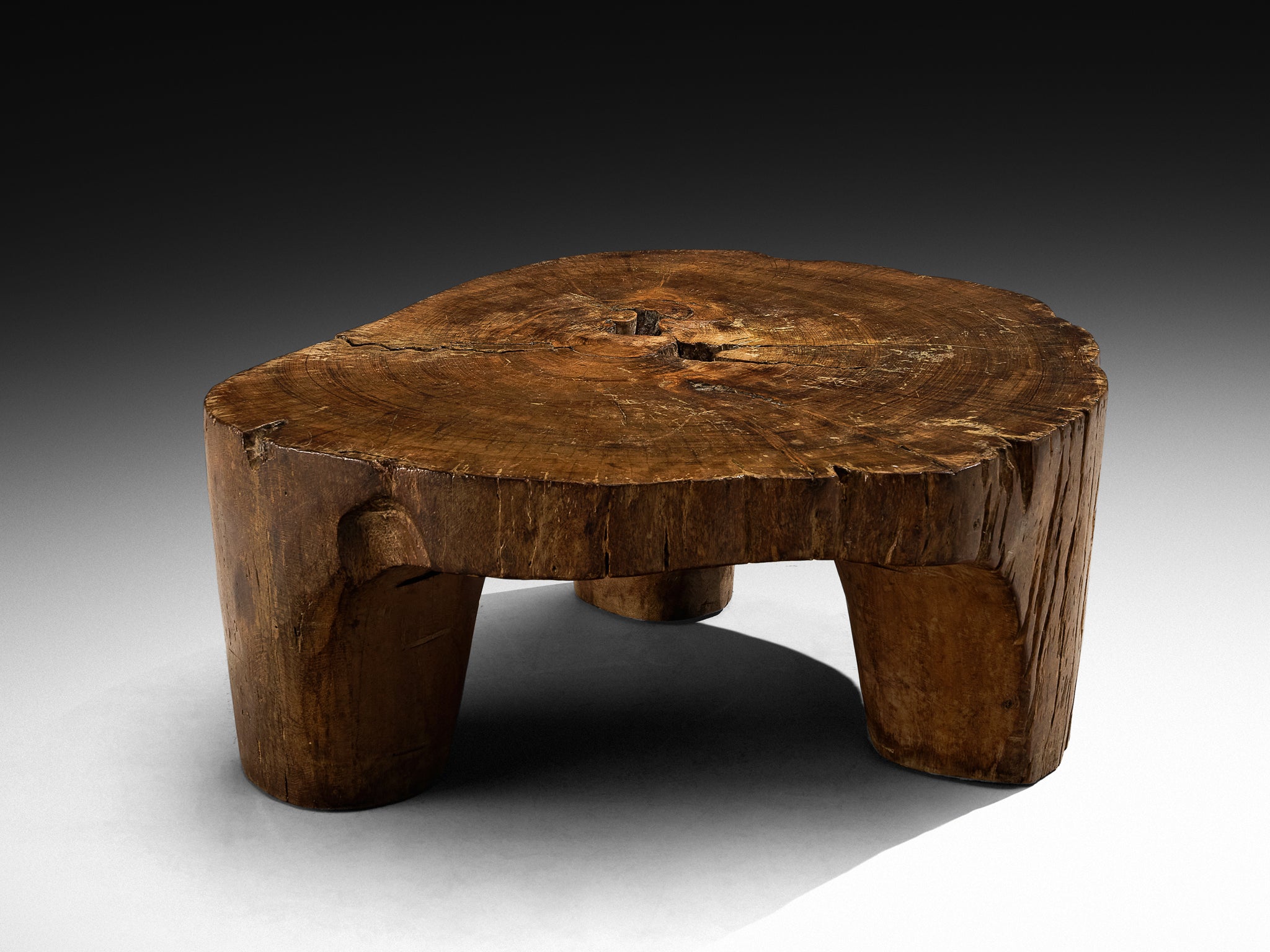


José Zanine Caldas Hand-Carved Coffee Table in Brazilian Hardwood
Tearsheet
×
Receive a copy in your email or download directly:
I accept emails from Morentz.
 Open here
José Zanine Caldas, coffee table, Brazilian hardwood (Pequi), Brazil, 1970s
This exceptional hand-carved coffee table embodies everything that José Zanine Caldas stood for: a deep respect for nature and, above all, for wood as a living material. Created in the 1970s, the table is carved by hand from a single piece of wood. A thick, round tabletop is supported by three sturdy legs, allowing the natural beauty of the material to take center stage. The wood displays a rich color and a beautiful, well-developed patina.
Later in his career, when Zanine Caldas returned to his home state of Bahia, he became inspired by local craftsmen who carved boats and furniture from felled trees. Influenced by their techniques, he began experimenting with chiseling and carving large, sculptural pieces of furniture like the present example.
A pioneer in forest preservation and ecological awareness, Zanine Caldas wrote extensively about his connection to the forest. He sought to work with salvaged wood whenever possible and often planted a new tree for every one used in his projects. His work stands as a powerful testament to the expressive potential and inherent beauty of natural wood.
Biography
José Zanine Caldas (1919–2001), born in Belmonte, Brazil, was celebrated for his raw, natural, and sculptural design qualities. A self-taught designer, Caldas began his career in the construction industry, working as a model builder for renowned architects and designers, including Oscar Niemeyer. In 1948, he founded Móveis Artísticos Z, a company producing semi-mass-produced plywood furniture. However, just two years later, he left the company and returned to his home state of Bahia. There, he embraced local materials and blended colonial aesthetics with the emerging modernist style. His work became distinguished for its fidelity to the essence of materials, breaking away from the rigid rules and objectivism of the Modernist movement. Caldas strongly believed in living harmoniously with nature, a philosophy reflected in his designs and approach to architecture. His innovative style, rooted in respect for natural materials and forms, remains a hallmark of his legacy.
Unlike most of his contemporaries, who graduated from art schools or architectural institutes, José Zanine Caldas was entirely self-taught, developing his own unique style and methods. He eventually left Bahia and moved to Rio de Janeiro, where he established his own studio. There, he created architectural models despite having no formal training as an architect. His innovative approach, skill, and ingenuity earned the admiration of renowned figures such as Lucio Costa and Oscar Niemeyer.
José Zanine Caldas had a deep fascination with diverse cultures and peoples. During his travels through Africa and Asia, he was profoundly influenced by the local customs and traditions he encountered. These experiences led him to recognize a universal truth: people living in harmony with nature tend to sustain themselves in remarkably similar ways, regardless of location. This realization became the foundation of his work, with the human pursuit of unity with nature emerging as its central theme.
In 1968, José Zanine Caldas returned to his native Bahia, drawn by its cultural and natural richness. There, he found inspiration in the local craftsmen who carved boats from fallen trees. Adapting this technique, Caldas began creating sculptural wooden furniture and artworks, chiseling and carving each piece by hand. His method ensured that every creation was one-of-a-kind, showcasing the raw beauty of the material. These handmade works became the centerpiece and pinnacle of his later career.
José Zanine Caldas was deeply committed to his environment, particularly the Brazilian landscape, and this dedication consistently guided his decisions. He was acutely aware of the damage caused by agriculture and deforestation to local ecosystems. As an advocate for rainforest conservation, Caldas established the Foundation Center for the Development of the Application of Brazilian Woods. Through this foundation, he actively worked to combat rainforest destruction, supporting efforts such as funding education and raising awareness about sustainable practices.
For his handmade furniture, José Zanine Caldas made the radical decision to use only found wood, following the practices of local craftsmen. He worked exclusively with wood from trees that had died or fallen naturally. This approach gave rise to his collection known as "Móveis Denúncia", or "protest furniture".
This exceptional hand-carved coffee table embodies everything that José Zanine Caldas stood for: a deep respect for nature and, above all, for wood as a living material. Created in the 1970s, the table is carved by hand from a single piece of wood. A thick, round tabletop is supported by three sturdy legs, allowing the natural beauty of the material to take center stage. The wood displays a rich color and a beautiful, well-developed patina.
Later in his career, when Zanine Caldas returned to his home state of Bahia, he became inspired by local craftsmen who carved boats and furniture from felled trees. Influenced by their techniques, he began experimenting with chiseling and carving large, sculptural pieces of furniture like the present example.
A pioneer in forest preservation and ecological awareness, Zanine Caldas wrote extensively about his connection to the forest. He sought to work with salvaged wood whenever possible and often planted a new tree for every one used in his projects. His work stands as a powerful testament to the expressive potential and inherent beauty of natural wood.
Biography
José Zanine Caldas (1919–2001), born in Belmonte, Brazil, was celebrated for his raw, natural, and sculptural design qualities. A self-taught designer, Caldas began his career in the construction industry, working as a model builder for renowned architects and designers, including Oscar Niemeyer. In 1948, he founded Móveis Artísticos Z, a company producing semi-mass-produced plywood furniture. However, just two years later, he left the company and returned to his home state of Bahia. There, he embraced local materials and blended colonial aesthetics with the emerging modernist style. His work became distinguished for its fidelity to the essence of materials, breaking away from the rigid rules and objectivism of the Modernist movement. Caldas strongly believed in living harmoniously with nature, a philosophy reflected in his designs and approach to architecture. His innovative style, rooted in respect for natural materials and forms, remains a hallmark of his legacy.
Unlike most of his contemporaries, who graduated from art schools or architectural institutes, José Zanine Caldas was entirely self-taught, developing his own unique style and methods. He eventually left Bahia and moved to Rio de Janeiro, where he established his own studio. There, he created architectural models despite having no formal training as an architect. His innovative approach, skill, and ingenuity earned the admiration of renowned figures such as Lucio Costa and Oscar Niemeyer.
José Zanine Caldas had a deep fascination with diverse cultures and peoples. During his travels through Africa and Asia, he was profoundly influenced by the local customs and traditions he encountered. These experiences led him to recognize a universal truth: people living in harmony with nature tend to sustain themselves in remarkably similar ways, regardless of location. This realization became the foundation of his work, with the human pursuit of unity with nature emerging as its central theme.
In 1968, José Zanine Caldas returned to his native Bahia, drawn by its cultural and natural richness. There, he found inspiration in the local craftsmen who carved boats from fallen trees. Adapting this technique, Caldas began creating sculptural wooden furniture and artworks, chiseling and carving each piece by hand. His method ensured that every creation was one-of-a-kind, showcasing the raw beauty of the material. These handmade works became the centerpiece and pinnacle of his later career.
José Zanine Caldas was deeply committed to his environment, particularly the Brazilian landscape, and this dedication consistently guided his decisions. He was acutely aware of the damage caused by agriculture and deforestation to local ecosystems. As an advocate for rainforest conservation, Caldas established the Foundation Center for the Development of the Application of Brazilian Woods. Through this foundation, he actively worked to combat rainforest destruction, supporting efforts such as funding education and raising awareness about sustainable practices.
For his handmade furniture, José Zanine Caldas made the radical decision to use only found wood, following the practices of local craftsmen. He worked exclusively with wood from trees that had died or fallen naturally. This approach gave rise to his collection known as "Móveis Denúncia", or "protest furniture".
,%20Brazil,%201970s%20This%20exceptional%20hand-carved%20coffee%20table%20embodies%20everything%20that%20Jos%C3%A9%20Zanine%20Caldas%20stood%20for:%20a%20deep%20respect%20for%20natur...)
Choose options
José Zanine Caldas Hand-Carved Coffee Table in Brazilian Hardwood
Sale price£62,220.73
Regular price
Tearsheet
×
Receive a copy in your email or download directly:
I accept emails from Morentz.
Product Details
VAT within the EU: When buying or delivering an item within the EU, VAT usually applies and will be added.