


George Nakashima 'Minguren II' Coffee Table in English Walnut
 Open here
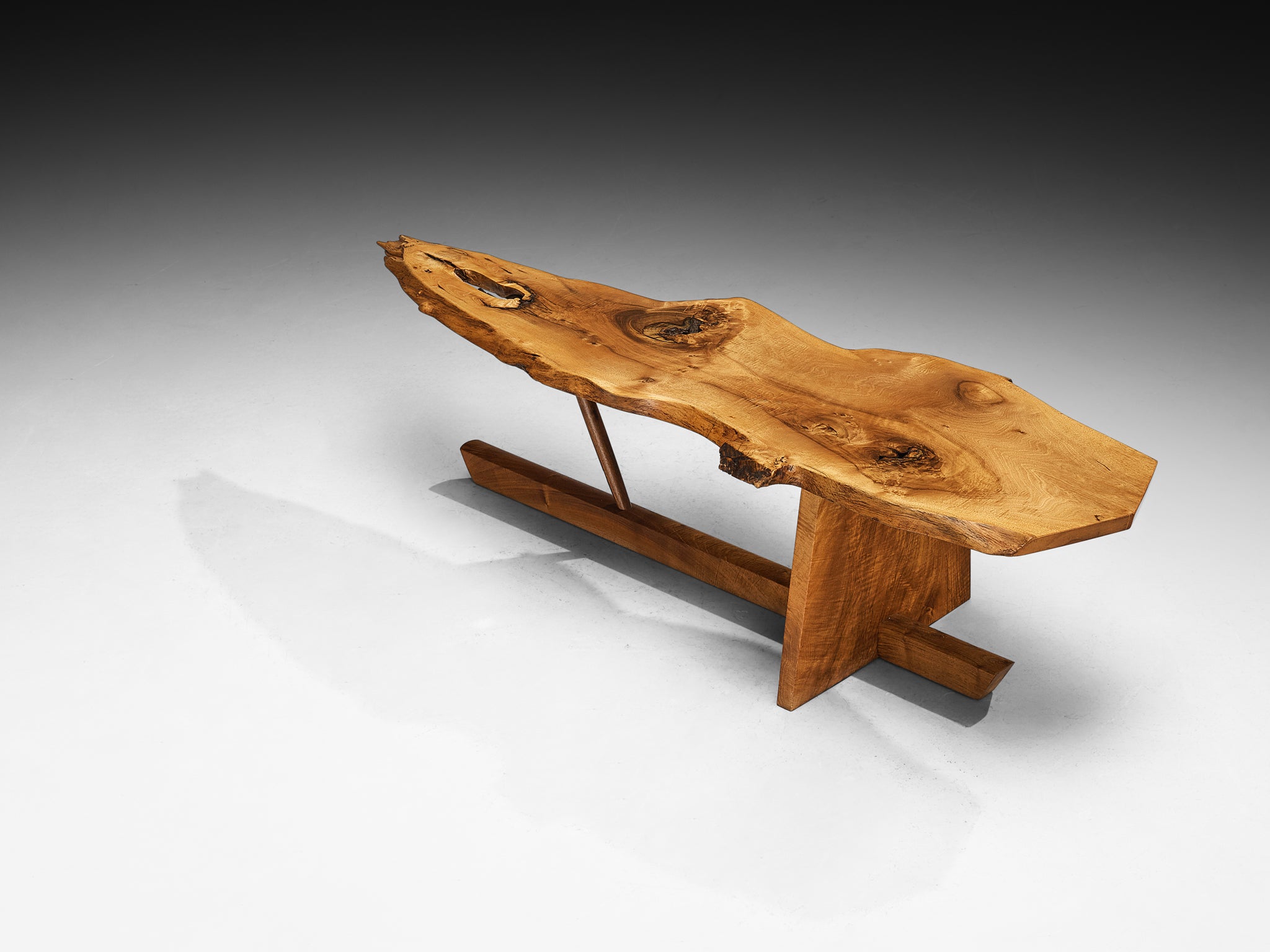
George Nakashima for George Nakashima Studio, 'Minguren II' coffee table, English walnut, American black walnut, United States, 1973
The Minguren II coffee table was developed in the mid-1960s in connection with George Nakashima’s work in Japan and his collaboration with Japanese sculptor Masayuki Nagare. Nagare was the founder of Minguren (“People’s Tool Guild”), a collective of designer-craftsmen formed to sustain traditional Japanese craft practices while adapting them for contemporary design. One of Nagare’s aims was to encourage American and European designers to have their works produced in Japan by members of the association.
George Nakashima’s career expanded its horizons to Japan in 1964, following his meeting with Masayuki Nagare and joining the Minguren group. This led to an enduring relationship with Sakura Seisakusho, their Takamatsu-based woodworking workshop responsible for producing Nakashima furniture in Japan and the only facility outside his New Hope studio authorized to do so. Takao Mitsuya, head of the furniture department at the Odakyu Department Store, invited Nakashima to present his work in a series of exhibitions featuring Western furniture designers. These exhibitions were highly successful and contributed to the growth of Nakashima’s reputation in Japan.
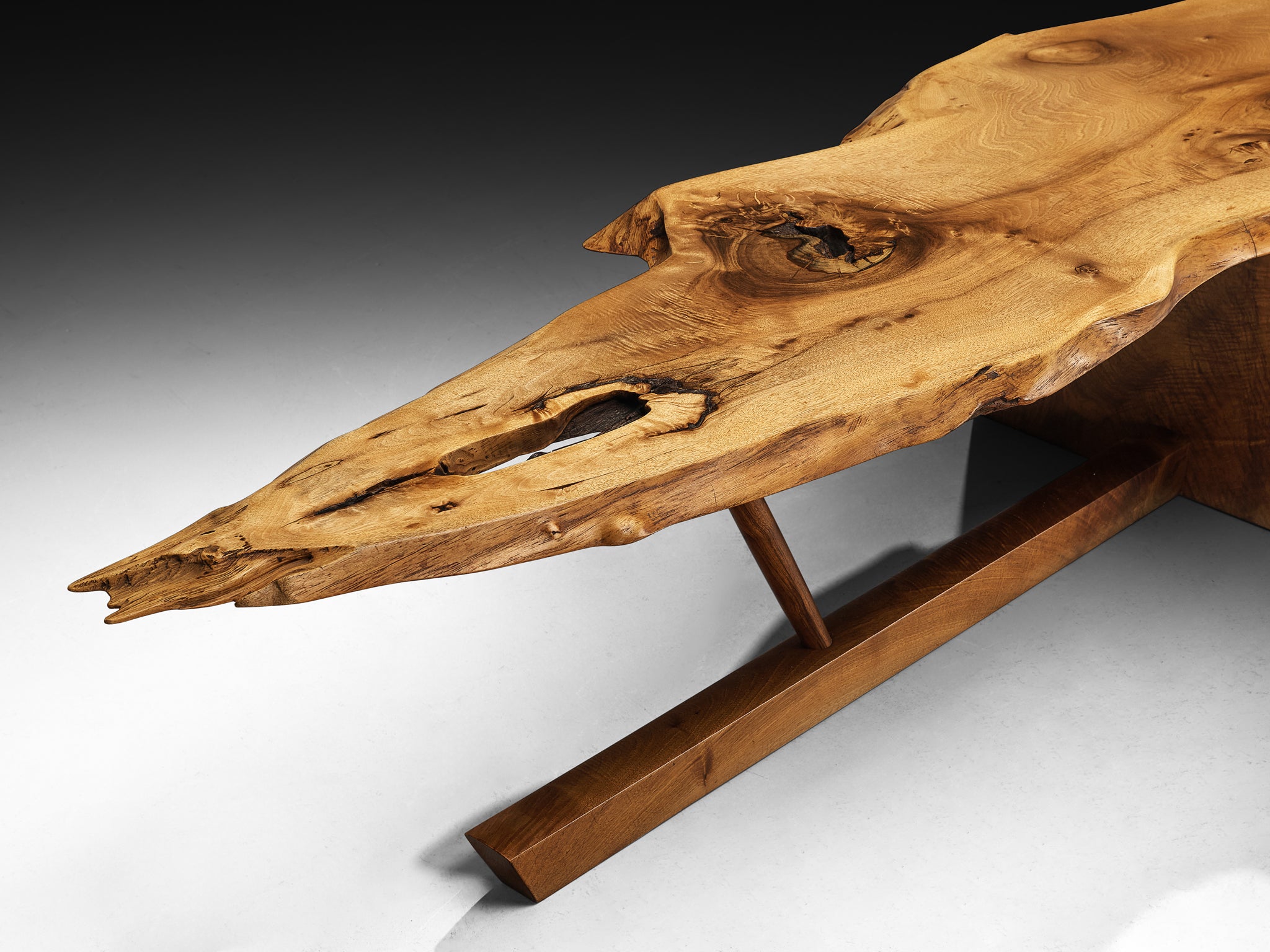
The present coffee table is a Minguren II model, custom made in 1973. Executed in English walnut – a rarely used material within his practice – the table emphasizes the distinctive character of the slab through its free-flowing edges. This approach highlights the natural qualities of the wood and lends the design a dynamic, unrestrained presence. It marks a departure from industrial mass production and aligns with a philosophy focused on revealing the “soul of the tree” through honest materials, skilled labor, and functional objects shaped by human hands.
The free-form top contrasts elegantly with the base’s stark simplicity, a hallmark of Nakashima’s work that reflects both nature’s order and the maker’s hand. The asymmetrical composition further enhances the piece’s visual strength and timeless appeal.
George Nakashima (1905-1990) was a well-known woodworker, architect and furniture designer from Japanese descendants. He was born in Spokane, Washington and enrolled in the University of Washington program in architecture. After his graduation in 1931, he decided to live his life as a bohemian in France. Afterwards, he spent some time in North Africa and eventually settled in Japan for some time. There, he started working for Antonin Raymond, who was an American architect. While working for Raymond, Nakashima extensively toured Japan while trying to understand the Japanese architecture and design. Around 1940, Nakashima decided to leave Japan and returned to the US. However, like many others with a Japanese ancestry, he was interned during World War Two and sent to Camp Minidoka in Idaho. There, Nakashima met a master woodcarver who tutored him in Japanese crafting techniques. From him, he learned to master traditional Japanese hand tools and joinery techniques. From here onwards, he began to use woodworking with discipline and patience, striving towards perfection in his designs. In 1943, he was released from the camp and invited by Antonin Raymond to live in his farm in New Hope, Pennsylvania. During this period, New Hope formed the home port for many great designers such as Phillip Lloyd Powell and Paul Evans. Nakashima was a very spiritual and philosophical designer. The basis of Nakashima's work was derived from his practice of integral yoga. Therefore, primary goal of Nakashima's work was to live in harmony with nature rather than to destroy it for their own use. Above all, Nakashima wanted to embody a message to all modern societies that we must constantly remember the eternal in all that we do. He often said of his own work that he gave trees a second life. His designs are known for their exquisite craftsmanship and are often 'signed' with dovetails and butterfly connections. With these ideas in mind, Nakashima created his own style based on Japanese designs and shop practices, combined with the American and International Modern Styles. Therefore, he became one of the best 20th century American Art furniture designers.
The Minguren II coffee table was developed in the mid-1960s in connection with George Nakashima’s work in Japan and his collaboration with Japanese sculptor Masayuki Nagare. Nagare was the founder of Minguren (“People’s Tool Guild”), a collective of designer-craftsmen formed to sustain traditional Japanese craft practices while adapting them for contemporary design. One of Nagare’s aims was to encourage American and European designers to have their works produced in Japan by members of the association.
George Nakashima’s career expanded its horizons to Japan in 1964, following his meeting with Masayuki Nagare and joining the Minguren group. This led to an enduring relationship with Sakura Seisakusho, their Takamatsu-based woodworking workshop responsible for producing Nakashima furniture in Japan and the only facility outside his New Hope studio authorized to do so. Takao Mitsuya, head of the furniture department at the Odakyu Department Store, invited Nakashima to present his work in a series of exhibitions featuring Western furniture designers. These exhibitions were highly successful and contributed to the growth of Nakashima’s reputation in Japan.
The present coffee table is a Minguren II model, custom made in 1973. Executed in English walnut – a rarely used material within his practice – the table emphasizes the distinctive character of the slab through its free-flowing edges. This approach highlights the natural qualities of the wood and lends the design a dynamic, unrestrained presence. It marks a departure from industrial mass production and aligns with a philosophy focused on revealing the “soul of the tree” through honest materials, skilled labor, and functional objects shaped by human hands.
The free-form top contrasts elegantly with the base’s stark simplicity, a hallmark of Nakashima’s work that reflects both nature’s order and the maker’s hand. The asymmetrical composition further enhances the piece’s visual strength and timeless appeal.
George Nakashima (1905-1990) was a well-known woodworker, architect and furniture designer from Japanese descendants. He was born in Spokane, Washington and enrolled in the University of Washington program in architecture. After his graduation in 1931, he decided to live his life as a bohemian in France. Afterwards, he spent some time in North Africa and eventually settled in Japan for some time. There, he started working for Antonin Raymond, who was an American architect. While working for Raymond, Nakashima extensively toured Japan while trying to understand the Japanese architecture and design. Around 1940, Nakashima decided to leave Japan and returned to the US. However, like many others with a Japanese ancestry, he was interned during World War Two and sent to Camp Minidoka in Idaho. There, Nakashima met a master woodcarver who tutored him in Japanese crafting techniques. From him, he learned to master traditional Japanese hand tools and joinery techniques. From here onwards, he began to use woodworking with discipline and patience, striving towards perfection in his designs. In 1943, he was released from the camp and invited by Antonin Raymond to live in his farm in New Hope, Pennsylvania. During this period, New Hope formed the home port for many great designers such as Phillip Lloyd Powell and Paul Evans. Nakashima was a very spiritual and philosophical designer. The basis of Nakashima's work was derived from his practice of integral yoga. Therefore, primary goal of Nakashima's work was to live in harmony with nature rather than to destroy it for their own use. Above all, Nakashima wanted to embody a message to all modern societies that we must constantly remember the eternal in all that we do. He often said of his own work that he gave trees a second life. His designs are known for their exquisite craftsmanship and are often 'signed' with dovetails and butterfly connections. With these ideas in mind, Nakashima created his own style based on Japanese designs and shop practices, combined with the American and International Modern Styles. Therefore, he became one of the best 20th century American Art furniture designers.

Choose options
George Nakashima 'Minguren II' Coffee Table in English Walnut
Sale price£100,685.35
Regular price
Product Details
VAT within the EU: When buying or delivering an item within the EU, VAT usually applies and will be added.