
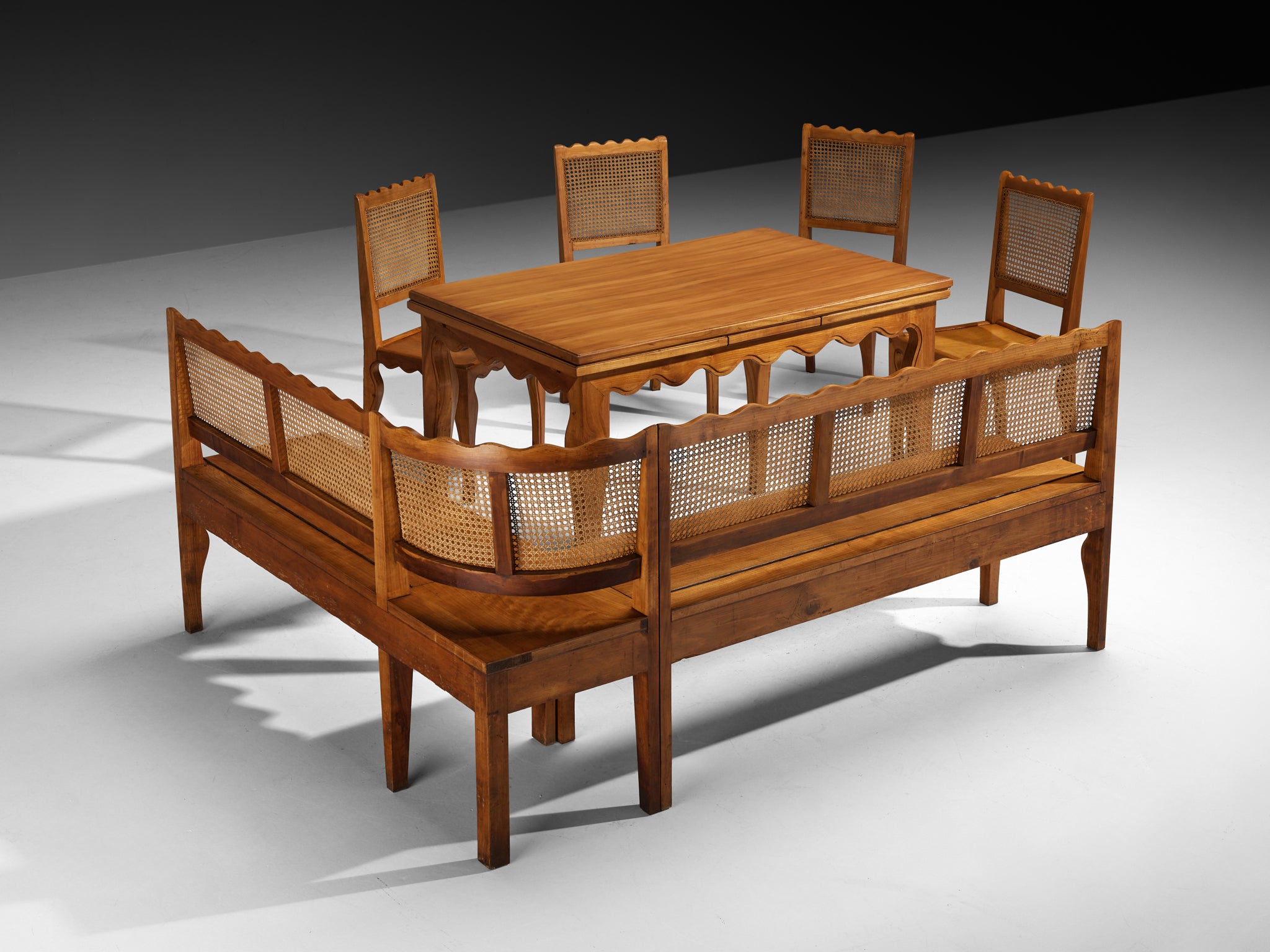
1940s Paolo Buffa Custom Dining Room Set in Cherry Wood and Cane
 Open here
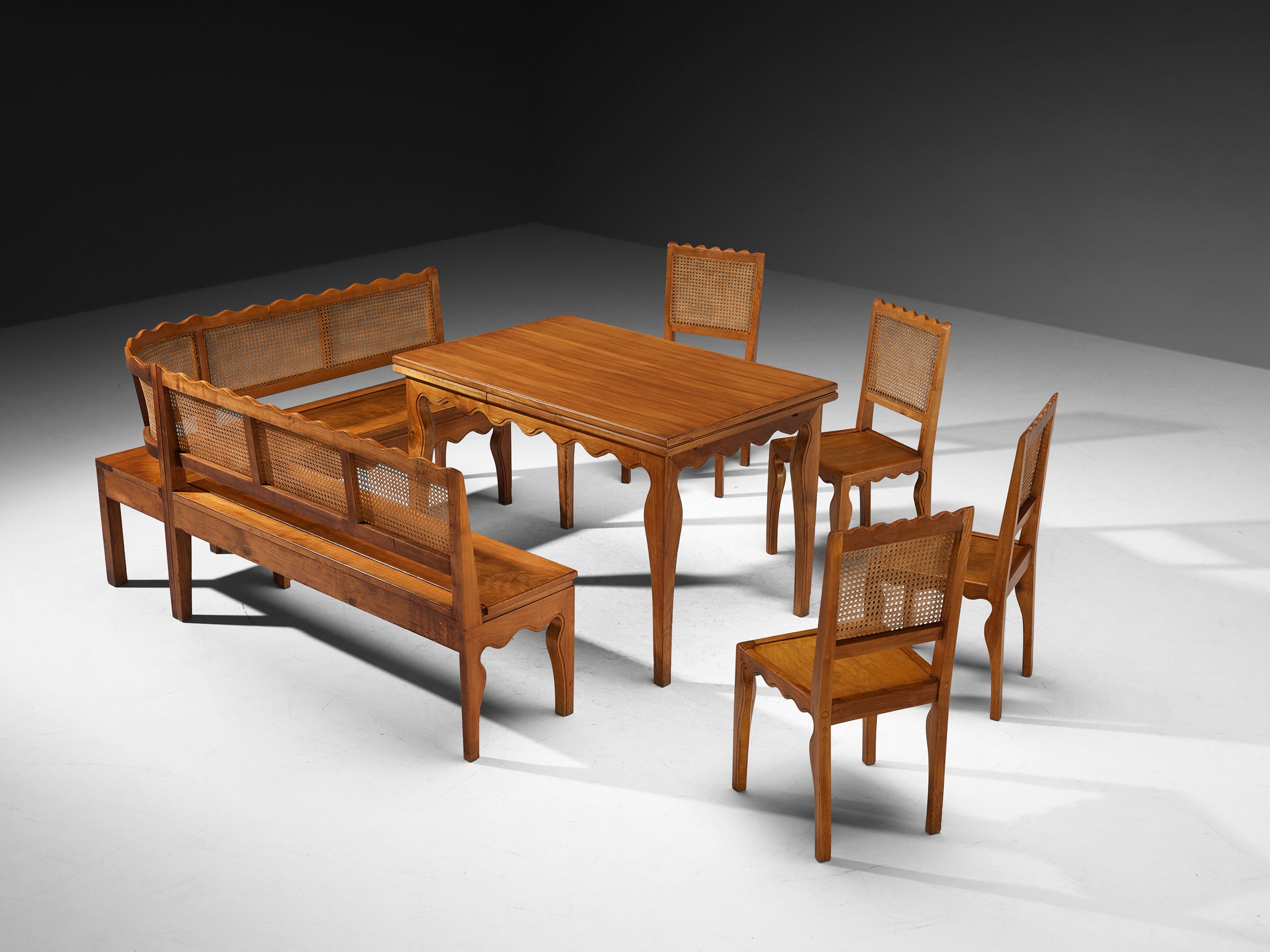
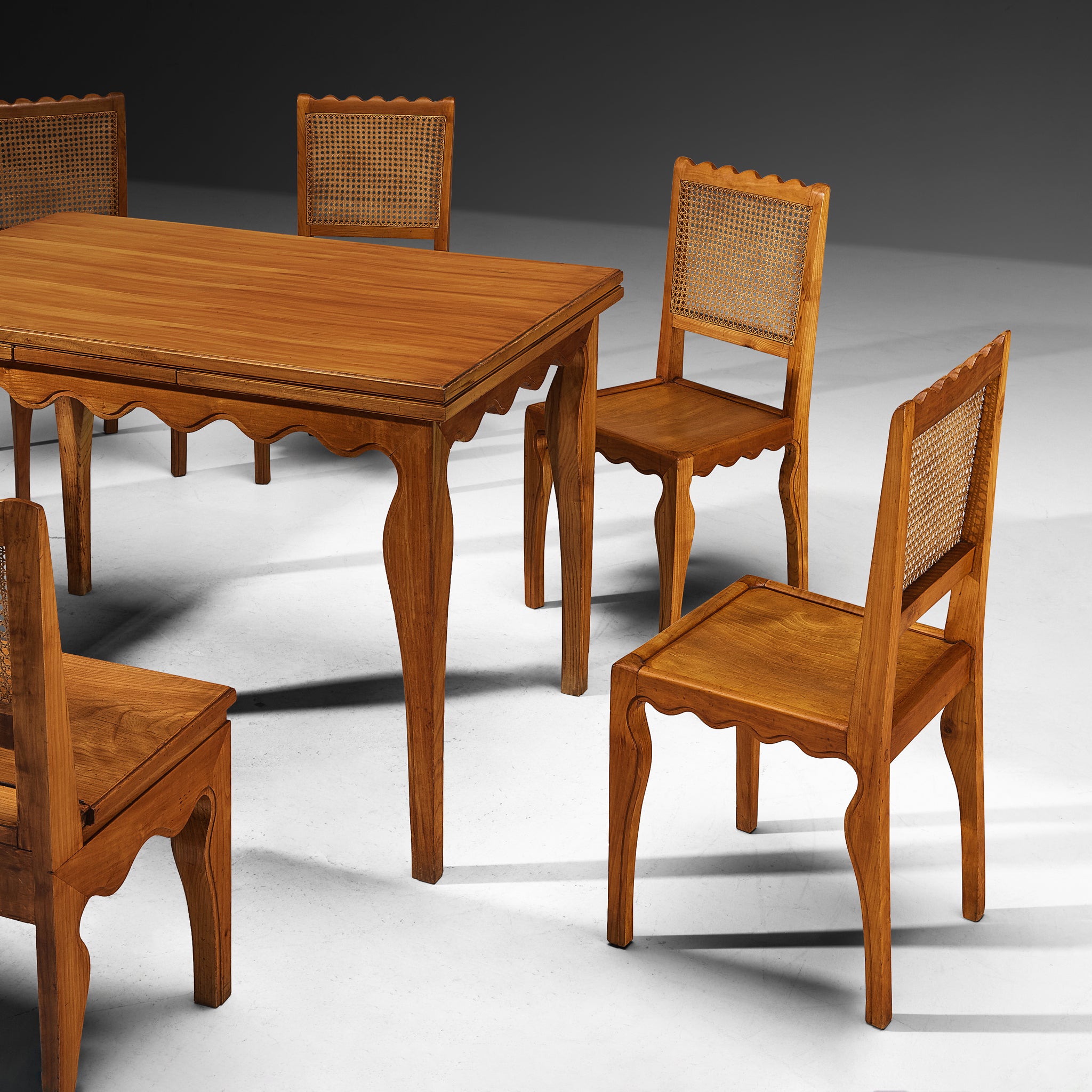
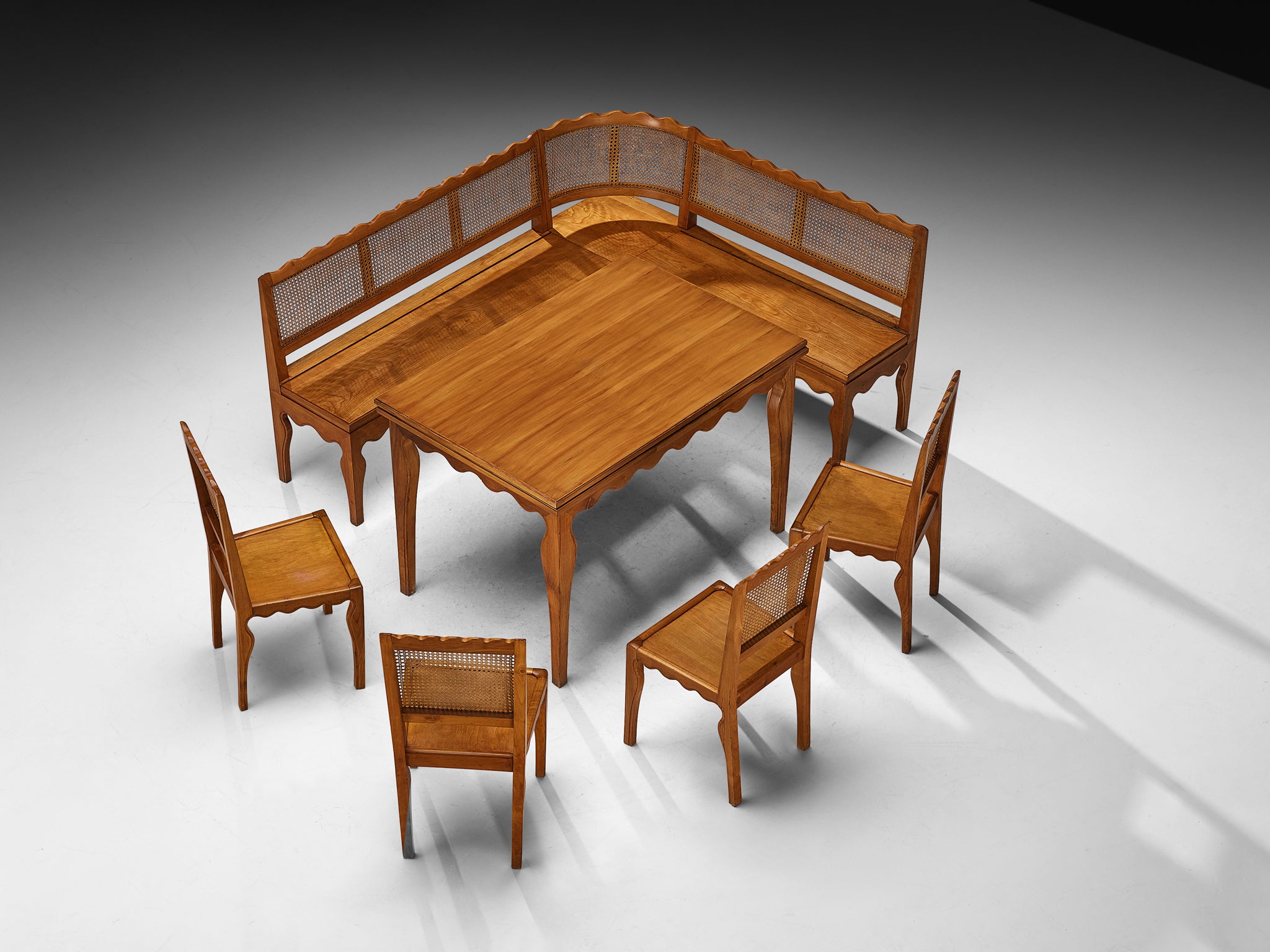
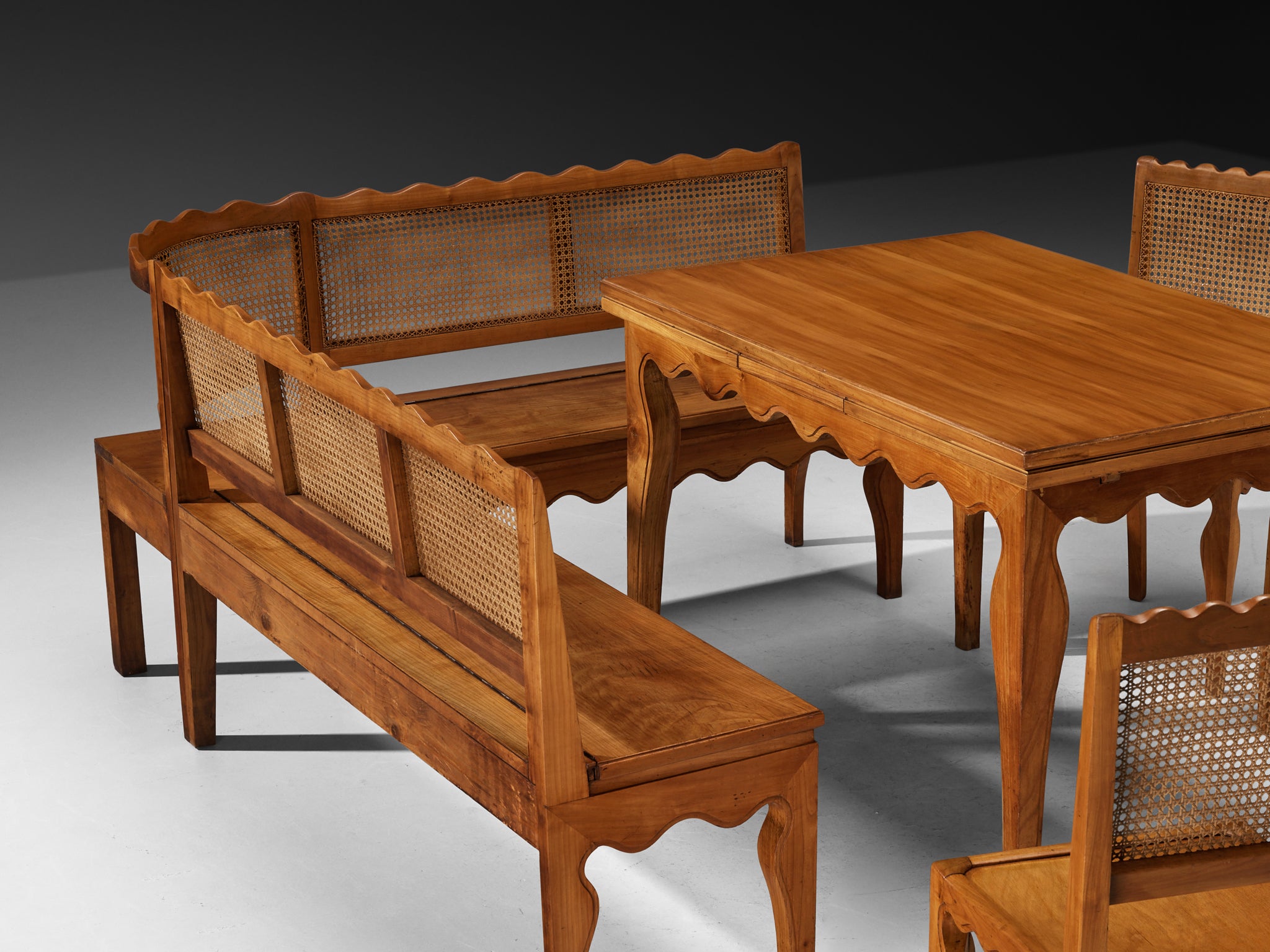
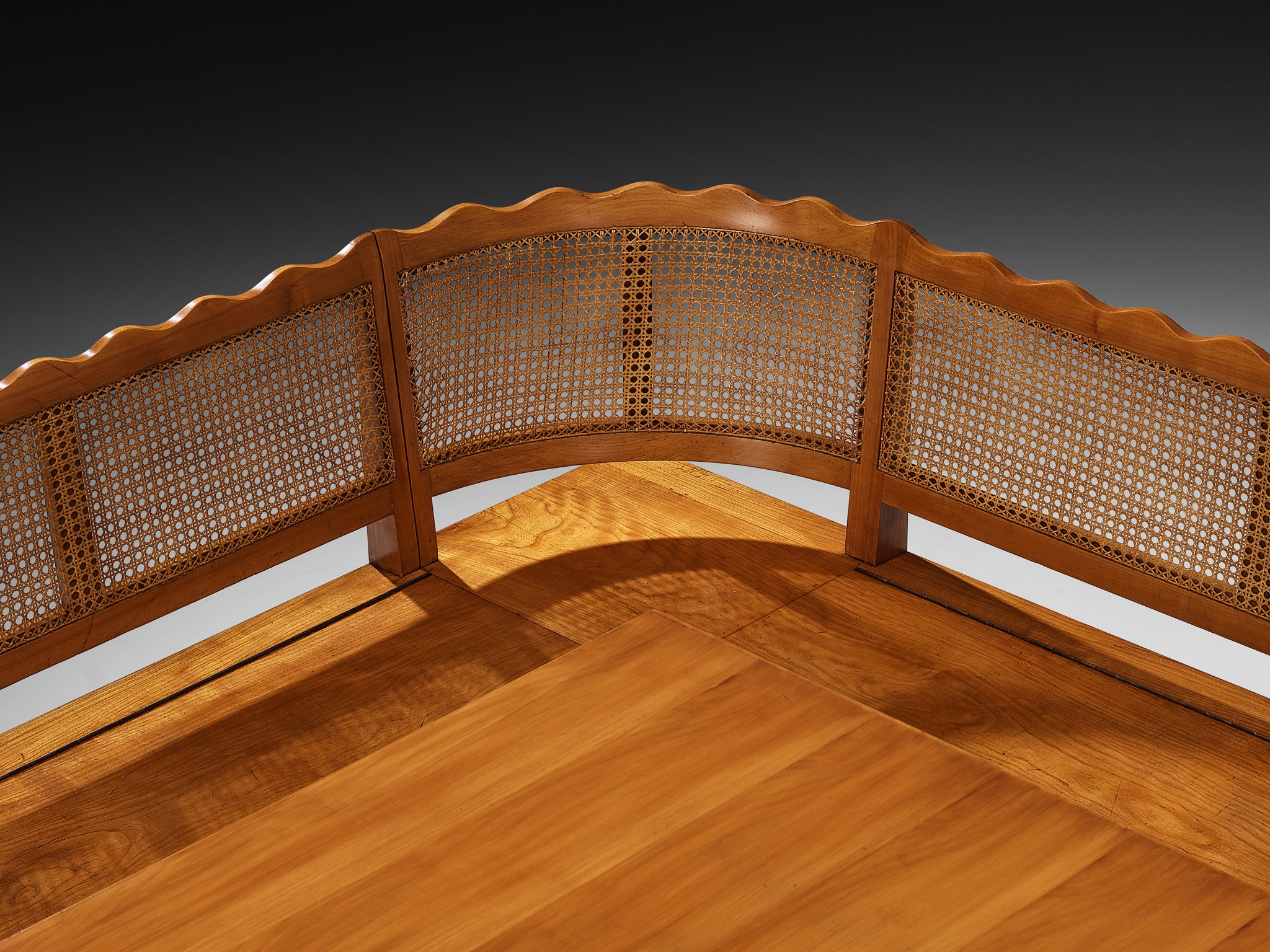
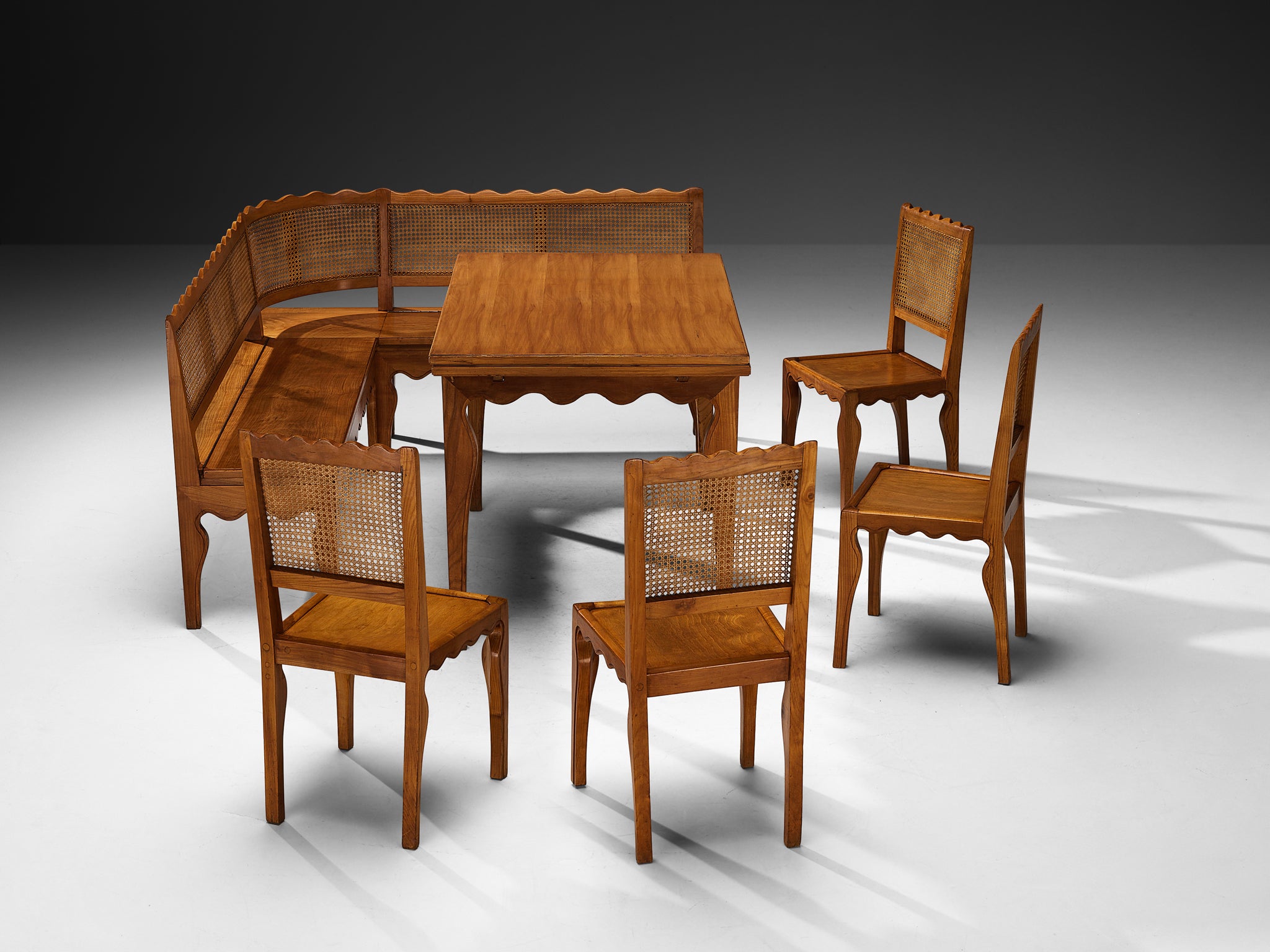
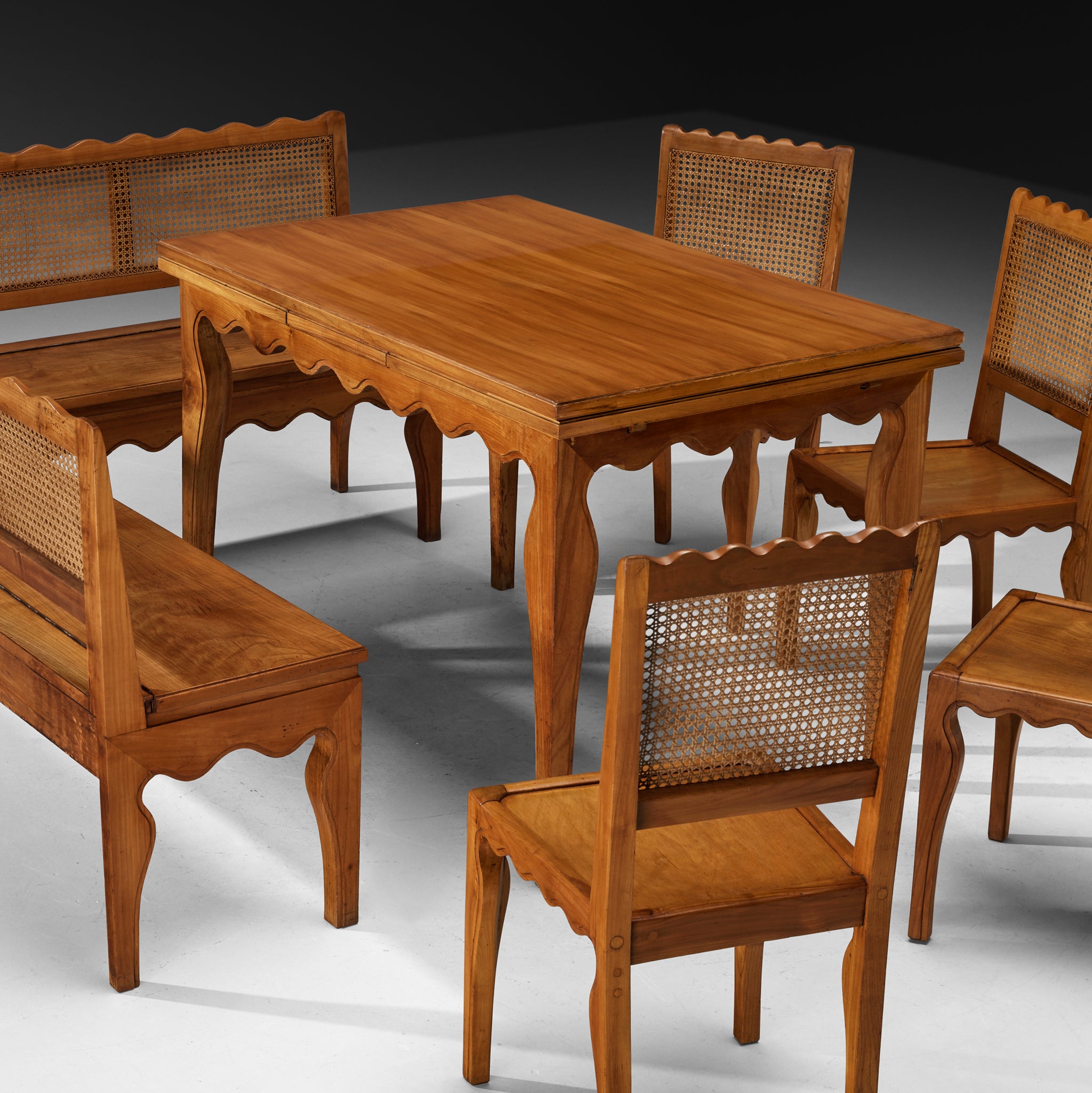
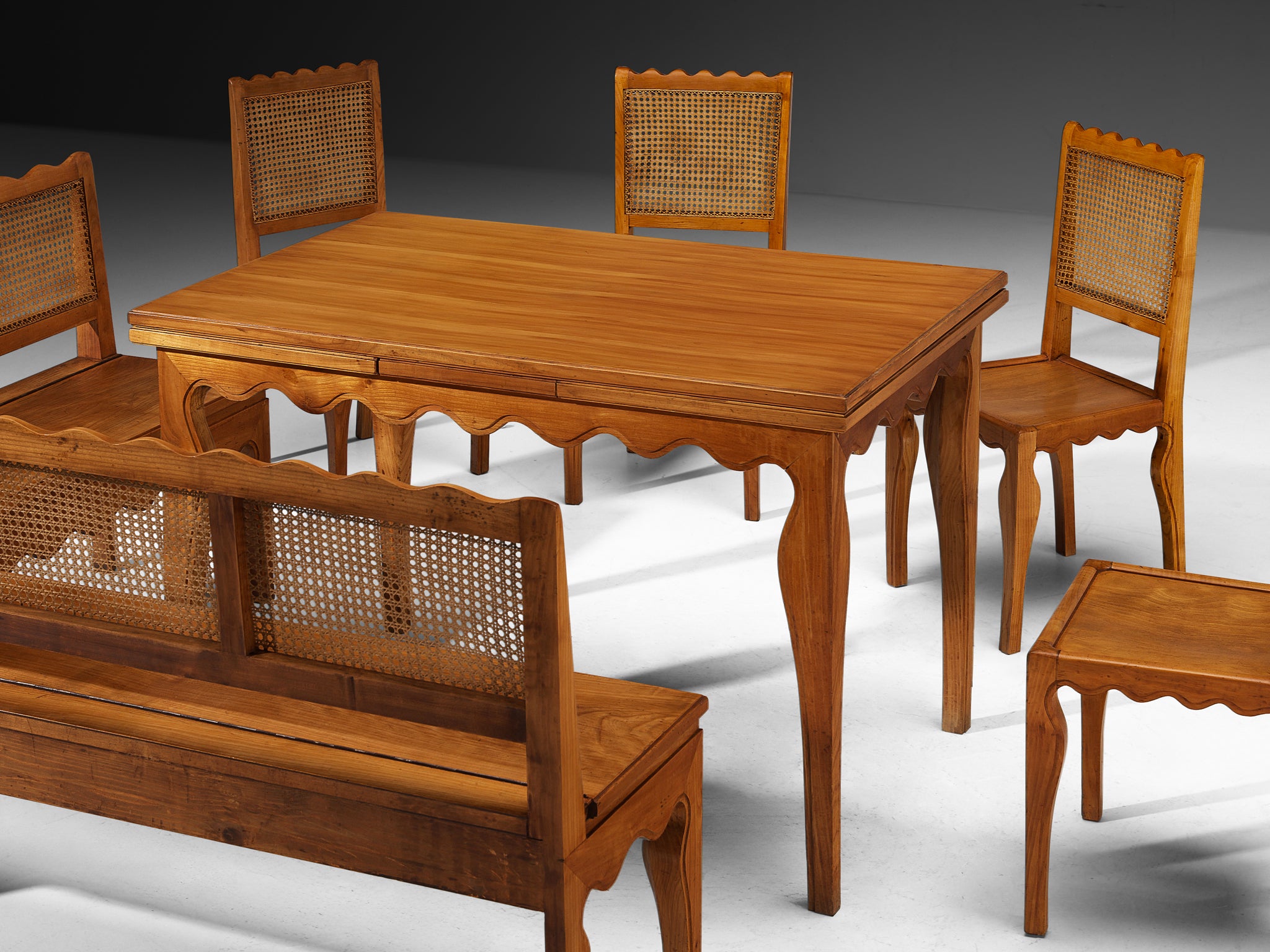
Paolo Buffa, custom dining room set consisting of four chairs, a bench, and table, cherry, cane, Italy, 1940s
Paolo Buffa was a prominent figure in the realm of Italian furniture design and architecture. He played a significant role in the renewal of Italian applied arts during the early twentieth century, with a career spanning almost half a century. In an unusual departure from his neoclassical designs with a modern touch, Buffa employed a rustic aesthetic to create this custom-made set, dating from the 1940s.
Buffa's dining ensemble is characterized by a distinctly rustic aesthetic and the use of natural cherry and cane, an unusual choice within the designer's oeuvre. This quality makes the designs particularly intriguing, as Buffa is primarily celebrated for his refined neoclassical furniture with its elegant proportions and sophisticated detailing. Although rustic designs appear at certain moments throughout his career, they constitute only a small fraction of his overall production.
The rustic approach can also be observed in a select group of Buffa's cabinets, where sinuous forms and carved fronts evoke the texture of woven baskets. Such works demonstrate that, while Buffa was primarily associated with refined neoclassical designs, he also explored a more organic and materially expressive design language.
Despite its apparent simplicity, the present chairs, table, and bench remain unmistakably a creation of Paolo Buffa. His restrained use of ornament allows the natural qualities of the cherry and cane to take center stage, while the undulating curve emerges as the defining feature of the design. This recurring motif appears throughout Buffa's work and serves as an immediate marker of his authorship.
The deceptively uncomplicated appearance conceals a sophisticated level of craftsmanship, combining carefully selected materials with subtle carving techniques. As with much of Buffa's furniture, refinement is achieved not through excess decoration but through an exceptional understanding of proportion, material, and form.
Biography
Paolo Buffa (born 1903, Milan – died 1970, Milan), a distinguished figure in the world of Italian furniture design and architecture, graced the scene with his unmistakable style for a span of almost fifty years. Buffa’s artistic repertoire is notably distinguished by his expert fusion of neoclassical and sleek Art Deco formal elements. Crafted with finesse and elegance, Buffa’s premium-quality pieces were fashioned from refined materials, with the explicit purpose of furnishing the homes of a discerning and affluent clientele. These furniture creations were tailored to meet the demands of individuals who were inclined towards contemporary aesthetics, functionalism, and comfort. Buffa’s creative repertoire extended beyond furniture design to architecture, and he undertook an array of commissions that spanned public buildings, as well as villas and country homes.
Paolo Buffa’s formative years were spent amidst an artistic milieu, having been born to Giovanni Buffa, a renowned draftsman of exceptional talent. Giovanni Buffa shared ownership of a highly prosperous workshop dedicated to the creation of exquisite stained glass artistry. Among his notable works are the stained glass windows of the illustrious Duomo di Milano, a historic cathedral located in Milan. Such a creative household fostered an environment of artistic excellence, which undoubtedly played a crucial role in shaping Paolo Buffa’s artistic sensibilities.
Buffa’s artistic training commenced at the prestigious Accademia di Belle Arti di Brera, and he eventually obtained his degree from the Politecnico di Milano in 1927. After gaining experience working in his father’s studio, Buffa went on to work as an apprentice at the Ponti e Lancia studio, which was jointly owned by the celebrated architects Gio Ponti (1891- 1979) and Emilio Lancia (1890-1973). This experience proved to be a significant turning point in Buffa’s career, as he drew inspiration from Lombard Neoclassicism and was exposed to the ideas and concepts of some of the most prominent architects of the region. He assimilated these teachings and employed them in his own work, which was characterized by a fusion of traditional Lombard woodworking techniques and modern design aesthetics.
In 1928, Paolo Buffa founded his own design studio in Milan in partnership with architect Antonio Cassi Ramelli (1905-1980). Here, they produced an extensive collection of furniture designs that drew inspiration from the classical revival style, albeit with a softened touch. In 1936, Buffa branched out on his own to establish an independent studio. He made a name for himself by showcasing his work at exhibitions, including the prestigious Triennale di Milano. Buffa’s furnishings were numerous and varied, but always tailored to the specific needs and desires of his discerning clients. Each piece was crafted to perfection by highly skilled artisans, such as cabinetmakers Turri Mosè, Fratelli Lietti, Quarti, Serafino Arrighi, Colico, and Angelo Marelli. Buffa’s passion for design persisted throughout his life, and he remained actively engaged in the field until his death in 1970.
Paolo Buffa was a prominent figure in the realm of Italian furniture design and architecture. He played a significant role in the renewal of Italian applied arts during the early twentieth century, with a career spanning almost half a century. In an unusual departure from his neoclassical designs with a modern touch, Buffa employed a rustic aesthetic to create this custom-made set, dating from the 1940s.
Buffa's dining ensemble is characterized by a distinctly rustic aesthetic and the use of natural cherry and cane, an unusual choice within the designer's oeuvre. This quality makes the designs particularly intriguing, as Buffa is primarily celebrated for his refined neoclassical furniture with its elegant proportions and sophisticated detailing. Although rustic designs appear at certain moments throughout his career, they constitute only a small fraction of his overall production.
The rustic approach can also be observed in a select group of Buffa's cabinets, where sinuous forms and carved fronts evoke the texture of woven baskets. Such works demonstrate that, while Buffa was primarily associated with refined neoclassical designs, he also explored a more organic and materially expressive design language.
Despite its apparent simplicity, the present chairs, table, and bench remain unmistakably a creation of Paolo Buffa. His restrained use of ornament allows the natural qualities of the cherry and cane to take center stage, while the undulating curve emerges as the defining feature of the design. This recurring motif appears throughout Buffa's work and serves as an immediate marker of his authorship.
The deceptively uncomplicated appearance conceals a sophisticated level of craftsmanship, combining carefully selected materials with subtle carving techniques. As with much of Buffa's furniture, refinement is achieved not through excess decoration but through an exceptional understanding of proportion, material, and form.
Biography
Paolo Buffa (born 1903, Milan – died 1970, Milan), a distinguished figure in the world of Italian furniture design and architecture, graced the scene with his unmistakable style for a span of almost fifty years. Buffa’s artistic repertoire is notably distinguished by his expert fusion of neoclassical and sleek Art Deco formal elements. Crafted with finesse and elegance, Buffa’s premium-quality pieces were fashioned from refined materials, with the explicit purpose of furnishing the homes of a discerning and affluent clientele. These furniture creations were tailored to meet the demands of individuals who were inclined towards contemporary aesthetics, functionalism, and comfort. Buffa’s creative repertoire extended beyond furniture design to architecture, and he undertook an array of commissions that spanned public buildings, as well as villas and country homes.
Paolo Buffa’s formative years were spent amidst an artistic milieu, having been born to Giovanni Buffa, a renowned draftsman of exceptional talent. Giovanni Buffa shared ownership of a highly prosperous workshop dedicated to the creation of exquisite stained glass artistry. Among his notable works are the stained glass windows of the illustrious Duomo di Milano, a historic cathedral located in Milan. Such a creative household fostered an environment of artistic excellence, which undoubtedly played a crucial role in shaping Paolo Buffa’s artistic sensibilities.
Buffa’s artistic training commenced at the prestigious Accademia di Belle Arti di Brera, and he eventually obtained his degree from the Politecnico di Milano in 1927. After gaining experience working in his father’s studio, Buffa went on to work as an apprentice at the Ponti e Lancia studio, which was jointly owned by the celebrated architects Gio Ponti (1891- 1979) and Emilio Lancia (1890-1973). This experience proved to be a significant turning point in Buffa’s career, as he drew inspiration from Lombard Neoclassicism and was exposed to the ideas and concepts of some of the most prominent architects of the region. He assimilated these teachings and employed them in his own work, which was characterized by a fusion of traditional Lombard woodworking techniques and modern design aesthetics.
In 1928, Paolo Buffa founded his own design studio in Milan in partnership with architect Antonio Cassi Ramelli (1905-1980). Here, they produced an extensive collection of furniture designs that drew inspiration from the classical revival style, albeit with a softened touch. In 1936, Buffa branched out on his own to establish an independent studio. He made a name for himself by showcasing his work at exhibitions, including the prestigious Triennale di Milano. Buffa’s furnishings were numerous and varied, but always tailored to the specific needs and desires of his discerning clients. Each piece was crafted to perfection by highly skilled artisans, such as cabinetmakers Turri Mosè, Fratelli Lietti, Quarti, Serafino Arrighi, Colico, and Angelo Marelli. Buffa’s passion for design persisted throughout his life, and he remained actively engaged in the field until his death in 1970.

Choose options
1940s Paolo Buffa Custom Dining Room Set in Cherry Wood and Cane
Sale price£49,050.97
Regular price
Product Details
VAT within the EU: When buying or delivering an item within the EU, VAT usually applies and will be added.