
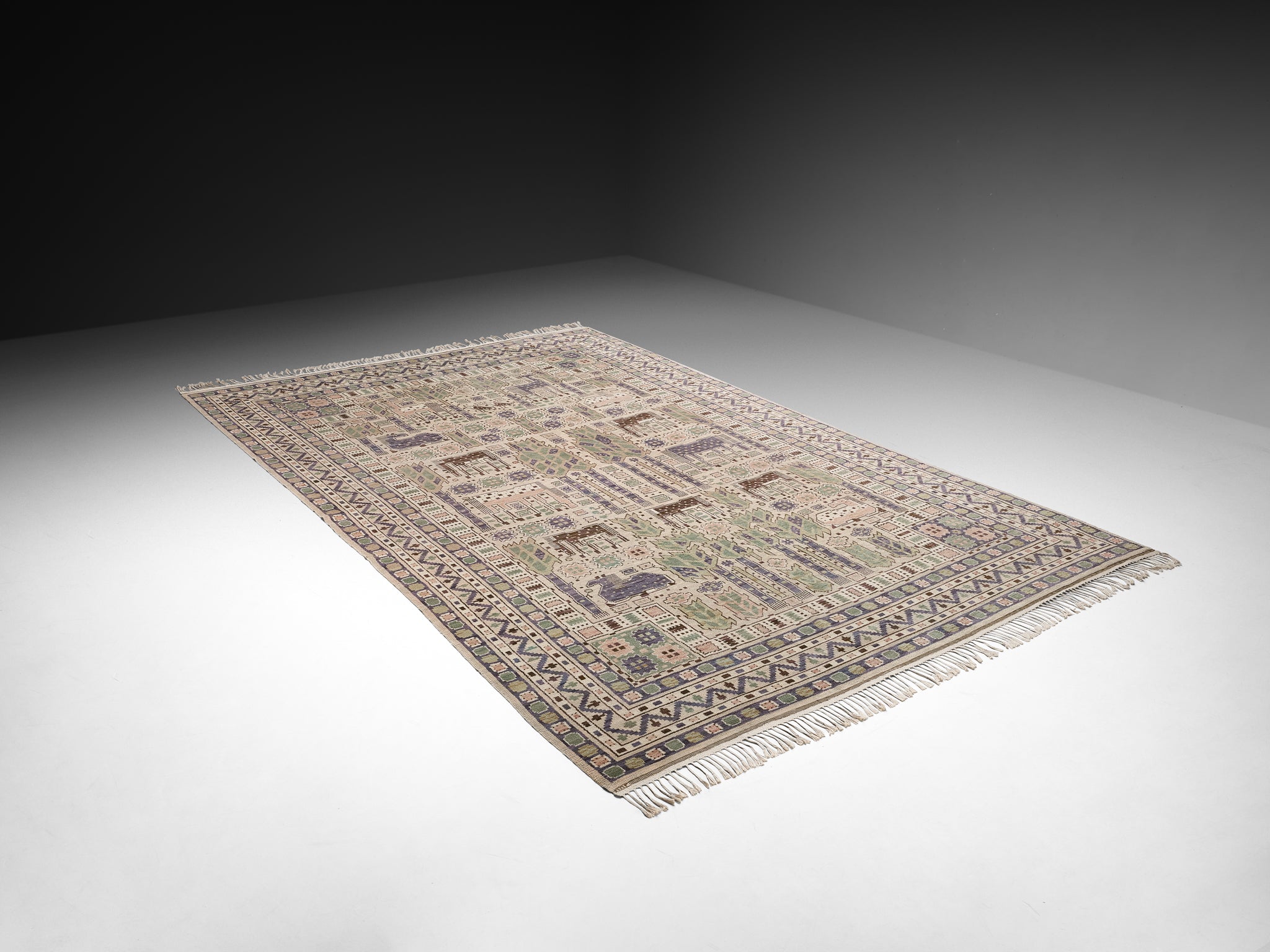


Märta Måås-Fjetterström Rare and Large 'Hästhagen' Carpet in Wool 522cm/205.51in.
Tearsheet
×
Receive a copy in your email or download directly:
I accept emails from Morentz.
 Open here
Märta Måås-Fjetterström, 'Hästhagen' carpet, wool on linen warp, Sweden, design 1923, woven 1930s
This exceptional handwoven 'Hästhagen' carpet was designed by Märta Måås-Fjetterström (1873–1941), one of Sweden's most influential textile artists of the twentieth century. Not only is this carpet beautifully designed, its size of 522 x 326.5 cm (205.51 x 128.54 in.) which is one of the largest examples known to exist, makes it even more impressive. Hästhagen was first created for The Gothenburg Tercentennial Jubilee Exhibition in 1923, an event that drew over four million visitors. It was instrumental in establishing a new design identity in Sweden, one that united elements of tradition and modernity. At a time when economic decline and post-war hardship dominated European discourse, the exhibition offered a positive and diverse perspective. A version of the carpet was presented as a wedding gift to the Crown Prince and Princess of Norway, Olav and Märtha. The Norwegian Royal Family commissioned another identical rug. The carpet is regarded as one of Märta Måås-Fjetterström’s most important works.
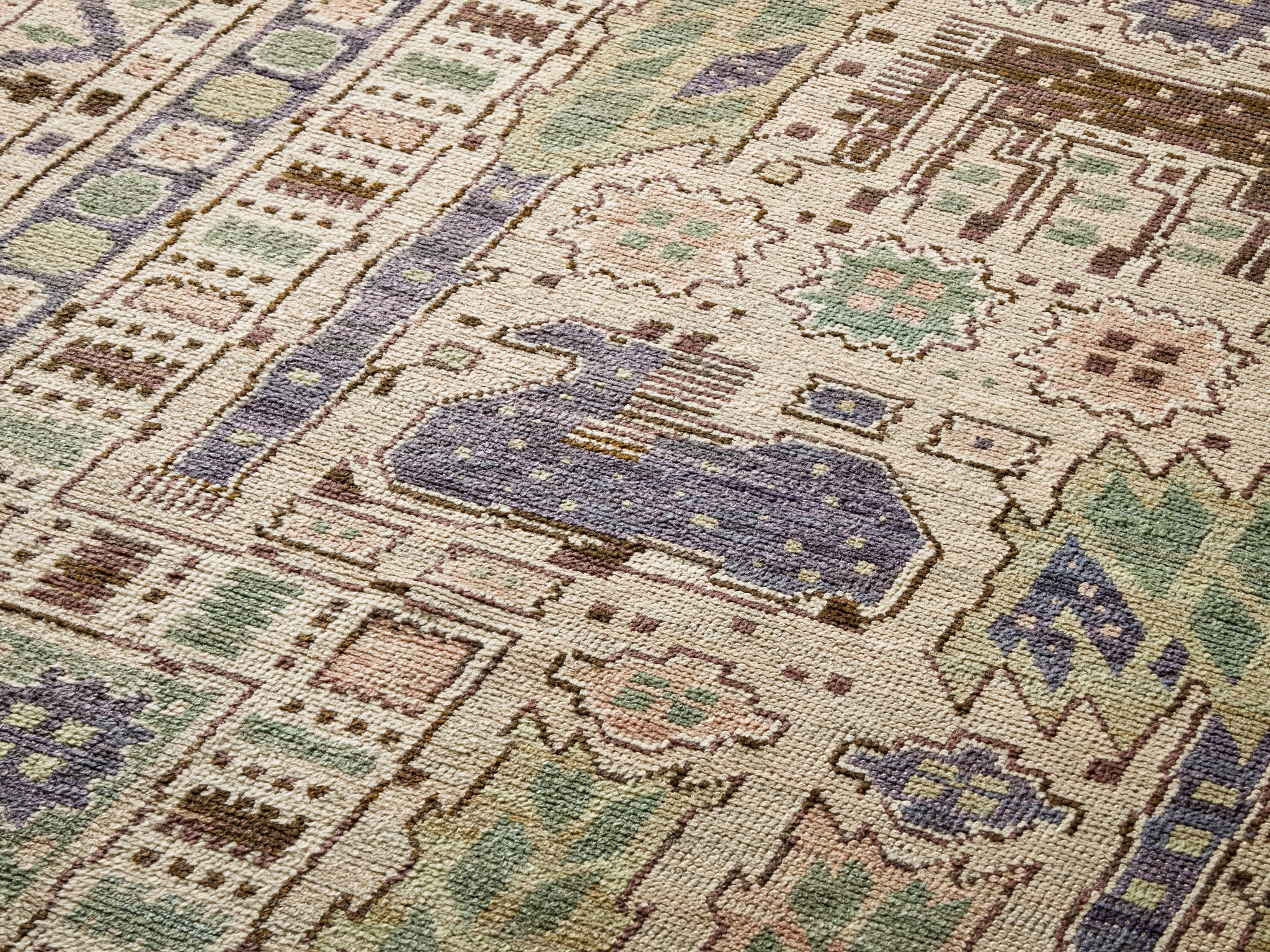
This carpet was crafted using the knotted pile technique, the most exclusive and time-intensive weaving method. Highly favored by the artisans, this technique involves individually hand-knotting the knots around a ruler before cutting it to create a smooth surface. The resulting texture is thick and raised, enhancing the depth and intensity of the colors. The dense knotting allows for highly intricate patterns. The layout of the carpet showcases a striking composition of abstract geometric shapes and figurative motifs. Dominated by natural muted tones that are undoubtedly Nordic, its most depicted horse figure in various constellations aligns with the meaning of “'Hästhagen” – Swedish for “Horse Pasture”. The rug is further framed by fringes on two sides.
The bottom of the carpet bears the inscription: "MMF" (Märta Måås-Fjetterström’s initials).
Biography
Märta Måås-Fjetterström was born 1873 in Kimstad, a small village located in Östergötland, Sweden. At the age of seventeen, she participated the School of Industrial Arts in Stockholm with a major in art and followed a training as an illustrator and drawing teacher. After she had graduated, she started working as a teacher in the weaving studio at the Lund Museum of Cultural History (Kulturen). She was commissioned by Georg Karlin, the founder of Kulturen, to create her first textile sketches. After some years, she became the director of the Malmöhus County Handicraft Association in Malmö. Both schools, and many other institutions like these in Sweden at that time, aimed at preserving the traditional principles of Scandinavian design as a response to progressive art movements that flourished in other European countries like the Art Deco movement. Måås-Fjetterström was at that time searching for new ways to improve and individualize the traditional methods and motifs she encountered. Her ingenuity and creative approach towards the textile arts were perceived as a threat to Hemslöjden's preservation of their traditional patterns and techniques, which is why she was fired in 1911.
Shortly thereafter Måås-Fjetterström awaited a new opportunity and moved to Vittsjö where she met Lilli Zickerman (1858-1949), initiator of the National Association of Swedish Handicraft Societies. Together they directed a new weaving school where Måås-Fjetterström enjoyed her artistic independency. The school provided a workshop with skilled weavers who made it to weave the carpets and tapestries designed by Måås-Fjetterström. She developed techniques and patterns suitable for artistically produced rugs and tapestries, which were given titles and signed “MMF”. The ‘Blommande träd’ rug that is now on display is a great example of a design made by Måås-Fjetterström during this period.
In 1919, at the age of 46, Märta Måås-Fjetterström opened her own company and a weaving studio in Båstad, Sweden. At this point, she would come to revolutionize the Swedish textile tradition. She employed over twenty skilled weavers, of which the first women were her former students from the Vittsjö weaving school. Her main sources of inspiration were the nature around here, oriental knotted rugs and old Scanian textiles. Måås-Fjetterström's designs continuously changed along with the world’s zeitgeist and aesthetics. When modernist and functional architecture flourished in the 1930s, her designs took a more simplistic turn by the implementation of balanced simple lines and shapes executed in a few colors. She gained huge success on an international scale and exhibited at prominent art and industrial exhibitions in various cities located in Europe and the United States.
Towards the end of 1940, she wrote her lifelong friend Carl Malmsten (1888-1972): “But the road is long and instead of decreasing, the projects and sketches in my drawer accumulate, as if waiting to be realised. Before you can finish, life is over. I wish I could continue on another planet.” Måås-Fjetterström dies in 1941 after a period of illness, only 67 years old. She left almost 700 sketches of patterns for rugs and fabrics and working instructions, but not to forget, a hard-working team of professional weavers. The company was about to close its doors until Carl Malmsten, among others, arranged a fundraiser that saved the collection and the studio. In January 1942, AB Märta Måås-Fjetterström is launched and is directed by the textile artist Barbro Nilsson between 1942 and 1970.
Up until this day, the studio is widely recognized for its carpets and tapestries of remarkable skillful craftsmanship and designs of artistic and cultural value. Their approach to design and weaving is passed on from generation to generation. A team composed of well-educated weavers using the exact same techniques devised over 100 years ago.
This exceptional handwoven 'Hästhagen' carpet was designed by Märta Måås-Fjetterström (1873–1941), one of Sweden's most influential textile artists of the twentieth century. Not only is this carpet beautifully designed, its size of 522 x 326.5 cm (205.51 x 128.54 in.) which is one of the largest examples known to exist, makes it even more impressive. Hästhagen was first created for The Gothenburg Tercentennial Jubilee Exhibition in 1923, an event that drew over four million visitors. It was instrumental in establishing a new design identity in Sweden, one that united elements of tradition and modernity. At a time when economic decline and post-war hardship dominated European discourse, the exhibition offered a positive and diverse perspective. A version of the carpet was presented as a wedding gift to the Crown Prince and Princess of Norway, Olav and Märtha. The Norwegian Royal Family commissioned another identical rug. The carpet is regarded as one of Märta Måås-Fjetterström’s most important works.
This carpet was crafted using the knotted pile technique, the most exclusive and time-intensive weaving method. Highly favored by the artisans, this technique involves individually hand-knotting the knots around a ruler before cutting it to create a smooth surface. The resulting texture is thick and raised, enhancing the depth and intensity of the colors. The dense knotting allows for highly intricate patterns. The layout of the carpet showcases a striking composition of abstract geometric shapes and figurative motifs. Dominated by natural muted tones that are undoubtedly Nordic, its most depicted horse figure in various constellations aligns with the meaning of “'Hästhagen” – Swedish for “Horse Pasture”. The rug is further framed by fringes on two sides.
The bottom of the carpet bears the inscription: "MMF" (Märta Måås-Fjetterström’s initials).
Biography
Märta Måås-Fjetterström was born 1873 in Kimstad, a small village located in Östergötland, Sweden. At the age of seventeen, she participated the School of Industrial Arts in Stockholm with a major in art and followed a training as an illustrator and drawing teacher. After she had graduated, she started working as a teacher in the weaving studio at the Lund Museum of Cultural History (Kulturen). She was commissioned by Georg Karlin, the founder of Kulturen, to create her first textile sketches. After some years, she became the director of the Malmöhus County Handicraft Association in Malmö. Both schools, and many other institutions like these in Sweden at that time, aimed at preserving the traditional principles of Scandinavian design as a response to progressive art movements that flourished in other European countries like the Art Deco movement. Måås-Fjetterström was at that time searching for new ways to improve and individualize the traditional methods and motifs she encountered. Her ingenuity and creative approach towards the textile arts were perceived as a threat to Hemslöjden's preservation of their traditional patterns and techniques, which is why she was fired in 1911.
Shortly thereafter Måås-Fjetterström awaited a new opportunity and moved to Vittsjö where she met Lilli Zickerman (1858-1949), initiator of the National Association of Swedish Handicraft Societies. Together they directed a new weaving school where Måås-Fjetterström enjoyed her artistic independency. The school provided a workshop with skilled weavers who made it to weave the carpets and tapestries designed by Måås-Fjetterström. She developed techniques and patterns suitable for artistically produced rugs and tapestries, which were given titles and signed “MMF”. The ‘Blommande träd’ rug that is now on display is a great example of a design made by Måås-Fjetterström during this period.
In 1919, at the age of 46, Märta Måås-Fjetterström opened her own company and a weaving studio in Båstad, Sweden. At this point, she would come to revolutionize the Swedish textile tradition. She employed over twenty skilled weavers, of which the first women were her former students from the Vittsjö weaving school. Her main sources of inspiration were the nature around here, oriental knotted rugs and old Scanian textiles. Måås-Fjetterström's designs continuously changed along with the world’s zeitgeist and aesthetics. When modernist and functional architecture flourished in the 1930s, her designs took a more simplistic turn by the implementation of balanced simple lines and shapes executed in a few colors. She gained huge success on an international scale and exhibited at prominent art and industrial exhibitions in various cities located in Europe and the United States.
Towards the end of 1940, she wrote her lifelong friend Carl Malmsten (1888-1972): “But the road is long and instead of decreasing, the projects and sketches in my drawer accumulate, as if waiting to be realised. Before you can finish, life is over. I wish I could continue on another planet.” Måås-Fjetterström dies in 1941 after a period of illness, only 67 years old. She left almost 700 sketches of patterns for rugs and fabrics and working instructions, but not to forget, a hard-working team of professional weavers. The company was about to close its doors until Carl Malmsten, among others, arranged a fundraiser that saved the collection and the studio. In January 1942, AB Märta Måås-Fjetterström is launched and is directed by the textile artist Barbro Nilsson between 1942 and 1970.
Up until this day, the studio is widely recognized for its carpets and tapestries of remarkable skillful craftsmanship and designs of artistic and cultural value. Their approach to design and weaving is passed on from generation to generation. A team composed of well-educated weavers using the exact same techniques devised over 100 years ago.
,%20o...)
Choose options
Märta Måås-Fjetterström Rare and Large 'Hästhagen' Carpet in Wool 522cm/205.51in.
Sale price$87,500.00
Regular price
Tearsheet
×
Receive a copy in your email or download directly:
I accept emails from Morentz.
Product Details
VAT within the EU: When buying or delivering an item within the EU, VAT usually applies and will be added.